Why Rats Turn Up After a Hard Rain in Covington and Newport
Posted by Mosquito Squad Plus
August 10, 2026
Rats move above ground after a hard rain. In the older parts of Covington and Newport you notice it as a shape crossing an alley in daylight, or a fresh hole punched in at the base of a retaining wall, or scratching in a basement wall that was quiet all summer. The rain is not incidental to any of that. Under those streets runs a pipe system that fills to capacity when it storms, and when it fills, the animals living down there have to go somewhere.
The trigger here has very little to do with the calendar. Most pest advice you will read about rodents is built around cold weather, mice testing your dryer vent in late October, the whole fall-migration story. That story is real and we have written about fall invaders and rodents moving indoors as the nights cool. It is also incomplete for the river cities, because rat pressure in Northern Kentucky has a second trigger that runs all twelve months, and that trigger is rainfall.
The Pipe Under Your Street Is Two Pipes in One
Northern Kentucky does not have one sewer system. It has two, and which one you live over changes your rodent problem more than the age of your siding does.
The older river neighborhoods sit on what engineers call a combined system. Sanitation District No. 1 describes it plainly: the older, more urban parts of Northern Kentucky, Covington and Newport specifically, run a combined sewer that carries wastewater and storm water in the same pipe, and during heavy rainfall the system fills with more water than it can hold and overflows into local waterways.
The same network runs under Latonia and the older blocks above the floodwall, so this is not only a downtown problem. From a rat's point of view the arrangement is close to ideal: one pipe network under the oldest and densest housing in the region, carrying food waste from every kitchen drain on the block, dark, warm in winter, cool in summer, safe from hawks and dogs and traffic. It also connects to every building above it.
The scale is documented. A Clean Water Act settlement between SD1, the EPA, and the Department of Justice found the district discharging untreated and combined sewage into the Ohio River and its tributaries at nearly a billion gallons a year, requiring at least $880 million in fixes. Those fixes are underway. The network itself has not moved.
Inside the Pipe When It Storms
A colony living in a combined sewer is fine right up until the moment it rains hard. Then the pipe it lives in becomes the pipe carrying every driveway, roof, and parking lot in the neighborhood, and the water rises fast.
Public health agencies that deal with this in older cities have documented where the animals go. King County Public Health states it directly: rats reach homes through sewer pipes, old side sewers and plumbing put a property at higher risk, and flooding or heavy rain drives rats into the side sewer lines that run from the house out to the street. Their guidance also notes the detail most people get wrong. Kitchen pipes are too narrow, so a rat that comes up comes up through the toilet.
That version is rare. The common one is duller and far likelier on your block: the water rises, the colony leaves the main line, and it relocates to the nearest dry cover. That means a crawl space, a porch void, a garage slab, a woodpile against a foundation. Your yard, or your neighbor's.
Then the water drops, and some of them go back. Some of them do not, because they have found something better.
Newport sits on the same combined system as Covington, so the East Row blocks and the Licking Riverside blocks behave identically in a storm. We have written before about how pest pressure in Northern Kentucky starts at the river and works inland. Rats follow that same gradient, with one difference: they get to travel underground the whole way. Fort Thomas sits high above those same blocks and sees noticeably less of it.
Why This Is a Rat Problem and Not a Mouse Problem
The distinction matters for what you do next, and most homeowners collapse the two into one word.
The species working the river cities is the Norway rat. The Minneapolis Health Department profile covers it well, and the alternate names tell you everything: brown rat, sewer rat. An adult runs seven to ten inches in the body with a tail nearly as long again, and about eleven ounces. Indoors it stays low, in basements, wall spaces, and on the ground floor, which is the opposite of what a mouse does. Outdoors it burrows along building foundations, under rubbish, in gardens, and in unused sewers and storm drains.
Two numbers from that same profile change how you inspect a property. A Norway rat gets through any opening larger than half an inch, which is a much bigger gap than the one you seal for mice. And it can swim through sewers and enter a building through a toilet or a broken drainpipe, which is a route no amount of caulking around your windows will close.
There is one more trait that explains why your first weekend of effort failed. Rats constantly explore and memorize their surroundings, and they quickly detect and avoid new objects placed in a familiar environment. Set a trap on Friday and it may sit untouched until the following Wednesday. The trap is fine. The rat is being a rat, and this is the single most common reason homeowners decide trapping does not work and reach for poison instead.
Reading Your Own Property
Rat control starts with an inspection you can do yourself. Walk the outside of your house and look down. Norway rat activity announces itself at ground level, and it is legible once you know the shape of it.
Cooperative extension guidance on rat burrows around a house gives you the measurements to check against. A main burrow opening runs two to four inches across and is smooth from use. There is usually one main entrance plus one or two less obvious ones nearby, which exist so the animals can leave in a hurry. Below ground the tunnels stay within about eighteen inches of the surface and may run three feet or more, with chambers for nesting and food.
Not every hole in your yard belongs to a rat. Chipmunk burrows run smaller with no fan of soil at the mouth. Crayfish chimneys appear in wet low ground near a creek and build a mud tower. Groundhog holes are far larger, eight to ten inches, with a heavy spoil pile. When you are unsure, photograph the opening with a coin beside it for scale before you touch anything, because an active colony reopens a filled hole overnight.
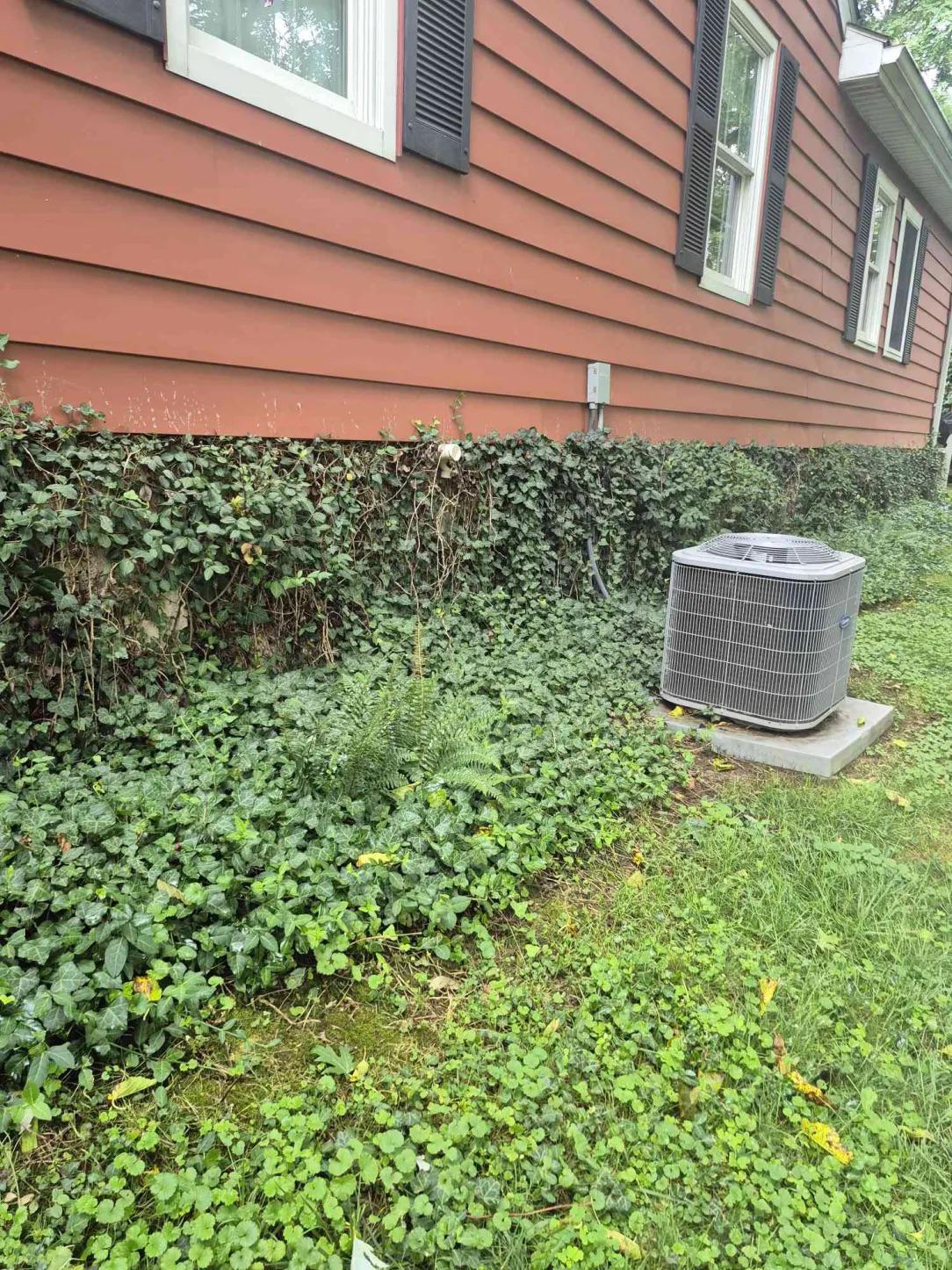
Where to look, in the order we look: the seam where a concrete stoop or patio slab meets the house, the base of a retaining wall, under a deck or porch, behind a detached garage, along a fence line, and around the point where your gas or water line enters the foundation. Dense ground cover and ivy against a wall hide all of it, which is part of why we ask about landscaping first.
A hillside lot hides burrow entrances under ivy and retaining walls, and a flat lot hides them behind the detached garage, so our property inspection covers both before anything gets quoted. Inside, the signs skew low and loud. Droppings along a baseboard or in a bottom kitchen drawer. Greasy smudge marks where a body has repeatedly brushed the same corner. Gnawing on wood or wiring. Scratching in a wall or under the floor at night, coming from the basement rather than the ceiling. If the noise is overhead in the attic, you are likely dealing with something else, and our rodent control inspection starts by settling that question.
Boone County Has a Different Version of This
If you live in Union, Hebron, or a newer subdivision in Florence, everything above describes a problem you mostly do not have, and knowing why keeps you from chasing the wrong fix.
SD1's own wastewater service breakdown explains the split. The combined system is generally located in the river cities. Separate systems, found in more recently developed areas, run two distinct networks, one carrying wastewater to treatment and one carrying storm runoff to the nearest creek or river. A storm surge in a separate storm line is moving rainwater past a lot less food and a lot less shelter than a surge in a combined line. Those storm lines are not idle, though. We covered how Florence's storm drains breed mosquitoes in that same infrastructure, a different pest working a different pipe under the same pavement.
Rats still show up out here. The invitation just comes from the property itself: an open compost pile, a bird feeder over a deck, feed at a barn, a dumpster at the strip center behind the subdivision. The pressure in Burlington and Independence tracks the food, and the fix starts at the feeder and the trash can. Newer construction also gives you a real advantage, which is fewer half-inch gaps to find in the first place. Erlanger and Fort Mitchell sit between the extremes, so we inspect there without assuming either pattern.
What You Are Feeding Without Meaning To
A colony stays where the calories are. This is the part of rodent work homeowners have the most direct control over and the part almost nobody does first.
Dense blocks with almost no lawn concentrate all of it, which is the same reason downtown Covington gets hit hard by mosquitoes despite having so little grass. Bird feeders are the big one, and people hate hearing it. Seed on the ground under a feeder is high-quality food delivered nightly on a schedule, and public health officials who handle post-rain rodent surges say the same thing every time: feed the birds and you are feeding the rats. If you have active burrows and a feeder, the feeder comes down until the burrows are gone. It can go back up later.
The rest of the list is short. Pet food and water bowls left outside overnight. Grease and drippings under a grill. Fallen fruit from a backyard tree. Open compost. Trash bags set out the night before pickup, which in a Covington alley is a buffet on a timer. Grass clippings and brush piles do not feed anything, but they provide the ground cover a burrow needs.
Alley-loaded blocks add a variable you do not control, which is the dumpster behind the businesses at the end of your street. We handle that side of the equation in our commercial pest work across the region, and the residential answer is short. You cannot fix your neighbor's dumpster. You can close your own building and pull your own food, and that is usually enough to move a colony off your property and down the block.
None of this alone will end an established infestation. All of it together decides whether the property is worth staying on.
Why DIY Rat Poison Usually Backfires
The instinct after finding a burrow is to buy a bucket of bait blocks and fill the hole. We understand it. It is also the sequence most likely to leave you worse off.
Neophobia gets you first. A rat that has memorized your yard treats a new bait station as a threat for days, while the food you never removed stays familiar and free.
Then there is where the animal dies. A poisoned rat that already knows its way into a wall void or under a slab dies there, and you inherit an odor lasting weeks plus the flies that follow. University of California rat management guidance is explicit that entry points should be minimized before any outdoor baiting, so poisoned animals cannot come inside to die. Run it out of order and you have traded a rat for a smell you cannot reach.
Everything else eats a poisoned rat too. Rodenticides are toxic to non-target animals, which covers the dog in your yard, the neighbor's cat, and the hawks and owls holding the rodent population down for free. In a dense river neighborhood you rarely control what wanders through.
Chemical control does have a place, and it is part of professional rat control in Northern Kentucky: tamper-resistant stations set along the runways the animals already use, placed after the food is gone and the building is closed.
What Long-Term Rat Control Requires
Long-term rat control in an old river-city house comes down to closing the building, and doing it at the half-inch standard rather than the mouse standard.
Start below grade, because that is where a Norway rat is working. The gap where the gas or water line enters the foundation. The crawl space vent with a rusted screen. The threshold under a garage door that has bowed enough to see daylight. The basement window frame that has rotted at one corner. For a narrow gap, copper mesh or coarse steel wool jammed in and locked down with sealant will hold, because neither one can be chewed through. Anything wider wants hardware cloth or sheet metal. A rat goes through expanding foam, soft wood, and thin plastic without slowing down.
Old river housing compounds every bit of this, and we covered the structural side separately in our piece on why old homes need structure-first work. Rats travel the same cracked mortar joints and pipe chases that cockroaches and ants use, which is why sealing your foundation pays off against several problems at once. If your basement has more than one of these going, they are sharing a route.
Then check the plumbing, which is the piece unique to this problem. A cracked or displaced side sewer lateral is an open door from the street main into your building envelope, and it will defeat every other thing on this list. If you have had repeated basement backups or you own a house whose lateral has never been scoped, that inspection is worth more than another weekend of caulking.
Higher-ground communities sit outside the combined-sewer footprint entirely, so Fort Wright, Crestview Hills, and Edgewood fall closer to the Boone County pattern than the river one. Your elevation and your sewer type together decide which playbook applies.
Trapping is what removes the animals already inside, and snap traps set flush against walls and in dark corners along established runways do it better than anything else. Give them several days before you judge the results.
The health side deserves attention for documented reasons. Urban Norway rat populations carry and shed Leptospira at high prevalence worldwide, and leptospirosis spreads through contact with contaminated water, which is a live consideration in old basements in a river town that floods. Salmonella and rat bite fever sit on the same list. None of that is cause for alarm in a house with two rats in the crawl space. It is a reason not to let two become twenty.
Getting Rat Control Started in Northern Kentucky
Rat control is not a spray-the-yard job, and we will not sell it to you as one. It starts with a walk of the property to find the burrows, the entry points, and the food, and it usually ends with a conversation about a drain, a feeder, or a garage door.
That structural work is what our Home Shield program is built around, at $99 a month. It works the below-grade openings on a recurring schedule, which is what keeps a sealed building sealed after a freeze-thaw season pries something back open. Properties carrying heavy yard pressure on top of it are usually better served by Complete Home and Yard at $119 a month, which layers full yard management over the structural side. Both carry a satisfaction guarantee and no long-term contract.
We are a veteran-owned family business and we have worked this side of the river since 2013. On rat work that history earns its keep, because knowing which streets sit over the combined system saves an hour of guessing on the first visit. You can see every community we cover on our areas we service page, or read what our customers say first.
If something crossed the alley after the last storm, do not wait on the next one. Reach Mosquito Squad of Northern Kentucky at (859) 222-7345 and we will walk the property with you.