Commercial Pest Control in Northern Kentucky: What a Warehouse Owner Near CVG Actually Needs
Posted by Mosquito Squad Plus
June 29, 2026
A warehouse near CVG, the Cincinnati/Northern Kentucky International Airport in Hebron, is designed around one thing: getting product across the dock as fast as possible. Nobody designs it to keep mice out, because keeping mice out and keeping doors open are working against each other every hour of the shift. That tension is the entire commercial pest control problem in Northern Kentucky. We have been in enough of these facilities along the I-71 and I-75 corridor to know the mouse a customer spots during a tour is almost never the problem the owner thinks it is. It is the symptom of an open dock door and a building nobody set up to keep wildlife on the outside of it.
Northern Kentucky is built for moving freight, and the same things that make it the best logistics address in the Midwest make it a genuinely hard place to run a clean commercial facility. The region sits within a one-day drive of roughly two-thirds of the United States population, which is why more than a hundred logistics companies operate here and why CVG anchors a DHL global super-hub and the Amazon Air cargo hub. That economy runs on buildings that are designed to stay open. Dock doors up, trailers backed in, product moving across the threshold every hour of the shift. A building that is open by design is a building that pests treat as an open invitation, and the commercial pest control approach that works for a Florence retail strip does not transfer cleanly to a 400,000-square-foot warehouse with twenty-six dock positions.
This is the piece most owners near CVG underestimate until a customer sees something. So here is the honest version of what commercial pest control actually involves in this market, what it costs you when it is done wrong, and what a facility along the freight corridor genuinely needs from a provider.
Why the Logistics Corridor Changes the Pest Equation
Residential pest control in Northern Kentucky is mostly an exterior job. You treat the perimeter, knock down the mosquitoes and ticks coming off the tree line, and keep the pressure outside where it belongs. Commercial work in a distribution facility flips that completely. Roughly ninety percent of the work in a warehouse is interior, because the whole structure is engineered to let the outside in. Every dock door that lifts is a four-foot gap at floor level. Every trailer that backs in brings its own cargo, and that cargo has been sitting in another yard, another warehouse, another truck.
The University of Kentucky Department of Entomology puts the structural reality plainly. A house mouse can squeeze through a gap no wider than a pencil, roughly a quarter inch, and a rat needs only a half-inch crack the size of a quarter. A loading dock seal that has aged out, a dock leveler with a worn gap, a man-door propped open for airflow on a July afternoon, all of these are highways into the building. The corridor itself compounds the problem. Trailers cycling through a CVG-adjacent facility have come from everywhere, and rodents are remarkable hitchhikers. The freight does not just bring product. It brings whatever was nesting near the product at the last stop.
There is a second pressure that is specific to this region and easy to miss. Northern Kentucky does not have a county-level pest abatement program working in the background. As we covered in our piece on tick pressure across the region, the Northern Kentucky Health Department monitors mosquito populations and disease surveillance across Boone, Campbell, and Kenton Counties but does not run proactive neighborhood-level spraying the way Lexington and Louisville do. For a commercial property that means there is no ambient population reduction happening around your building. Whatever pressure builds in the green space at your fence line, the retention pond at the back of the lot, or the landscaping along the customer entrance is yours to manage entirely. Nothing external is helping.
Rodents Are the Foundation, Not an Add-On
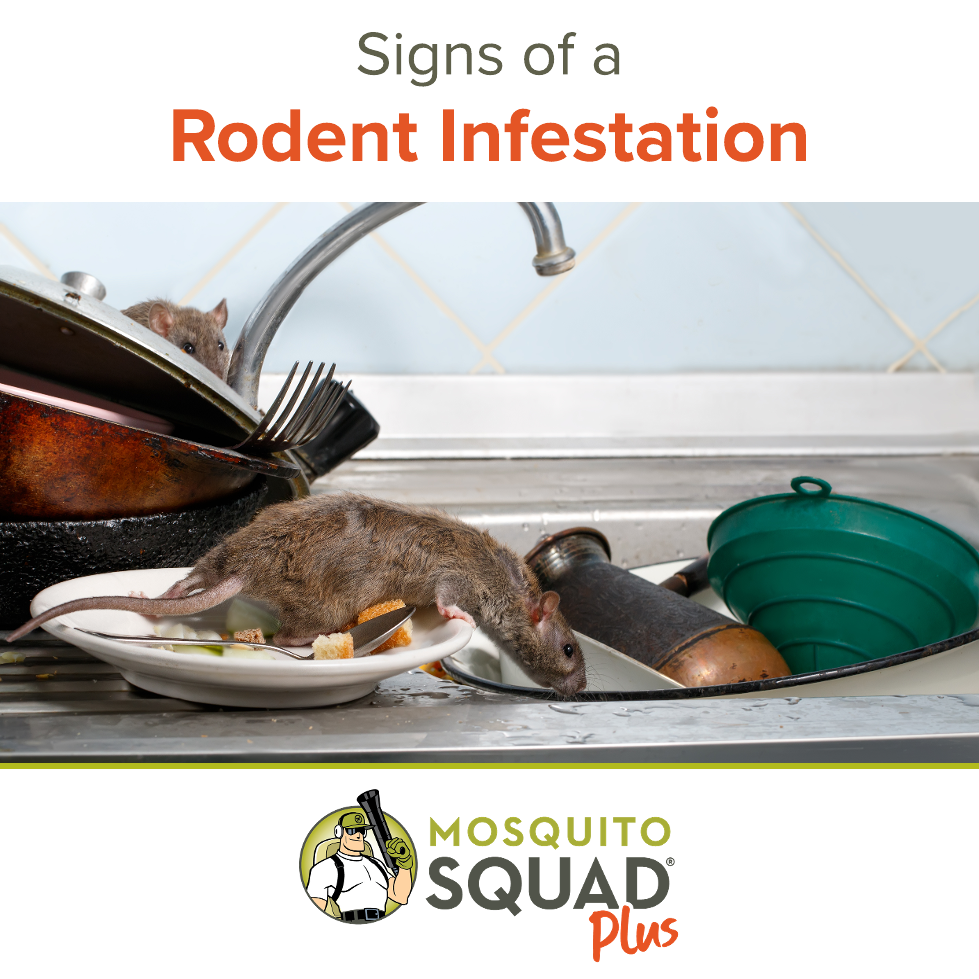
In commercial work, rodent control is not one service among many. It is the floor that everything else stands on. A distribution facility that has its fly program dialed in and its exterior barrier handled but is quietly feeding a mouse population in the wall voids does not have a clean building. It has a building with a countdown running.
The reason rodents sit at the center comes down to what they cost beyond the obvious. The University of Kentucky's entomology extension is direct about this: the greatest economic loss from rodents is not what they eat but what has to be thrown out because of contamination, plus the structural damage from gnawing. Penn State Extension is just as blunt about the mechanism, noting that mice chew on electrical wiring in a way that can cause structural damage and fires. In a warehouse that means the risk is not just a chewed pallet of product. It is equipment failure, an electrical fire in a building full of combustible packaging, and the kind of downtime a just-in-time fulfillment operation cannot absorb. We have pulled a nest out of a control panel more than once, and the maintenance lead is never surprised, only annoyed he did not catch it first. A facility moving product for eight clients cannot eat a refrigeration failure or a conveyor outage traced back to a chewed harness.
There is also the contamination pathway that turns a nuisance into a liability. Mice can transmit salmonellosis when food contact surfaces are contaminated with infected droppings, the exact scenario that ends a food-grade audit. The exposure is not limited to food handling. The CDC notes that rodents spread hantavirus through urine, droppings, and saliva, and that control and exclusion is the primary way to prevent it. OSHA flags that people working in rodent-infested buildings face elevated risk, especially during dusty cleanup. For staff working around rack systems and motor rooms where droppings collect out of sight, that is a worker-safety issue, not just a product one. The behavioral detail matters too: mice forage only short distances from the nest, usually within ten to twenty-five feet, and travel tight against walls and edges. That is why rodent work in a warehouse is not about scattering bait and hoping. It is about reading the building, finding where activity concentrates, and placing equipment based on the structure rather than a routing convenience.
Our approach to rodent control in commercial settings is built around that reality. Interior ready-to-use trap stations along the runs where mice actually move, exterior rodent stations forming a perimeter that intercepts pressure before it reaches the dock line, and exclusion work that closes the entry points rather than just thinning the population that already got in. The University of Kentucky recommends permanent sealants like cement, sheet metal, and hardware cloth for the cracks and openings around doors, foundations, vents, and the penetrations where plumbing and electrical lines enter the structure. Exclusion is the part that actually changes the trajectory of the building. Everything else manages the symptom.
The Open Dock Door Problem Nobody Engineers For
A warehouse near CVG is built around throughput. The dock doors are open because product is moving, and product moving is the entire point of the building. No facility manager is going to keep the doors sealed during a shift to inconvenience the mice. So the work is not about closing the building. It is about treating it as the semi-open structure it actually is and building a program that accounts for that.
This is where the difference between a real commercial program and a chain spraying on a calendar shows up. The national chains spray monthly because monthly is efficient for routing a truck. It has nothing to do with the biology of the pest. Most of the pests in a Northern Kentucky facility run on roughly a twenty-one-day life cycle, which means a thirty-day interval leaves a window every single cycle where a new generation matures between treatments. We treat on the pests' actual life cycle rather than the calendar that is convenient for the route, because the goal is to break the reproductive cycle, not to leave a door-hanger proving someone showed up.
Spiders ride along with the rodent pressure in these buildings, and they tell you something. Spiders are a downstream pest. They show up where there is already an insect population to eat, gathering in the high corners, the rack uprights, and the still zones of the building where the other bugs have collected. Walk a facility with me and the webs in the southwest corner are not the problem, they are the map. A spider problem in a warehouse is rarely a spider problem. It is evidence of the food source already established, which is why the program has to address what the spiders are eating rather than just knocking down webs. The same shelter logic that drives mosquito pressure in the shaded canopy of a neighborhood like Fort Thomas plays out indoors at the facility scale. You read the indicator, you find the source, you treat the source.
Food and Beverage Distribution Raises the Stakes
Northern Kentucky is not only a parcel and e-commerce corridor. The region is home to a substantial food and flavoring manufacturing base across Boone, Campbell, and Kenton Counties, along with the cold-storage and food-grade distribution space that moves product for grocery and restaurant supply chains. For those facilities, the pest program is not a comfort measure. It is a compliance requirement with a paper trail and an auditor attached.
The FDA Food Code is explicit that a food facility has to be maintained to prevent pests, and that a documented pest management program is part of how a facility demonstrates control. The industry standard goes further. The National Pest Management Association's food facility standards align with the Food Safety Modernization Act and Good Manufacturing Practices, and they are what the major third-party auditors measure a facility against. So a food-grade operation here needs more than treatment. It needs a defensible record: where the stations are, what was found at each service, what was done about it, and the trend over time. An auditor who finds a mouse has found a problem. An auditor who finds a mouse and no paper trail has found a failed inspection. The documentation is the difference between an isolated finding and a systemic one.
Cold storage adds its own wrinkle, and it is the spot most calendar programs get wrong. Refrigerated and frozen space pushes activity toward the warmer perimeter, the dock seals, the motor rooms, and the temperature transitions where condensation and warmth collect. If you only ever set stations in the obvious ambient aisles, you are inspecting the rooms the pests already left. A program written for ambient warehouse space and pasted onto a cold-storage facility will miss exactly where the pressure concentrates. The building has to be read on its own terms.
What a Facility Near the Corridor Actually Needs From a Provider
The honest checklist is shorter than most providers want it to be, but every item earns its place.
First, a real walkthrough before a number ever gets quoted. Commercial pricing that comes over the phone without anyone looking at the dock line, the rack configuration, the sanitation, and the exterior pressure is a guess, and a guess gets corrected later in ways you will not like. Pricing on a commercial property in this market is quoted per facility after a physical walkthrough, with no long-term contract holding you to a program that is not working.
Second, exclusion has to be part of the conversation, not an upsell after the fact. A provider who only wants to talk about treatment frequency and never mentions sealing the building is selling you a subscription to a problem rather than a solution to it. The structural openings are where the program actually succeeds or fails.
Third, a service interval that matches the biology. If the proposed plan is monthly because that is the standard, ask why monthly and not the twenty-one-day cycle the pests actually run on. The answer tells you whether you are buying a real program or a routing schedule.
Fourth, documentation you can hand to an auditor or a prospective client without flinching. For a food-grade facility this is non-negotiable. For everyone else it is still the thing that lets you answer the question when a customer asks what your pest situation looks like.
And fifth, a guarantee that means something between scheduled visits. Our commercial work carries a 100 percent satisfaction guarantee with free re-treatment between regular visits for the covered pests, because a program that only works on the day the technician is standing there is not a program. It is a photo op. When something shows up between services, the right answer is that we come back, not that we will catch it next month.
We are headquartered at 21 Old Beaver Road in Walton, which sits at the high point of the corridor where I-71 and I-75 diverge, and we serve commercial facilities across Boone County from Hebron and Erlanger through Florence, the fast-growing Independence corridor, and the Kenton County side around Crestview Hills. We covered the rural-suburban dynamic that shapes pest pressure across southern Boone County in our Walton pest control piece, and the wildlife-corridor pressure that feeds the Union area, and the same attention to what is actually happening on a specific property is what drives the commercial work. The building near the airport and the building out on the county line are not having the same pest conversation, and the program should reflect that.