Why Brown Recluse Spiders Are a North Alabama Problem and Barely a Georgia One
Posted by Mosquito Squad Plus
September 2, 2026
The spider that turns up in a Madison County garage in February is usually the one nobody was looking for. Everything else has gone quiet by then. Kudzu bugs are dormant in the wall voids, fire ant mounds have flattened out, and the mosquito calls stopped in November. Then somebody shifts a stack of boxes in the back corner of the garage and finds a pale brown spider on a flat scrap of silk that does not look like a web at all.
That spider has a real chance of being a brown recluse, and the reason has more to do with where Huntsville sits on the map than with anything about the house.
The Range Line Runs Right Through Us
Alabama Cooperative Extension publication ANR-1043, written by Auburn entomologist Xing Ping Hu, puts it plainly. The brown recluse has been collected throughout Alabama but turns up more commonly in the northern half of the state. Madison County is about as far into that northern half as you can get without crossing into Tennessee.
A few hours southeast the picture changes completely. Researchers at the University of Georgia tracked brown recluse reports across that entire state from 2002 through 2008 and confirmed nineteen individual spiders in six years. Across Georgia's whole recorded history the count sat at fifty-eight. UGA entomologist Nancy Hinkle described the recluse as a Midwesterner rather than a Southerner, with north Georgia marking the southernmost edge of the range. Two of the confirmed finds below the fall line had not gotten there on their own. One arrived in moving boxes out of Tennessee. The other came in a truckload of firewood from northern Alabama.
That work is old enough now that the counts have surely moved, but the shape of it holds. Physicians across the Deep South diagnose recluse bites routinely in places where the spider is scarce. The correction that gets published in response travels further than the range map does. Huntsville homeowners hear that correction and assume it applies to them the way it applies to Atlanta or Mobile. We sit inside the range while most of the region sits outside it, which makes the reassuring version of the story wrong in exactly one part of the Southeast.
Spider control in Huntsville has to account for that. A franchise operating out of Savannah would not need to.
It Does Not Build the Web You Are Looking For
Most homeowners misread the evidence in front of them, and it costs them months.
Recluses do not spin webs to catch prey the way orb weavers and house spiders do. Hu describes irregular flat retreats built from disorderly silk, usually tucked into a corner or laid against a flat surface. No funnel, no spiral, no tidy geometry. It reads as a smear of cobweb somebody should have dusted, which is precisely why it gets dusted.
Two other signs carry more weight than the silk. Recluses molt, and the shed skins stretch out flat on whatever surface they were left on, frequently on the side of a stored box. Those molts are often the first hard evidence that a property has a resident population rather than a single wanderer. The eye pattern settles identification when the violin marking will not, since a recluse carries six eyes in three pairs where most spiders carry eight. Sac spiders and funnel weavers both run eight in two rows of four, which is a large part of why they get blamed for bites they did not deliver.
The violin marking on the back is the feature everyone knows and the weakest one to lean on. ANR-1043 notes that its shape and intensity both vary. Plenty of harmless brown spiders wear something close enough to fool a homeowner holding a phone flashlight.
Where They Actually Live in a Huntsville House
The indoor habitat list runs against the instinct most people have about spiders. Recluses settle into spaces without air conditioning or ventilation. Near a furnace or water heater. Behind a toilet or a tub. Under stairs, in basements, in cluttered closets and storage areas, under furniture and folded bedding. Storage boxes, shoes, coats, stored clothing, and drawers all appear by name in the Extension guidance.
Read that against how a lot of North Alabama houses actually get used. The garage that never got fully unpacked. The spare room closet holding seasonal clothes and nothing else for eleven months of the year. The crawl space hatch that gets opened once. Huntsville has absorbed an enormous number of new residents over the past decade. A household that moved in eighteen months ago with sealed boxes still stacked along a garage wall has built close to ideal recluse habitat without intending to.
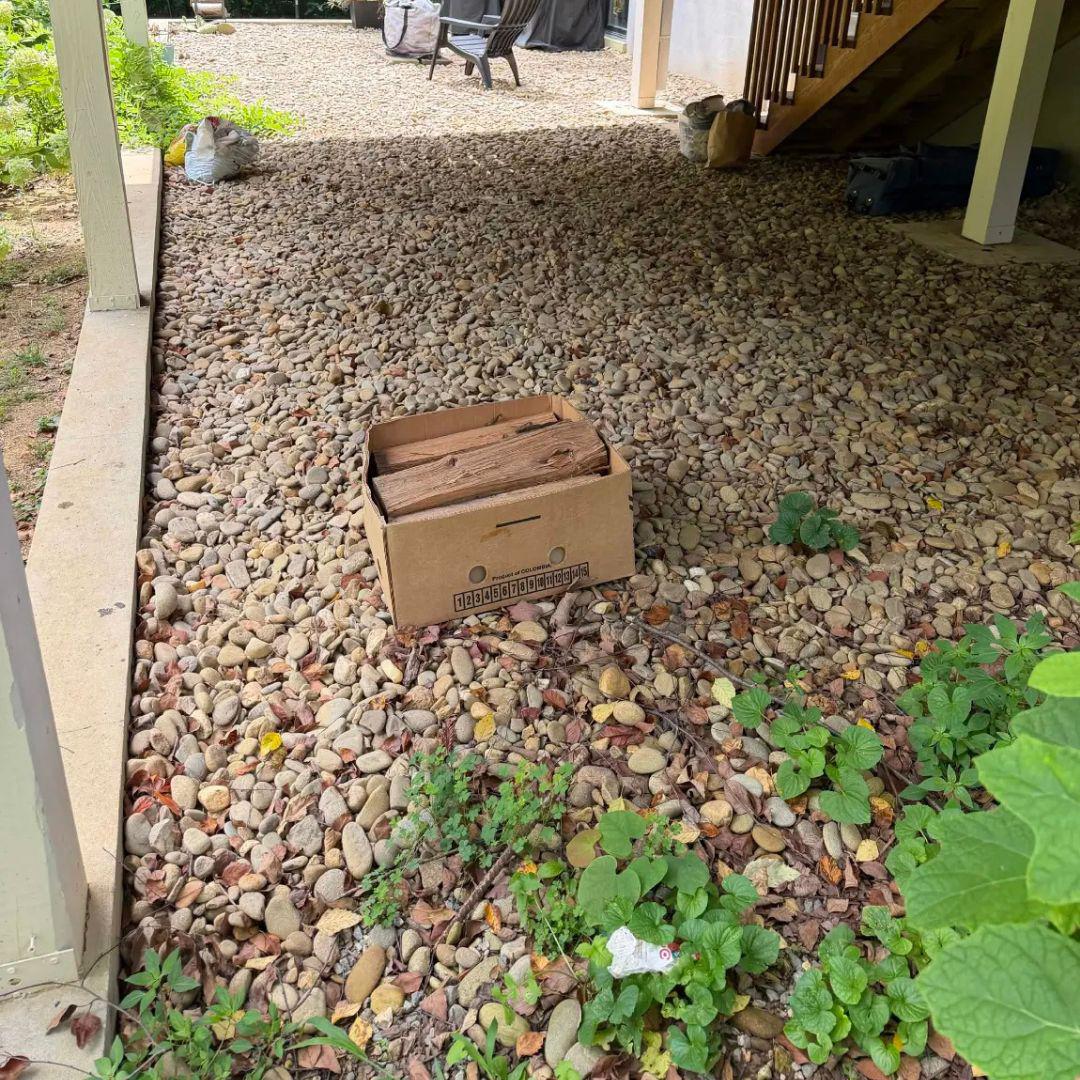
Outdoors the harborage is dry rather than damp: rock and log piles, woodpiles, tree bark, leaf litter, brush. Properties out toward Owens Cross Roads and Hampton Cove with rock outcrop, stacked stone, and firewood against an outbuilding hold more of it than a freshly graded lot in Madison does. Entry happens through foundation cracks, gaps around doors, vents, and the space under eaves or soffits. Hu also makes the point that people carry recluses indoors directly, inside boxes and furniture, which is how the spider reached coastal Georgia in the first place.
One biological detail explains why this persists once it starts. A brown recluse can survive up to twelve months without food or water and live two to four years. Clearing out the insects it was eating will not starve it on any timeline a homeowner would notice.
Why the Season Reads Backward
The active temperature range runs from 45 to 110 degrees, which covers most of the North Alabama calendar. Seasonal logic that governs the rest of our work does not really apply. Mosquitoes run a spring to fall arc. Fall invaders mass on warm walls in October. Recluses are indoors year round in a conditioned house.
What shifts seasonally is your odds of meeting one. They hide during daylight and wander at night, and daytime wandering gets triggered by hunger, overcrowding, pesticide application, or disturbance. That last one is why people meet them when they do. You find the spider during the week you clean out the garage, sort the storage closet, or pull the holiday bins down from the shelf. The population was there in July. January is when you moved the box.
Recluses may also go quiet in winter in response to shorter light cycles even inside a heated house, which helps explain why activity seems to arrive in bursts instead of building steadily.
What Actually Works
ANR-1043 is blunt on this point. Once brown recluses establish in a home they are difficult to control, and their secretive habits are the reason the publication puts treatment in professional hands. The publication frames real control as an integrated plan requiring cooperation between the resident and the pest professional. Neither party gets there alone.
Your half is harborage and access, and it is most of the job. Declutter closets and storage areas so there are fewer dry, dark, undisturbed places to sit. Clear out dead insects, because those are the food supply. Seal cracks at windowsills, door thresholds, and around pipes and vents. Improve ventilation in attics and crawl spaces. Outside, move woodpiles, leaf litter, and loose rock away from the foundation. Sticky traps run along baseboards, in closet corners, and near stored items give you the cheapest honest read available on whether you have a population or a one-off.
Our half is the perimeter and the way in. A treated barrier around the foundation, the entry points, the vents, and the door and window openings works on the route recluses use to get inside and on the insects they came in chasing. That is the same exterior work your other pest coverage already depends on. For a spider problem that began outside in the rock piles and firewood, it is the piece that changes the trajectory.
Home Shield is the plan our spider control guidance points to, and it runs that perimeter work on a recurring visit alongside the ant and roach coverage. Properties where the rock piles and firewood out back are feeding the population indoors need the yard handled at the same time, which is where Complete Home and Yard comes in. Both carry our satisfaction guarantee.
One honest caveat. A heavy established population living inside the walls of a house is a bigger job than a perimeter program, and ANR-1043 is candid that those cases are hard. If the flashlight walk turns up molts and egg sacs in several rooms, say so when you call so the walkthrough is scoped to what is actually there.
About the Bite
Worth keeping proportionate, because the folklore runs hot here.
Spider bites in general are rare, and a recluse bites in self-defense. The fangs are small enough that they cannot penetrate clothing. People get bitten rolling onto one in their sleep, putting on a shoe or jacket that has been sitting, or moving a stored item with a spider inside it. Most bites stay localized and resolve within about three weeks without complications or medical treatment. Some produce a necrotic sore that takes considerably longer to close. Systemic reactions involving fever or nausea occur in rare cases, more often in children and older adults, and death is described as extremely rare. University of Kentucky Entomology frames it the same way: bites are uncommon, but the venom can sometimes cause serious wounds, so an established population is worth taking seriously.
If you think you have been bitten, clean the wound and see a doctor. Bring the spider if you still have it, even crushed, because identification changes the course of treatment.
The reason to deal with a recluse population is not that any one bite is likely to be severe. It is that this spider lives in the places you reach into without looking first.
Where to Start
If you are in Huntsville, Madison, Harvest, or out toward New Market, start with a flashlight and an hour. Check the garage corners, the storage closet, the space behind the water heater, and the boxes you have not opened since the move. You are looking for flat scraps of silk, shed skins on the side of a box, and small pale brown spiders that run instead of freezing.
One spider does not make an infestation. Molts and egg sacs in three separate places do. Our spider control work starts by sorting out which of those you have before anybody decides what to treat. Coverage across the rest of the valley is listed on our areas we service page.
For a walkthrough, reach the Huntsville office or call (256) 907-8493. Estimates are free.