How to Keep Stink Bugs Out of a Northern Kentucky Home Before September
Posted by Mosquito Squad Plus
August 28, 2026
A brown marmorated stink bug in late August has one job left before winter. It needs a dry, tight crevice that will hold a steady temperature until March, and it has a few weeks to find one. In the forests where the species evolved, that meant the loose bark of a standing dead tree. In Northern Kentucky it usually means a house.
Which house comes down to what your walls are made of, what color they are, and how tight your screens were the last time anyone measured them. Most homeowners here start thinking about this in the second week of October, standing in a bedroom with a vacuum hose. By then the decision has already been made for you.
The Ohio Valley runs about a month ahead of the southern half of the country on this insect, which puts the useful work in the last two weeks of August rather than the first week of October.
Before There Were Houses, There Were Dead Trees
Understanding where these insects went before American subdivisions existed explains most of their behavior on your siding.
A USDA research team ran surveys through mid-Atlantic forests, using both human surveyors and detector dogs, to find out where the species overwinters when no building is available. Their results were published in PLOS ONE, and the picture is narrow. Overwintering adults turned up in dry crevices in dead, standing trees with thick bark, mostly oak and locust. Only about twelve percent of the dead trees they surveyed had the characteristics the bugs were selecting for.
Twelve percent. That is the scarcity your house is competing against.
A heated wall cavity with a soffit gap is a better version of the thing they were already hunting, available in far greater supply, and reachable by a strong flier. Your house did not attract anything. Your house qualified. This is not an insect that has taken a liking to modern construction. It is an insect that found a warehouse full of exactly what it already wanted.
That framing changes what you do about it. If your house is being chosen for a specific physical quality, then changing that quality is the lever. Killing whatever is visible on the siding today is not.
We should be clear about what that source says and what it does not. The USDA team surveyed mid-Atlantic forest, not the Ohio River bluffs. Oak and locust are common hardwoods across this region, but nobody has published a count of standing dead timber on the hillsides above Covington, and we will not invent one. The mechanism carries over to your property. The survey numbers stay where they were measured.
The Quarter-Inch Rule Was Written for Mice
The standard exclusion advice, the advice we give ourselves for rodents, is to seal anything wider than a quarter inch. That number comes from mouse anatomy and it is correct for mice. Applied to stink bugs, it fails.
Michael Potter and Ric Bessin at the University of Kentucky ran mesh trials specifically on adult brown marmorated stink bugs and published the results in ENTFACT-654. Challenged with half-inch galvanized hardware cloth, one hundred percent of the bugs passed through. Challenged with quarter-inch mesh, fifty percent still got through. Keeping adults out required mesh openings of one sixth of an inch or smaller.
Read that against the attic vent screen on your house. Quarter-inch hardware cloth is the standard product, it is what most contractors install, and against this insect it is a coin flip.
The same publication flags window-mounted air conditioners as a common entry route and recommends sealing or removing them before fall, which is the single easiest item on any Northern Kentucky exclusion list and the one you are most likely to skip.
This is why we treat stink bug control in Northern Kentucky as a separate job from rodent work rather than a line item on the same visit. Somebody in Fort Mitchell who took good rodent-exclusion advice last September did real work and cut their mouse pressure. They also left half their stink bug openings wide open, because the spec they were following was never written for a shield-shaped insect that can compress itself into a bark crack.
One more thing from that same Kentucky publication is worth carrying with you. Adults are strong fliers capable of dispersing more than a mile, and they are practiced hitchhikers on vehicles and freight. Kentucky recorded its first confirmed brown marmorated stink bug in October 2010 and the insect spread across the state from there.
That distance figure matters for how you think about your own lot. A clean yard with no host trees on it is not protection, because the population arriving at your wall in September did not necessarily grow up on your property. It grew up somewhere within a mile and flew. This is one of the few structural pests where what your neighbors do has almost no bearing on what lands on your siding, and where the only surface you control is the building itself.
Our post on fall invaders and rodents covers the rodent side of that October push in full, and the quarter-inch guidance there is right for mice. This page is the correction for the other half of the problem.
Why Your House and Not the One Next Door
Neighbors compare notes every October and the counts never match. One property in Crestview Hills fills its window tracks while the house across the street reports six bugs all season, and the homeowner losing that comparison usually takes it personally.
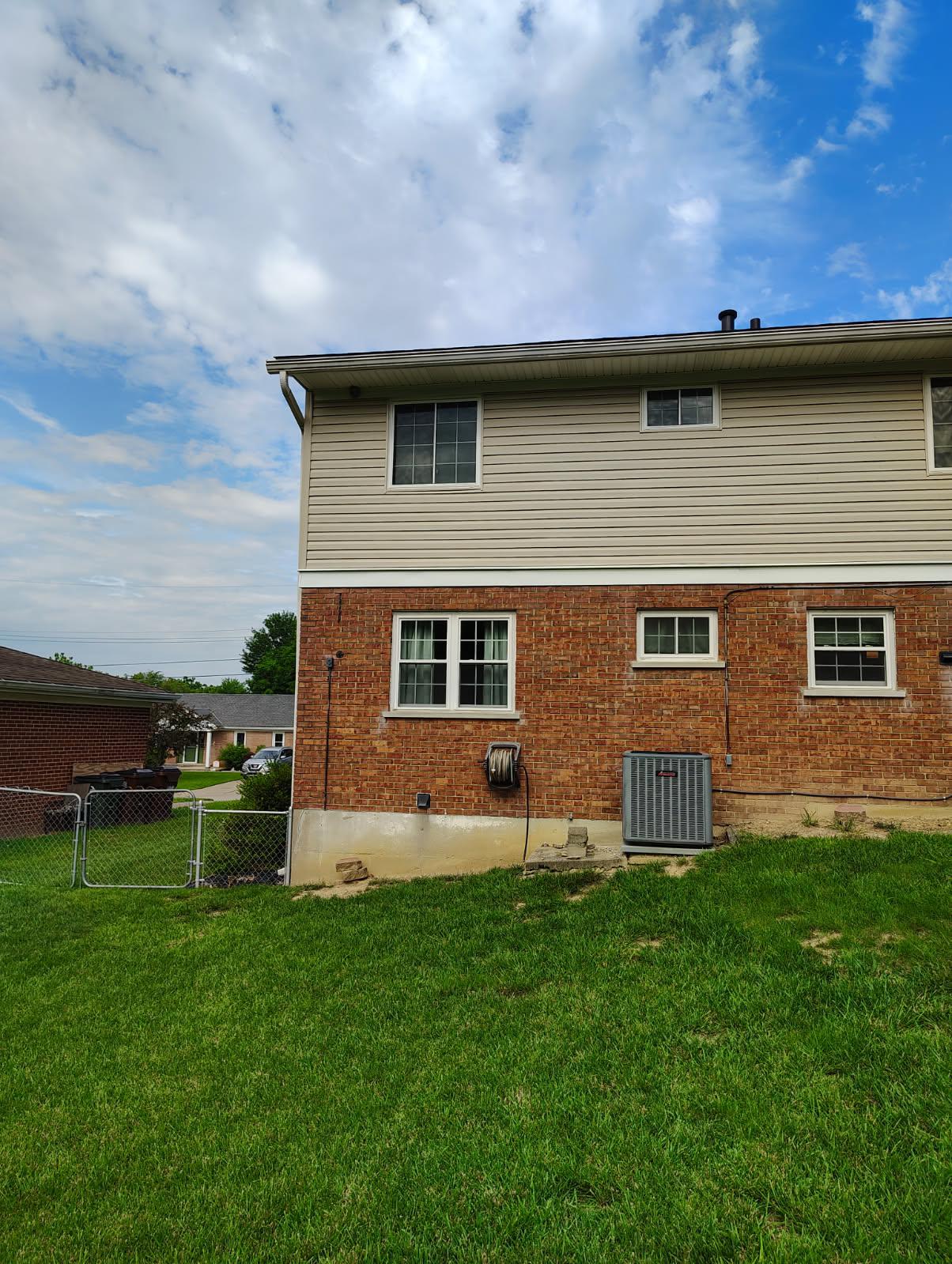
Researchers recruited homeowners to count adults on their exterior walls daily through two autumn dispersal seasons and published the results in Agricultural and Forest Entomology. Three variables separated the heavily loaded homes from the light ones: building material, color, and setting. Homes built of natural materials carried the largest numbers. Homes in forested rural settings carried more than homes elsewhere. And white houses consistently counted fewer adults than brown, tan, and grey ones.
That was mid-Atlantic citizen science, not a Kentucky survey, so treat it as a profile rather than a local measurement. The profile still describes a great many properties in Fort Thomas, Fort Wright, and the wooded ridge lots above the river valley with uncomfortable accuracy. Brick, stone, cedar, a dark exterior, trees at the property line.
Then aggregation takes over and multiplies whatever the starting conditions were.
This species communicates by chemistry. Washington State University points out that unlike the sex pheromones most people have heard of, which pull in males only, the brown marmorated stink bug's pheromone is an aggregation pheromone. It attracts males, females, and nymphs alike. Utah State Extension describes the clustering behavior on host plants and buildings as being controlled by those same pheromone cues, and USDA Agricultural Research Service chemists list overwintering site location among the functions that chemistry serves.
The first arrivals therefore function as an advertisement. A dozen adults settling on a warm brick wall in early September are recruiting the next several hundred, and the gap between a nuisance winter and a bad one is often decided during that first week of signal.
That is the strongest practical argument we can make for treating early rather than reacting. The goal is not to kill your way through a population that keeps replacing itself. The goal is to keep the wall from becoming a billboard in the first place, which is a much smaller job and has to happen before the signal starts.
What "Before September" Means on a Northern Kentucky Calendar
Timing is where the Ohio Valley separates from every southern market, and it separates by about a month.
University of Georgia describes winter diapause as the pivot of the whole life cycle, with adults responding to shortening day length in fall. Utah State's monitoring calendar puts population spikes in July and August, with overwintering site seeking running from late September into November. Extension programs across the region consistently describe adults massing on building exteriors in early to mid September before moving inside as temperatures drop.
Line those up and the answer for our territory is not subtle. Population is at its peak right now. Wall congregation begins in roughly two to three weeks. The exclusion work has to land in between.
That is a tighter window than a homeowner in Chattanooga or Huntsville is working with, and it is why generic fall pest advice tends to arrive here about three weeks late. The Ohio Valley is a stronghold for this insect in a way the southern markets simply are not. Our fall structural season opens earlier, runs hotter, and gives you less room to react.
Practically, that means late August. Not the second week of October, when the bugs are in the attic and the only remaining option is cleanup. Properties in Union, Independence, and Burlington that get sealed and treated in the next three weeks are ahead of the dispersal rather than behind it.
Boxelder Bugs Are Running the Same Play
Stink bugs get the attention, but they arrive with company, and the company works on an almost identical schedule.
Boxelder bugs cluster on the warm south and west walls, respond to shortening days on an overlapping schedule, and slip through the soffit and window gaps stink bugs use. Northern Kentucky carries the heaviest boxelder pressure of any market we operate in. If you have a female boxelder or a maple anywhere near the house, boxelder bug control in Northern Kentucky belongs on the same work order rather than as a separate call in three weeks.
The timing overlap is close enough that separating the two jobs mostly wastes a visit. Both respond to the same shortening days, both stage on the same sun-warmed elevations through early September, and both are gone into the wall by the time most homeowners call. A single exterior application in the right three weeks reaches both.
Cluster flies and spiders round out the group, the spiders because the other insects massing on your walls are food. A fall plan aimed only at stink bugs tends to leave the rest of that traffic untouched, so our pest packages handle the fall structural pests as one problem on your property.
Sealing a House Against a Bug That Fits Through Screen
Take a tape measure to your exterior before you buy anything, because the mesh spec is the whole game and most of what is already on your house will not hold.
Attic and gable vents come first. If the existing screen measures a quarter inch, it is stopping half of them. The University of Kentucky's number is one sixth of an inch or finer, which in practice means fine insect screening rather than hardware cloth. Soffit vents get the same treatment.
Window screens next, and this is where a surprising number of Northern Kentucky homes fail on nothing more complicated than a torn corner or a frame that no longer sits square in the track. Window air conditioners come out, or they get sealed around the full perimeter.
Then your ordinary openings. Caulk around window and door trim. Swap out tired weatherstripping and any door sweep that no longer touches the threshold, starting with the garage service door. Seal where cable, gas line, dryer vent, and hose bib penetrate the wall. Check your chimney chase and any point where two of your rooflines meet a wall. In Hebron and Highland Heights those roofline junctions account for more of what gets in than the vents do.
Older housing stock in Latonia and Newport leaks in far more places than newer construction does, for reasons we went through in detail on pest control in Covington and Newport. A hundred winters of expansion and contraction open mortar joints and pull trim away from sheathing, and nearly every gap that creates is wider than a sixth of an inch.
None of this is glamorous work. Budget an afternoon and a caulk gun for most houses, more if the attic and gable screens have to come out and be replaced at the finer mesh.
Where the Exterior Treatment Earns Its Keep
Sealing handles the openings you can reach. A treated exterior handles the wall itself, which is where the recruiting happens.
Product goes on the elevations that get afternoon sun, the soffit and eave line above them, the band where your siding meets masonry, and every vent and penetration in that zone. It thins the adults staging outdoors before the chemical signal has time to build, and it stays active on the surface for weeks. Timing is the entire value here. Applied in late August it meets your population as it arrives. Applied in late October it meets an empty wall and a full attic.
Squad Home Shield is the program built for that. It runs year round instead of as a single autumn visit, so the treated surface is fresh when dispersal starts rather than three weeks stale. If your lot also carries pressure off the trees, Complete Home and Yard brings the yard side into the same schedule, which suits the wooded ridge properties in Edgewood and Erlanger.
One clarification worth making before you spend money. Mosquito Barrier Treatment targets the yard, so it will do nothing for what is overwintering in your attic in January, and mosquito control in Northern Kentucky is a separate season with a separate target. Different pest, different target surface, different visit. We would rather tell you that before you buy.
A satisfaction guarantee sits behind all of it.
If They Are Already Inside
Plenty of readers are already past prevention, so the short version follows.
Vacuum them. Do not sweep and do not crush, because crushing one releases the smell along with a brown fluid that marks pale paint and fabric. Empty the canister outside.
Skip the aerosol can. Those bugs sit in voids no spray reaches, they emerge in ones and twos for a month afterward, and dead insects left inside a cavity draw a second pest behind them. The University of Kentucky also notes that the pheromone traps used in agriculture do not work indoors during the overwintering period, so the products sold on that promise are not going to help you either. We covered the interior side of this in the fall invaders piece and the guidance has not changed.
What is in your walls now comes back out on the first mild afternoons of February, drifts toward the windows, and confuses everybody in the house. University of Maryland Extension confirms these insects neither feed nor reproduce indoors through winter, so nothing about a February appearance means a new population. Those adults entered in September and went dormant in the wall until the thermometer moved.
Getting the Work Done This Month
Pest control in Northern Kentucky changes shape in late August, and stink bugs are the pest that punishes a late start hardest.
The homeowners who come through clean tend to share a boring profile. They did unglamorous exterior work in the last two weeks of August, on the specific openings that matter for this specific insect, and they understood that quarter-inch mesh was never going to be enough on its own. Luck has very little to do with it.
If your house is brick, stone, or wood, if it reads dark from the street, or if it sits against trees anywhere in our Northern Kentucky service area, you sit at the heavy end of this and the calendar is working against you. You can read more about how we work on our why choose us page or see what customers say about the seasonal work. To get the exterior walked before the first cool night, request a quote or call Mosquito Squad of Northern Kentucky at (859) 359-2967.