The Spider on Your Concord Deck Isn't the One to Worry About
Posted by Mosquito Squad Plus
September 30, 2026
Walk up to almost any front door in Concord this time of year and look up before you knock. There is a decent chance you will see a big yellow and black spider hanging in a web strung from the gutter to the nearest tree, or stretched across the gap between two deck rails. Late September is when those webs get hard to miss. They catch the afternoon light, they are wider than a doorway, and the spider sitting in the middle is the size of your palm.
That spider is a Joro, and it is the one everybody is talking about. It is also, for most homeowners, the least concerning spider on the property.
The spider worth thinking about this fall is the one you have probably never seen. Brown recluses do not build webs across your walkway. They sit in the dark behind the storage bins in the garage, in the box of fall decorations you have not opened since last year, and in the attic space above the bonus room. Good spider control in Concord starts with knowing the difference between the spider that gets your attention and the one that is actually worth planning around.
Why Concord Homes Are Seeing More Spiders This Fall
When we asked one of our Knoxville techs whether Concord homes are seeing more spiders than this time last year, the answer came back fast: yes, most certainly, and a lot of that is the Joro spiders making their way west.
That lines up with what researchers have been tracking. The Joro was first detected in Georgia in 2014, and UGA's Joro fact sheet now lists Tennessee among the states where it is found, with the spider still spreading into neighboring regions. A few traits explain why Concord is getting its share.
They travel on the wind, and they hold up in the cold. UGA Extension points to ballooning, where young spiders float off on strands of silk, along with a high metabolism and cold tolerance as the reasons the species has spread so well. That cold tolerance is why the webs hang on well into autumn across East Tennessee instead of disappearing with the first cool night.
They do not mind people. Research out of the University of Georgia's Odum School of Ecology found that Joro spiders tolerate the noise and vibration of busy roads better than many native species, and they keep their body weight even in those stressful spots. A quiet cul-de-sac off Northshore Drive is nothing to them.
Fall is their peak. The same UGA fact sheet notes that adult females reach maturity in September and early October. The spiders were there all summer, but they were small. Now they are full size, and so are the webs.
Our tech was careful about one thing, and it is worth repeating. The research on exactly where these spiders like to settle is still being done, because they are invasive and still spreading. What our crews can say is what they have seen on actual Knoxville area properties: webs on eaves, in trees, along the sides of decks, and between deck rails, including one customer's deck where a Joro built its web. Newer builds and older brick homes both get them. The type of house does not seem to matter.
The Spider You Are Not Seeing: Brown Recluse in Concord
Here is where the Joro conversation gets in the way. All that attention on the big golden webs makes it easy to forget that Tennessee has two spiders that are genuinely venomous to people, and neither of them is the Joro.
The Tennessee Poison Center, working from University of Tennessee Extension information, lists the black widow and the brown recluse as the two venomous spiders in the state and notes that both are found in every Tennessee county. Concord is not an exception.
The brown recluse is the one that trips people up, because it behaves the opposite of the Joro in almost every way.
The Joro lives in the open. It hangs in a large golden web on the eaves, in the trees, or across the deck, it is brightly colored, and you notice it from late summer through fall because it is impossible not to. It is not considered dangerous to people.
The brown recluse lives in hiding. It is small and plain tan to brown, it spins loose, irregular silk instead of a showpiece web, and it spends its time in dark, dry, undisturbed spaces. You usually notice it only when you move whatever it was hiding under. It is venomous, and while bites are uncommon, the venom can cause a serious wound in some cases.
UT Extension's brown recluse publication describes where these spiders like to live, and it reads like an inventory of a typical Concord garage: darkened storage areas in closets, garages, basements, attics, and cupboards, plus boxes, stacked papers, clothing hanging on walls, firewood stacks, and piled bricks. They can go months without food or water, which is why a box that has been sitting untouched since last October is not a safe box just because it has been quiet.
Identification is harder than people think. According to UT Extension, the most reliable feature is the eye pattern: three pairs of eyes in a semicircle, instead of the eight eyes most spiders have. The violin shaped marking on the back helps, but other spiders carry similar markings, and the University of Kentucky's entomology fact sheet makes the same point. If you are not sure what you found, UT suggests taking it to your county Extension agent for identification.
If You Think a Brown Recluse Bit You
Most brown recluse encounters in Concord never turn into a bite. The Tennessee Poison Center describes the brown recluse as a shy spider that does not attack people and usually bites only when it is injured, which typically means it got pressed against skin inside a glove, a shoe, a folded towel, or a sleeve.
If you do get bitten, or you wake up with a wound you cannot explain after unpacking storage, the Poison Center's advice is to contact your primary care physician. You can also reach the Poison Help line at 800-222-1222 any time. If you can safely trap the spider in a jar, keep it. An identified spider is far more useful to a doctor than a description, and plenty of wounds blamed on recluses turn out to be something else entirely.
The prevention side is simple and worth building into the season. Shake out shoes, gloves, and jackets that have been in the garage. Wear work gloves when you open storage bins or move firewood. Keep beds and couches a few inches off the wall, and do not let bedding touch the floor in basement or bonus room guest spaces. Those small habits do more to prevent a brown recluse bite in a Concord home than any single treatment.
Why Fall Is When Concord Homeowners Run Into Recluses
We get asked whether brown recluses have a fall season the way Joros do. The honest answer is that the spider's calendar and the homeowner's calendar are two different things.
UT Extension information notes that most brown recluse bites happen between March and October, when people accidentally disturb the places the spiders are hiding: closets, outbuildings, and woodpiles. The egg sacs develop mostly from May through July, so by late summer there are more young spiders in the population than at any other point in the year.
Now think about what a Concord household does in September and October:
- Pulls the Halloween and fall decoration bins down from the garage shelf or attic
- Digs jackets and boots out of storage for the first cool mornings
- Restacks firewood by the back door or against the garage wall
- Clears out the garage before cars have to come back inside for winter
- Moves patio cushions, pool gear, and kids' outdoor toys into storage
Every one of those jobs puts a hand into exactly the kind of dark, undisturbed space a recluse picks. The spider did not suddenly get more active. You just went looking in its closet.
That is also why the eaves check our techs do on every visit matters for more than Joros. Gable vents, soffit gaps, and the space where the roofline meets the brick are the routes spiders use to reach the attic, and the attic is prime recluse territory in Concord homes, especially above garages and bonus rooms where nobody goes for months.
What Concord Homeowners Try First
When we asked our tech what people usually do before they call, the answer was the same one we hear across the whole Knoxville market: they knock the web down.
It feels productive, and for a day or two things look better. But as our tech put it, if you are just knocking down webs, you are not getting rid of the source of the problem. Either there is an underlying infestation you have not found, or you left the spider alive. Either way, it is going to rebuild.
With orb weavers that happens fast. A web can go back up overnight, and if the spot was good enough to build in once, it is good enough to build in again.
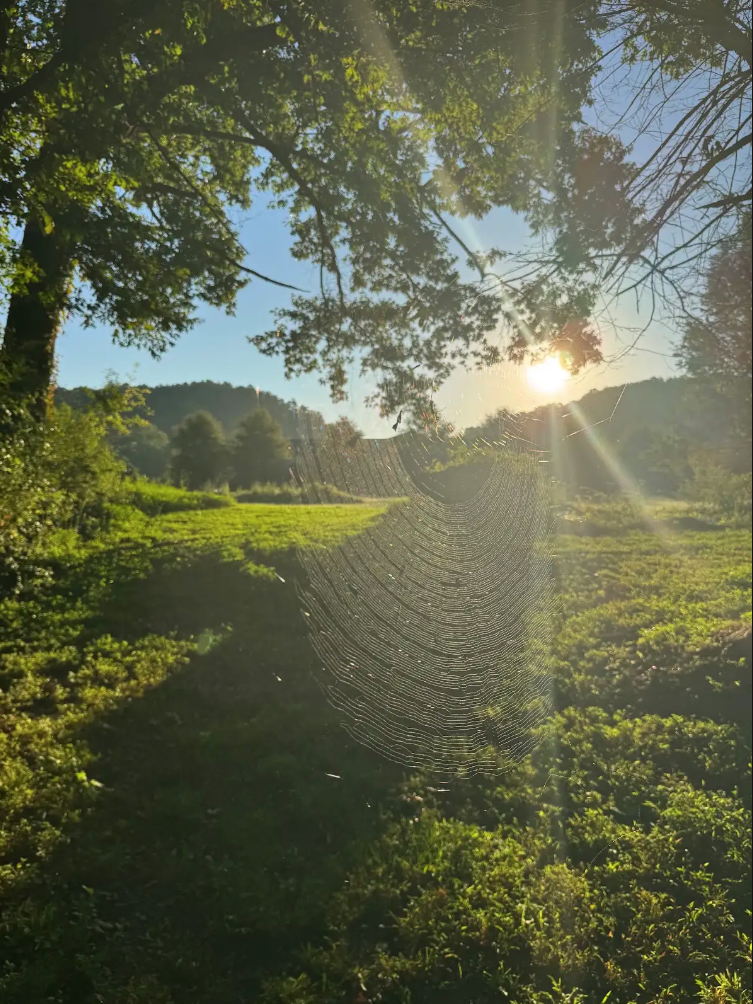
To be fair, UGA Extension's own guidance on Joros is not far off from what homeowners are already doing, with one important difference. Their recommendation is to remove and kill the spiders that build on or next to porches, walkways, decks, and doorways, anywhere people will walk into the web, and to leave the ones out on the edges of the yard alone. The key word there is the spider. Sweeping away silk while the spider drops to the gutter and waits does not accomplish much. A web out at the tree line, like the one in the photo above, can usually stay right where it is.
The other common moves:
Store bought sprays. A can of spray kills the spider you hit. It does nothing for a recluse in the back of a storage bin.
Glue traps in the garage. These are actually useful, just not the way most people use them. Sticky traps along garage walls and in the corners of storage rooms are a good way to find out whether you have recluses and roughly how many. They are a monitoring tool, not a fix.
Waiting for the first freeze. This one works less well than it used to. Joros survive the brief early freezes that knock back native orb weavers, and recluses that have made it inside your walls or attic are not bothered by the weather at all.
What Actually Works for Spider Control in Concord
The University of Tennessee spent eight years studying how to remove brown recluses from a single commercial building. The approach their entomologists recommend is not one product or one visit. It is a combination: inspection and monitoring, sanitation and habitat changes, and targeted applications in the areas where the spiders are active. The same logic holds on a Concord home, whether the spider is a recluse in the garage or a Joro on the deck.
Here is how that plays out in practice.
- Walk the whole property, not just the web you noticed. Our techs start checking the eaves before they reach your front door, then look at trees, deck sides, rails, the foundation line, and the garage entry. As our tech said, for spiders in general you are eyeballing the whole property during the survey, because the web you called about is rarely the only one.
- Cut down the hiding places. This is the part only a homeowner can do, and it makes the biggest difference for recluses. Swap cardboard boxes for plastic bins with tight lids. Keep stored clothing and shoes sealed. Get firewood off the ground and away from the house. Pull stacked lumber, bricks, and pots off the side of the garage. The UT Extension recommendations for keeping spiders out also include trimming branches and shrubs back from the house so spiders cannot use them as a bridge, and sealing cracks and gaps where they get inside.
- Treat where spiders actually live and travel. An exterior barrier treatment on the eaves, soffits, foundation, deck framing, and garage entry points does two jobs at once. It knocks down the spiders that are there, and it takes out a lot of the insects they are there to eat. Fewer bugs around your porch light means fewer reasons for a spider to set up shop next to it. Our Home Shield service focuses on the structure itself, and the Squad Yard Defender package pairs that with treatment across the yard.
- Keep it on a schedule. One treatment in October does not cover a spider population that has been building since May. Recurring visits are what keep the rebuilding cycle from starting over every time a new web goes up. A lot of homeowners roll spider coverage into the same seasonal plan they already use for mosquito barrier treatment, so it is one schedule instead of two.
- Monitor the inside. Keep a few glue traps in the garage and storage areas after treatment. A drop in what you catch is how you know the plan is working.
You can see everything that goes into our spider control service, or compare the full pest packages if you are dealing with more than one problem at once.
When to Treat for Spiders in Concord
Our tech's read on the calls coming in this month was simple: it is spider season, and the uptick is normal. It is getting close to fall. That is not a reason to panic, but it is a good reason to get ahead of the next few weeks.
Right now, late September into October. Joros are at full size and their webs are at their widest. This is also when homeowners are pulling boxes out of storage and running into recluses. If spiders are bothering you, this is a good time to start.
Before you unpack storage. If fall decor or stored furniture is about to come out, have the garage and entry points treated first.
Early spring. Recluses that hibernate outdoors come back out as temperatures rise, and Joro spiderlings hatch in spring. Starting coverage in March or April heads off the population before it builds all summer. Concord homeowners who already know their spring mosquito season starts early, which we covered in why mosquito control in Concord starts earlier than most homeowners expect, can put spiders on the same calendar.
Any time you find a recluse. One confirmed brown recluse in the house is a reason to take a closer look, not a reason to wait for the next season.
Spiders are not the only fall visitors that make their way toward the house. The same gaps around windows, siding, and attic vents let in the lady beetles and stink bugs we wrote about in keeping them out of your Knoxville home this fall, and our stink bug control and rodent control services work alongside spider treatment for the same reason. If you are further west in the market, the greenbelt effect we described in pest control in Oak Ridge works a lot like the wooded lots around Concord.
Keep an Eye on the Big Webs, and Plan for the Hidden Spiders
The big golden spider on your deck is a good conversation piece. It is new, it is striking, and it is not the one that should change how you store your fall decorations. The brown recluse in the garage is quieter, and it is the one that makes spider control in Concord worth doing properly.
We service Concord as part of our Knoxville market, from the lakeside streets off Northshore Drive to the newer neighborhoods out toward Farragut and West Knoxville. We know where spiders show up on these homes because we check those spots on every visit, starting with the eaves.
If you are seeing webs every morning or you have found something in the garage you would rather not find again, call Mosquito Squad of Knoxville at (865) 413-7732 or request a free quote. You can also see what we do across the area on our Concord service page, read what neighbors say in our customer reviews, and check our current special offers. Every visit is backed by our guarantee.