When the Spray Isn't Holding: The Hidden Water Our Techs Look For in Trussville Yards
Posted by Mosquito Squad Plus
October 16, 2026
Reviewed by Brandon Robertson
The call usually comes in about four days after a visit. The yard was treated, the shrubs and fence line got a full pass, and the first evening on the patio felt like a win. Then the mosquitoes are back. Not July-bad, but back enough that the homeowner wants to know what went wrong.
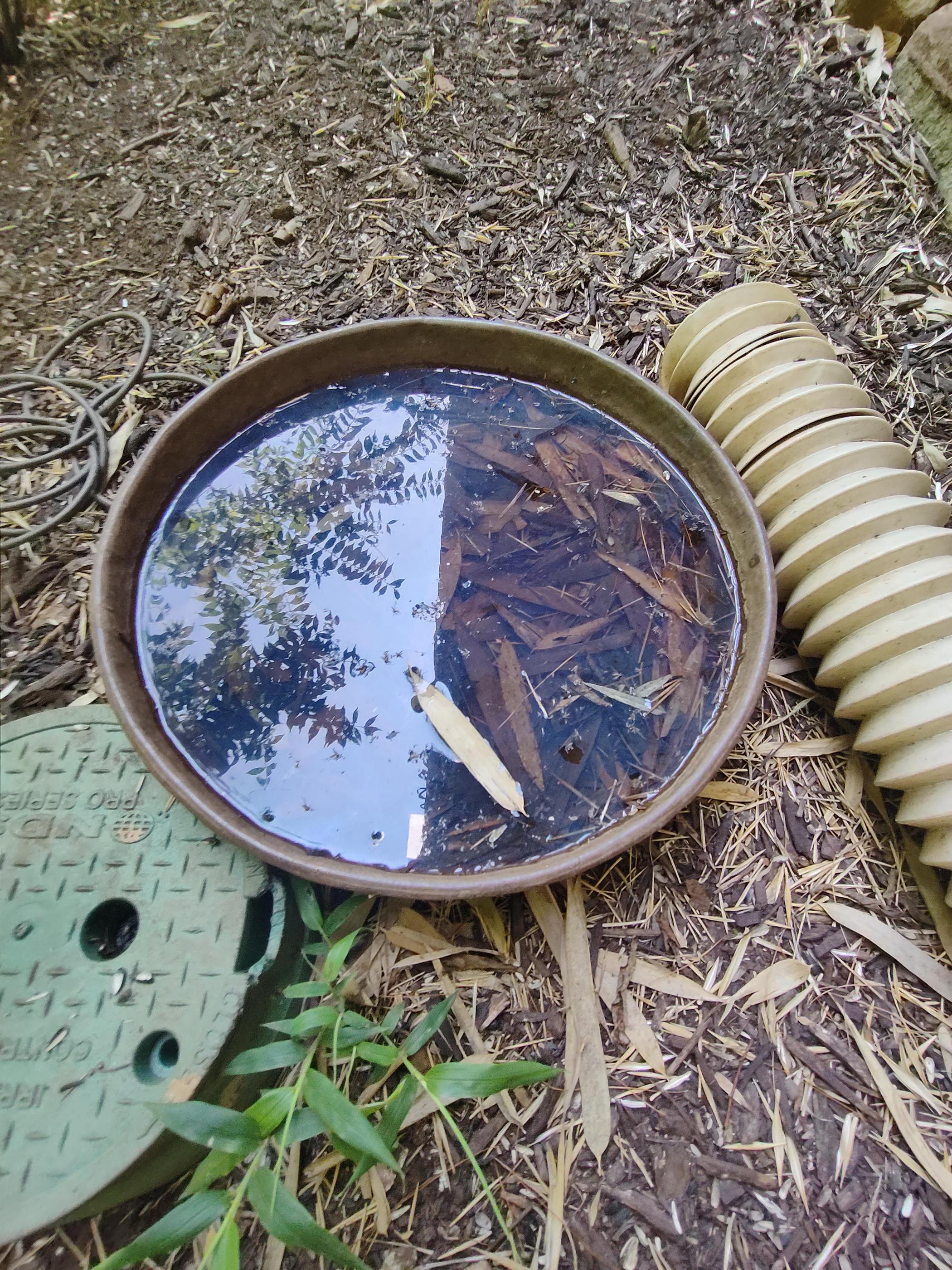
On Trussville routes this fall, the answer keeps turning up in the same kind of place. A fountain that got switched off sometime after Labor Day. A concrete birdbath nobody has refilled since school started, now half full of rainwater and brown leaves. A stack of empty flower pots by the back steps. None of it looks like a mosquito problem. All of it is.
Mornings in Trussville have gone cool, and the afternoons still climb back into shorts weather. That swing makes it feel like mosquito season should be over. Customers are telling our techs the same thing this month: it is better than summer, but they are still seeing them. When mosquito treatment in Trussville stops holding the way it did in July, the spray is rarely the weak link. Something on the property is still producing new mosquitoes faster than a barrier can knock them down, and fall is exactly when that something goes unnoticed.
Why It Happens in Trussville Yards This Time of Year
We have already written about how the Cahaba floodplain drives Trussville's spring season. The river is the reason mosquitoes show up early here, and no homeowner can do a thing about it. This post is about the other half of the picture: the small water sitting right next to the house. That water is fully within your control, and it tends to get worse in fall instead of better.
Where you live in town changes how much of this you get. When the Cahaba Project opened in April 1938, the city's own history of the Cahaba Project notes the old farmland was mostly bare of trees, and much of what stands there now was planted in the 1930s and 1940s. Those plantings are the canopy along Chalkville Road and the streets around it, now roughly eight decades on, and the neighborhood is listed on the National Register as the Cahaba Homestead Village Historic District. Big old trees over modest yards means a heavy October leaf drop landing on a short list of birdbaths, planters and porch pots. The newer subdivisions get it too where lots back up to woods, just usually from one side of the yard instead of straight overhead.
Four things stack up in October.
Water features go idle. Fountains get unplugged when the evenings cool off. Birdbaths stop getting the daily refill once nobody is out in the yard as much. Moving water does a poor job of raising mosquitoes. Still water does a great one. A fountain that ran all summer and kept its bowl churning becomes, the week it gets switched off, a shallow basin of standing water in one of the most sheltered spots in the yard.
The leaves come down, and a lot of them land in that water. This is the part that changes the math. The Alabama Department of Public Health notes that the larval stage can run anywhere from about four days to two weeks, depending on food and water temperature. Leaves are food. Researchers with the University of Illinois Natural History Survey found that leaf debris in standing water shapes how many Culex pipiens mosquitoes make it to adulthood, with some leaf types producing far more adults than others. A follow-up study published in Proceedings of the Royal Society B describes decaying leaves as a major energy source for larvae, which filter the bacteria growing on the leaves and graze right on the leaf surfaces. It also points to compounds released as leaves break down as a likely draw for egg-laying females. Clean water in July is a decent nursery. Leaf tea in October is a better one.
The rain gets irregular. The Alabama Office of the State Climatologist lists October as the driest month of the year on average statewide, with fall rainfall more variable and often shaped by tropical systems. In a Trussville backyard, that means a birdbath or an old pot can sit untouched through two dry weeks, then get topped off all at once by the tail end of a Gulf storm. The CDC explains that some mosquitoes lay eggs in containers just above the waterline, and those eggs hatch when rain refills the container. A dry birdbath with a crust of leaf muck around the rim is not out of the game. It is waiting.
The leaves sit longer than people realize. Trussville's Public Works leaf pickup runs November through March, with loose piles placed within five feet of the curb. That means the first heavy weeks of leaf drop land before the trucks start rolling. For most of October, leaves stay where they fall or sit in a pile by the street, and plenty of them end up in whatever is holding water nearby. Add that the National Weather Service puts Birmingham's average first freeze around November 9, and you get a stretch of several weeks with fresh leaves, standing water and no hard frost to shut anything down.
One mosquito deserves a name here because it's the one that matters most for health. Culex does its biting in the evening, it gravitates to water that's heavy with rotting plant material, and the ADPH identifies the Culex pipiens group as the mosquitoes most commonly tied to West Nile virus in people and horses. The state has logged cases in all of its public health districts, not just the rural ones. Fall evenings on the deck are prime time for it, and a leaf-filled basin is exactly the kind of water it looks for.
Pool areas stay on the list longer than people expect, too. Our crew is still treating around pools on Trussville routes this month. Nobody's swimming, but the shrubs, planters and shade around a pool deck keep holding resting mosquitoes a few steps from where the family still gathers on a warm afternoon.
What Trussville Homeowners Usually Try
Most people do the reasonable things first, and most of those things help a little.
They ask for more spray. One of our lead techs running Trussville routes said a handful of customers this month asked him to go a little heavier because they were still seeing mosquitoes. Sometimes that is the right call, especially after a soaking rain washes through the shrubs. But if a fountain bowl behind the azaleas is hatching a fresh batch every week, a heavier barrier just meets the same mosquitoes sooner. It doesn't stop them from coming.
They rake. Clearing leaves off the lawn is good for the grass and does cut down on shady resting cover. It does nothing for the leaves already sitting at the bottom of a birdbath or packed into a pot saucer. Raking can even push more leaves into a fountain basin if the pile gets built next to it. And a curbside pile waiting on the November trucks is still a pile of damp, shaded leaves a few yards from the driveway. The city also asks residents not to blow leaves into the street, which keeps them out of the storm drains that would otherwise back up and hold water.
They dump the obvious stuff. The kids' wagon, the bucket by the hose, the cover on the grill. Those are real breeding spots and they deserve to be tipped. The trouble is that the obvious stuff is what people already notice. The water that keeps a yard going in fall is the water nobody looks at anymore, because for six months it was decoration.
They buy a candle or a gadget. We get asked about citronella and plug-in repellers constantly, and we covered the natural treatment question on its own. The short version is that none of them touch the water.
None of this is wrong. It is just aimed at the adults, and if the source is still producing, every adult you kill gets replaced.
What Actually Works: Find the Source, Then Treat It
Here is how the job looks from the tech's side.
Walk past the obvious. The barrier part of the visit goes where adult mosquitoes rest during the day: the undersides of shrubs, ground cover, the shady side of the house, the space under the deck, the pool surround. What separates a visit that holds from one that does not is the extra lap around the property looking for water that should not be there. The lead tech on these routes put it plainly. A lot of yards have a fountain that is not in use, or a birdbath, and if the water is just sitting there with foliage in it, that is a breeding pool. On a Trussville yard this week, that is exactly what he found: a water feature nobody was running anymore, holding still water and leaves.
Get rid of the water if you can. If a feature can be emptied, the tech empties it. On the jobs we are describing, that often means blowing the standing water out of a fountain basin or birdbath on the spot so it is left dry. It takes thirty seconds and takes that source off the board.
Treat what can't be dumped. Some water has to stay. A fountain with a pump that is staying in place, a decorative basin too heavy to tip, a rain barrel feeding a garden. For that water, larvicide is the tool. The EPA explains that Bti, the most widely used biological larvicide, targets only the larvae of mosquitoes, black flies and fungus gnats, poses no risk to people, and can be used around homes in spots like flower pots and bird baths. Alabama Extension recommends the same approach for water you want to keep, naming fountains, birdbaths and rain barrels specifically, and notes that larvicides kill larvae and pupae before they turn into biters. This is the step most homeowners never take, because they do not know it is an option.
Check the forgotten containers. Old flower pots are a big one, and they're easy to miss because they don't look like they hold anything. A stack of empty plastic pots holds water in every rim and saucer, and the ones left upright collect leaves just like a birdbath does. Our techs have been told to look for exactly this and to treat with larvicide when the pots are staying put. State health officials put the scale bluntly: one discarded can holding rainwater can turn out thousands of mosquitoes. A stack of ten pots is a lot of cans.
Go back and find it when a customer calls. This is the habit that matters most. When a customer says it is not working, our lead tech goes back out, walks the property, and hunts for the source instead of just re-spraying. More often than not he finds it. He has been coaching the techs under him to do the same thing: do not just treat what you see, look around the whole property, because there might be a hidden water source nobody has thought about in weeks. That expectation is now part of how our crew runs mosquito treatment in Trussville and across the rest of the metro.
If you want the broader framework behind that walk-around, our 7 T's of mosquito control lay it out step by step. For a closer look at how a little standing water turns into a yard full of biters, our post on how mosquitoes reproduce on your property covers the life cycle, and our main mosquito control page explains the species we deal with most.
A Fall Walk You Can Do Yourself
You don't need to wait for a tech. Fifteen minutes on a dry afternoon covers most of it, and it makes the next visit far more effective.
Start with anything decorative. Fountains, birdbaths, urns, garden statues with a bowl, the pond liner you meant to fill in last spring. If it is off for the season, empty it and leave it dry or upside down. If it is staying, keep it running or ask about larvicide.
Look at everything in the leaf drop zone. Under the big hardwoods, check pots, saucers, wheelbarrows, trash can lids, the pool cover if you have one. Leaves plus water is the combination to hunt for. Anything holding a bottle cap's worth counts.
Check the wall, not just the water. A container that is dry today but has a ring of muck around the inside may still be carrying eggs. Scrub it out or store it under cover.
Pay attention to the time of the bite. Getting hit from sunset on points toward Culex and organic water close to the house. Bites in the middle of the afternoon point toward smaller containers. That one detail helps a tech find the source faster than almost anything else you can tell us.
We covered the drainage side of this checklist for hillside lots in Vestavia Hills. In Trussville in October, leaf-filled decorative water is the piece we find most.
The ADPH recommends emptying and scrubbing water-holding items like birdbaths and flowerpot saucers once a week. In a Trussville fall, with leaves landing daily, that weekly habit does more than it did in June.
When to Treat in Trussville
The short answer is that the season runs later than it feels. The state climatologist notes that early fall in Alabama often stays quite warm, and with Birmingham's average first freeze landing around the second week of November, a cool morning in October is not the end of anything. The cool-morning, warm-afternoon pattern Trussville is in right now is exactly the stretch when people cancel service. We treat through October, and into November when the fall stays warm. Stopping in mid-September usually buys a few weeks of evenings you cannot use, plus a yard full of standing water that never gets dealt with heading into winter.
There is a second reason to stay on through fall. Every forgotten fountain and leaf-filled pot that gets emptied or treated in October is one less container carrying eggs into next year. Eggs stuck to the inside of a dry container are part of why the first warm stretch in March brings mosquitoes back so fast. Our post on when to start treatment for best results covers the spring side, and our look at what a soggy Birmingham year does to mosquito season explains how a run of rain pulls the timeline forward.
Fall also brings a different crowd indoors. The same weeks mosquitoes are hanging on outside are when roaches and mice start showing up in Birmingham homes, which is why plenty of Trussville families roll their mosquito program into year-round coverage instead of stopping cold.
Mosquito Treatment in Trussville, From a Crew That Looks
Our Mosquito Barrier Treatment starts as low as $74 per treatment on a 21-day schedule, and our techs are expected to look for the standing water that would undo it. If you'd prefer a plant-based product, the natural treatment option runs on a similar schedule. If you want the house and yard handled year-round, Home Shield is as low as $99 a month and Complete Home & Yard starts at $119 a month. There is no contract.
If a treatment is not holding, tell us. Under our satisfaction guarantee, you can contact the office within 14 days of a service for a courtesy treatment at no extra charge, and that return trip is when our techs go looking for the source.
Mosquito Squad of Greater Birmingham is a veteran-owned family business that has been treating Trussville yards since 2018, along with neighboring Pinson, Center Point and Moody. Call (205) 900-3528 or request a free quote, and ask your tech to walk the water with you.