Why Roaches and Mice Start Turning Up Inside Birmingham Homes in the Fall
Posted by Mosquito Squad Plus
July 27, 2026
You flip on the kitchen light around eleven at night and something big moves across the floor toward the dishwasher. It is fast, it is glossy, and it is gone before you decide what to do about it. Then you stand there running the same two thoughts everybody runs. Where did that come from, and is there another one.
We take that call constantly from September through November, and the answer surprises most people. It probably did not come up through a drain. In this market, in this season, it more likely came in somewhere near your roofline and worked its way down inside the wall to your kitchen.
That distinction is not trivia. It changes where you look, what you seal, and whether the thing you do about it works for more than a couple of weeks.
The Roach in Your Kitchen Came From the Trees
Birmingham's big fall roach is usually the smokybrown, and it lives outdoors in the canopy rather than in your plumbing. Tree holes, leaf-packed gutters, mulch beds, woodpiles, the dark side of a soffit. That is its natural habitat, and this city gave it about as much of that habitat as a city can.
The reason it comes inside when the weather shifts is physical. UT's entomology publication on the species notes that it loses water through its shell faster than most other roaches, and that the loss accelerates as humidity falls. Birmingham runs humid all summer, so the yard is comfortable and the roach stays out in it. When fall finally drops the humidity, the yard stops working and the insect goes looking for somewhere damp and still.
The same publication lists what it settles for when tree holes run short: block walls, soffits, and attic eaves away from moving air. Your attic is a tree hole with better construction. Texas A&M's guidance says the same thing from the entry side, naming roof soffits alongside poorly sealed doors and floor drains as how the large roaches get in.
That is the part people miss while checking under the sink. In Mountain Brook and the older parts of Homewood, where mature hardwoods hang over rooflines, we find far more activity at gutter and soffit level than at the foundation.
Two Roaches, Two Directions, Two Different Jobs
There is a reason the treatment plan changes depending on which one you have.
The American cockroach, which most people around here call a palmetto bug or a water bug, works low. Crawl spaces, basements, drains, foundation gaps. Oriental cockroaches share that profile, and Texas A&M's guidance places them specifically in cooler ground-level sites: basements, crawl spaces, and wet areas.
That describes a lot of the older housing stock through Bessemer and Dolomite. Our post on the Red Mountain divide covers that side of it in detail, because drainage on both sides of the ridge keeps foundation soil damp enough to hold them year-round.
The smokybrown works high. Roofline, attic, upper walls. You will see it around porch lights at night because it flies reasonably well and moves toward light. If what you are finding turns up in an upstairs bathtub or running along a ceiling, you are not dealing with the same insect your neighbor found in his basement, and treating the foundation alone will not touch it.
Both belong to cockroach control as a category. They just require us to work different parts of the structure, which is why we walk the whole envelope rather than assuming.
What Fall Does Here, and Why It Sneaks Up
Birmingham does not get the hard seasonal break that markets north of us get. There is no single freezing night in October that sends everything at the walls at once. Ours arrives gradually, and that is exactly why it catches people.
Our own service calendar shows it. We are treating properties across Greater Birmingham into early November most years because the weather never gives a clean stopping point. What changes in September and October is subtler than temperature. The air dries out, the nights cool enough to matter to a cold-blooded insect, and outdoor food and shelter start thinning. None of that is dramatic enough to make a homeowner think about pest control, which is the whole problem.
So the migration happens quietly, one insect at a time, across about eight weeks. You do not notice on the first sighting because a single roach is just a roach. You do not really notice on the second because it was two weeks later and you had forgotten the first one. By the third you start counting backward, and by then the route has been open since September.
There is a second reason the timing feels wrong to people. A smokybrown takes roughly 600 days to reach maturity, and adults then live another three to nine months, according to Texas A&M's cockroach publication. The ones walking into your house this October were not produced this October. They have been in your yard for a year and a half, and the weather just changed their mind about where to live. That is why cockroach control here is a property conversation rather than a kitchen one.
That gradual quality is worth understanding if you moved here from somewhere colder. In a market with a real freeze, the fall invasion is an event you can point at. Here it is a slow leak, and slow leaks are the ones people live with far longer than they should.
Then the Rodents Follow
Roaches at least stay roaches. Rodents move in and multiply, and Birmingham gives them an unusually good route in.
Alabama Extension's rodent publication is specific about the numbers. A mouse gets through a quarter-inch opening. A rat needs half an inch. Those are small enough that most of the gaps around your house qualify without looking like gaps at all.
The part of that publication we wish more homeowners read is about climbing. Rats climb wires, cables, vines, and trees. They climb rough exterior siding, concrete, and rough sheet metal. They walk pipes up to three inches across. In a neighborhood with heavy canopy and limbs touching the roof, a roof rat does not need a foundation crack. It takes the tree, crosses to the gutter, and enters at the same soffit gap the smokybrowns have been using since September.
That is why we spend time at the roofline in Forest Park, Irondale, and the older streets in Birmingham proper, not just around the base of the house. House mice work lower and enter closer to the ground, so the two together cover the entire structure.
How much of this you deal with depends partly on when your house was built. The older stock north through Trussville and Center Point produces more rodent work for us, because decades of settling open gaps at the roofline and the foundation both. Newer construction down 65 toward Alabaster has a tighter envelope, and more of the pressure stays outside in the mulch and the tree line where it started.
Extension also makes a point about materials that saves people money. Rodent teeth do poorly on hard flat surfaces but handle anything with a rough edge to bite into. Secured sheet metal over an opening holds. Softer patches give them something to start on. Rodent control that lasts is exclusion done with the right material, not just something stuffed in the hole.
What Gives It Away Before You See One
Most people meet this problem visually, and by then it has been running a while. There are earlier signals.
Scratching or scrabbling overhead after dark, usually right after the house goes quiet, is the most common one we hear about and the one most often written off as squirrels. Our Birmingham customers mention it more than any other early sign. Droppings along the top plate in an attic or behind boxes in a garage, which is the point at which rodent work stops being optional. A greasy smudge where something is repeatedly squeezing through the same gap. Insulation that looks disturbed in one corner.
On the roach side, seeing one in daylight matters more than seeing one at night. Texas A&M puts it plainly: daytime sightings usually mean there are a lot of them around. A single roach at midnight is a roach. A single roach at two in the afternoon is a population.
Both of those are worth acting on before the count climbs, because the difference between an early call and a February call is substantial in both effort and cost.
Walk Your Own House Before You Call Anybody
You can find most of this yourself in about twenty minutes, and knowing what you have makes every conversation afterward shorter.
Start at the street and look at your roofline, which is where our own property walks begin here. Do you have limbs touching the roof or hanging within a few feet of it? Are your gutters holding leaves right now? Both of those are the highway, and both are visible from your driveway without a ladder.
Then walk the perimeter and look up rather than down, which is the opposite of what most people do. You are checking soffit vents for torn or missing screen, gaps where the soffit meets the wall, and any place a fascia board has pulled loose. Anything you can see daylight through from below is an opening.
Now look at ground level, and look for the boring stuff. Where do your utility lines pass through the wall? Is the collar around your dryer vent intact? Does your garage door seal against the slab across its whole width, or is there light at one corner? Is your mulch bed sitting against the siding rather than a few inches back from it?
Texas A&M's guidance names two of these specifically, telling homeowners to check the threshold seals under doors and confirm that roof soffits are screened. If you find an opening you cannot close properly today, UF's cockroach publication suggests tightly packed steel wool as a temporary filler until you can do it right.
Last, go in the attic with a flashlight if you can get there safely, since that is where rodent activity shows up first in this market. You are looking for droppings along the top plate, disturbed insulation in one specific area, and daylight anywhere it should not be. If you find any of the three, you have your answer about whether something is already using the route.
What Does Not Work, and Why We Still Get Asked
The over-the-counter spray around the baseboards is the most common first move, and it addresses the least important part of the problem. The insects you are seeing indoors are a fraction of what is in the wall void and the attic, and a baseboard treatment does nothing about the route they used to get there. You end up reapplying every few weeks and calling it maintenance.
Bug bombs perform worse than nothing on these species. Smokybrowns and American roaches sit in voids and attic spaces the fog never reaches. Foggers also push insects deeper into a structure rather than out of it, which turns a roofline problem into a wall problem.
For contrast, the UT entomology publication lists what does work on smokybrowns, and it is four things in order: pull the harborage and moisture-holding material away from the house, seal and treat the entry points, run a perimeter treatment with a microencapsulated product, and place granular bait around the structure. Nothing on that list happens inside your kitchen.
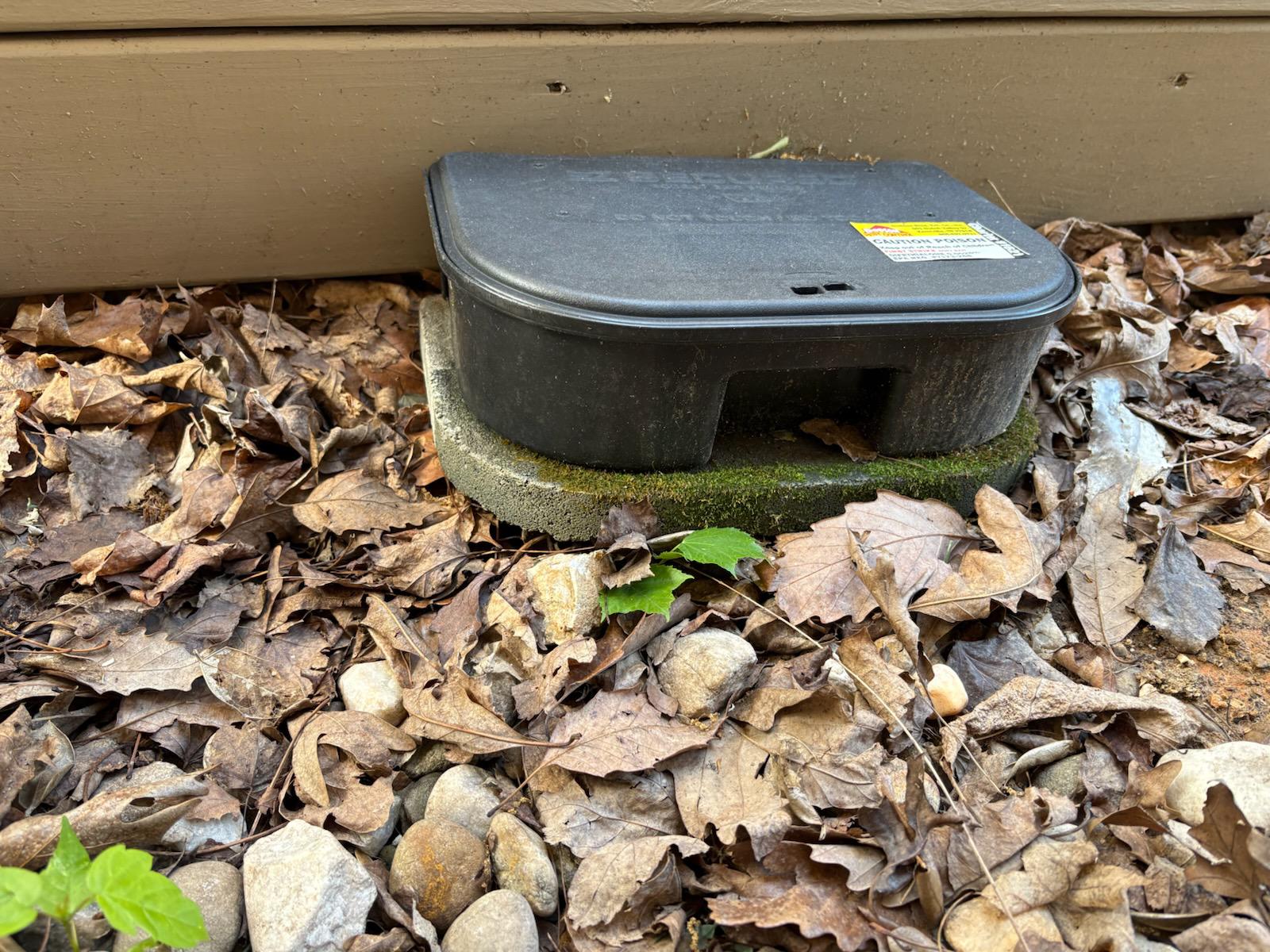
Traps handle rodents already inside and nothing else. Every mouse you catch is one that already found the opening, and the opening is still there. We have walked into plenty of houses with a dozen traps set and a gap behind the dryer vent that nobody had thought to look at.
Foam in a hole is the other one. It feels like sealing and it is not, because rodent teeth handle anything with a rough edge to start on. Alabama Extension recommends secured sheet metal over an opening for exactly that reason. If you have patched something with foam alone in the past and the problem came back, that is probably why rather than bad luck.
The last one is the honest mistake rather than a bad idea. People stop pest service in September because mosquito season winds down. That is the exact month the indoor migration starts, so the coverage ends right as the risk begins.
What We Do About It, and What You Can Do This Month
Our side is the structure envelope, worked from the roof down rather than the foundation up. Soffits, eaves, gutter lines, attic vents, utility penetrations, then the perimeter and the foundation. On a property with heavy canopy we spend most of the time up top, because that is where the traffic is. If your problem is more yard than structure, Yard Defender handles the harborage side instead.
Home Shield is the program built around that envelope, running year-round instead of stopping when mosquito season does. For properties that also want the yard managed, Complete Home and Yard extends it to the fence line and picks up fleas, chiggers, and fire ants along the way.
Your side is mostly about denying the route, and you can do most of it in a weekend. Trim limbs back off the roof, because a branch touching your house is a bridge for everything described above. Clean your gutters, since packed leaf litter is prime smokybrown habitat sitting directly against your soffit line. Pull mulch and ground cover back from the foundation and move the woodpile off the wall.
UF's cockroach guidance adds the step most people skip. Keep your window and soffit screens in repair, and make sure attic vents and the openings around drainage and sewer lines are screened or sealed. If you only do one thing off this list, make it the screens.
The CDC's rodent guidance and the EPA's prevention material both land on the same order of operations, which matches ours. Close the openings first, then remove what draws them to the building, then deal with whatever is already inside. Doing it in the other order is how people end up repeating the process every year.
The Rest of the Season
Roaches and rodents lead the fall list, and they bring company. Spiders turn up in more places because their food supply is drifting toward your walls. Finding fresh webs across the same doorway every morning tells you less about spiders than about what else has started gathering there after dark.
If your yard backs a wooded edge, you will keep getting ticks later in the year than you expect. That describes a lot of lots in Vestavia Hills, where the tree line sits close to the back of the house, and it holds along the 280 corridor too, where newer subdivisions were cut into wooded ground recently enough that the habitat still behaves the way it always did.
Mosquito pressure holds on longer here than in most of the Southeast too, which is the other reason September is a poor month to stop service. We are frequently still treating yards on a street when the first roach calls start coming in from that same street. Our post on Birmingham's changing mosquito season covers what that has looked like along the 280 corridor.
Getting It Handled
Two practical notes from our routes. Rain cancels treatment days, so a wet stretch in October squeezes everybody's schedule into the same narrow windows and the calendar tightens fast. And if you keep dogs outside, say so when you book. We can flag the account so you get a heads up ahead of every visit and have time to bring them in, rather than you having to chase us down about it each cycle.
If you have already seen one in the kitchen, the useful question is not whether there are more. It is where the route is, and that is what we look for.
And if you have not seen anything yet, this is the good month. Everything described here is easier and cheaper to handle while it is still outside your house, and right now, in most of Birmingham, it still is.
Reach out to our Birmingham team or call (205) 900-3528 and we will walk your property, roofline included. If you are not sure whether your street is on a route, the areas we service page has the full list.