When a Centerville Hornet Nest Is Too Low to Leave Alone
Posted by Mosquito Squad Plus
August 10, 2026
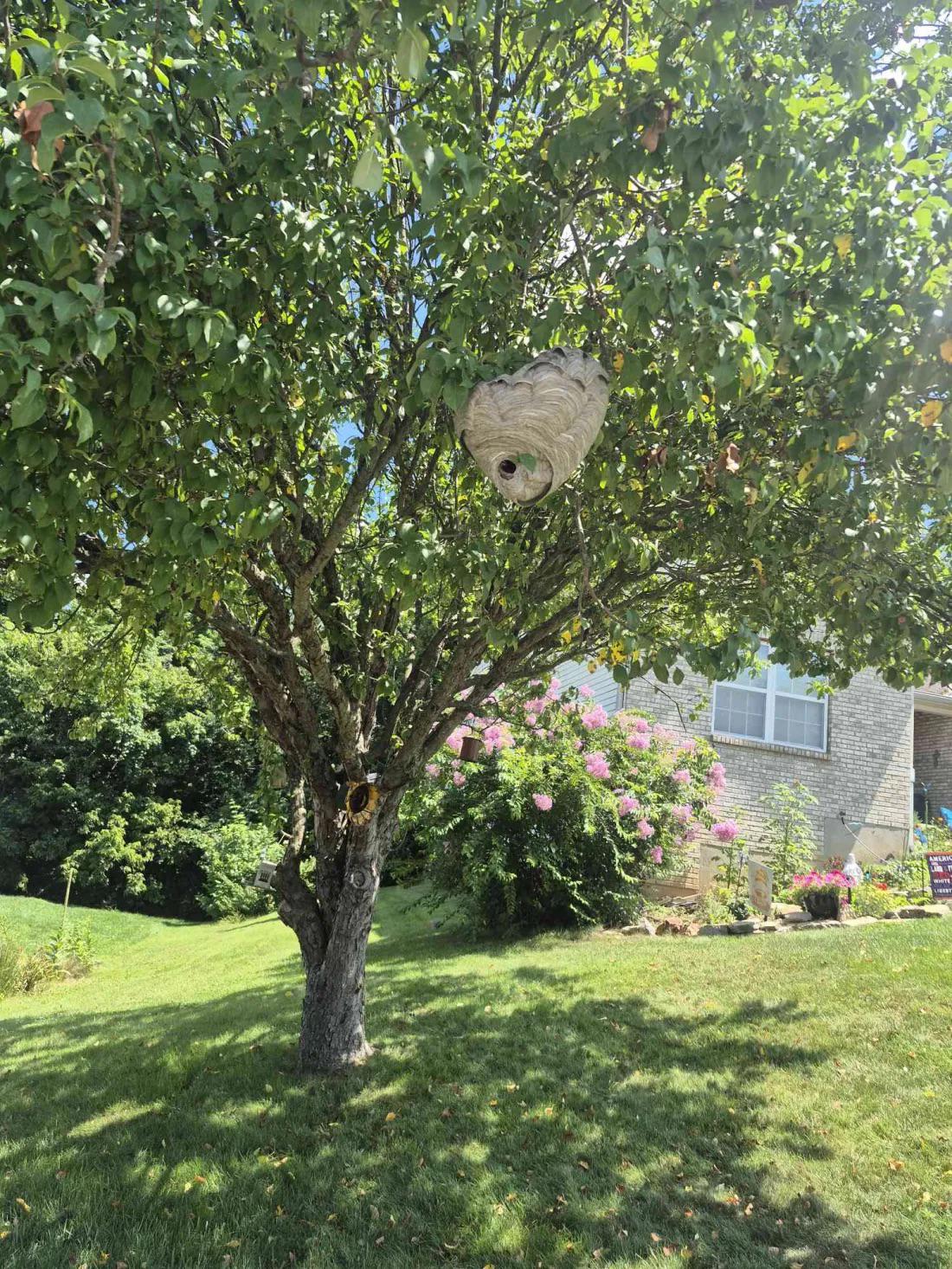
The nest in that ornamental pear out front hangs about eight feet off the ground, close enough to reach with a stepladder and a bad idea. It is gray and layered, football shaped and working on basketball, with one dark opening near the bottom where the traffic runs in and out. Nothing about it was visible in May, and it has been building since April.
We take that call all over the Dayton area every summer, and Centerville sends more than its share. It almost never opens with a question about insects. It opens with a location. Over the spot where your kids ride bikes, beside the window you crack every morning, above the strip of lawn you mow every Saturday, which is why you have been cutting a polite little arc around that tree for three weeks.
Nobody calls us because they identified a bald-faced hornet. They call because something the size of a basketball is growing over their children, and they have decided this is not a job for a homeowner with a broom.
Where Hornet Nests Hang in Centerville Yards
Read any extension guide on bald-faced hornets and you come away with a picture of a nest thirty feet up in a forest canopy, discovered in November when the leaves drop. Iowa State University Extension describes the nests as usually located in wooded areas, attached to a tree branch. University of Illinois Extension puts them at least three feet off the ground and often higher up in tree canopies. Purdue Extension tells homeowners plainly that colonies situated high in trees far from human activity should be left alone.
Every word of that is correct. None of it describes what we cut out of Centerville yards.
The nests we take down here hang in ornamental landscape trees standing in maintained front and side lawns, at heights we can usually reach from the ground or a short ladder. They hang in flowering pears, crabapples, and the dense shrub masses planted along foundations and property lines. They hang within a stride of your driveway. That is our own observation across a decade of removals rather than a number out of a fact sheet, and it holds year after year.
The history explains most of it. The City of Centerville records that suburbanization was apparent by the 1960s, with residential development springing up rapidly around the Four Corners, and the village passing 5,000 residents in 1968 on its way to becoming a city. That build-out arrived fast, it arrived on former farmland, and every one of those new lots got landscaped. The city still describes itself as a tree-lined community, which is true, and the trees doing most of that lining are small.
A queen scouting in April is not shopping for a forest. She wants anchored branch structure with cover overhead, and a fifteen foot ornamental with a tight rounded crown hands her exactly that at a quarter of the height. She does not know or care that the branch she picked is directly above a sandbox.
Compare that with the rest of our territory. Out along the park edges in Beavercreek and the wooded borders near Yellow Springs, nests go up into mature canopy where nobody ever meets them. In Oakwood, the old street trees do the same favor. Centerville splits the difference in the least helpful way available. Open yards, tidy lots, small decorative trees, and nests parked at eye level in the middle of daily life. The same layout shapes mosquito pressure here, which we walked through in our post on how Centerville sits in the valley.
The Height Rule Every Guide Gives You
The standard advice is good advice, and we give it ourselves several times a season. A bald-faced hornet colony left alone earns its keep. North Carolina State Extension points out that the workers hunt caterpillars and other insects to feed their larvae, which makes them free labor against whatever is chewing your hostas. Leave a high nest be and it works a full season, then dies at frost.
But that advice ships with a condition attached, and the condition is the first thing to fall off in transit. Iowa State spells it out: most nests can be ignored if they sit high in a tree or on a house, but if the nest is in a high-traffic area, such as above an exterior doorway or on a low-hanging branch you mow or garden under, removal is acceptable.
Read that again, then look out your front window. Low-hanging branch. Mowed under weekly. Twenty feet from the door. In a lot of Centerville yards, the exception is the situation.
So when your neighbor says leave it be, or a search result explains that hornets are beneficial and you should learn to coexist, nobody is lying to you. They are answering a question about a different nest. Whether a colony can be ignored is a question about geometry, and the only geometry that counts is the one outside your own back door.
That same rule is why we tell some homeowners the opposite. A colony fifty feet into the tree line behind a South Dayton lot may never need touching, the way the pressure we described at the back fence line in Springboro stays put until something drags it closer. Distance is doing the work there. Your landscaping removed the distance.
Timing shifts the math too, and the full seasonal arc of how these colonies build from April onward sits in our Dayton hornet timeline. The short version for August: whatever you are looking at is the smallest it will be for the rest of the year.
What Changes When the Nest Is Low
A colony defends a radius around its nest, and that radius does not shrink because the nest hangs closer to your grass. What changes is who is standing inside it.
At thirty feet in a canopy, the defended space is empty air. Nobody occupies it. The colony can grow all summer without ever meeting a person. At eight feet in your front yard pear, that same defended space contains a mower, a bike, a garden bed, a hose reel, and whoever is using them. The hornets did not get meaner. Your family moved into the perimeter.
Scale makes it worse as the season runs. Clemson Cooperative Extension puts a mature nest at up to fourteen inches across and over twenty-three inches long, built from layered hexagonal combs inside a mottled gray envelope. Iowa State puts peak worker population at 100 to 400 by summer's end. Every one of them stings repeatedly, and NC State is blunt about what that means: many workers swarm out aggressively when the nest is disturbed, the sting is instantly painful, and the soreness and swelling can persist for days.
Now think about what qualifies as a disturbance at eight feet. A string trimmer against the trunk. A ladder leaned on a branch. A basketball. A gust that knocks a limb into the envelope. Vibration is the trigger, and a small ornamental carries vibration through its entire structure in a way a mature oak simply does not. You do not have to touch the nest. You have to touch the tree.
That is the whole reason a low nest is a different animal. These hornets are no worse than the ones out in the woods. Everything you do in your own yard now reads to them as an attack, and you are the one holding the trimmer.
It is also why we field a specific flavor of August phone call. Graduation cookout Saturday, nest over the patio, and roughly seventy-two hours of runway. Our special event sprays exist for exactly that squeeze, and we hear it from Kettering and Clayton as reliably as the calendar turns. If you are not sure what you are looking at yet, the rundown on our wasp and hornet control page sorts the local stinging insects apart from a safe distance.
The Trees Doing the Hosting
There is a second layer here, and it belongs to what got planted during that build-out.
A great many of the small flowering trees standing in these yards are callery pear, sold for decades as Bradford, Cleveland Select, and Chanticleer. The Ohio Department of Natural Resources documents how completely the species took over Ohio landscaping, prized for its adaptability, its flowering, and its rounded crown, before the state banned new plantings in 2023. Existing trees were never regulated. They are all still out there, and the ones that went in during the eighties and nineties have aged into precisely the dense, brittle, low-branching shape a queen is after.
That rounded crown is the entire attraction. Anchored branch structure, leaf cover overhead, convenient working height, open flight paths in every direction. Somebody designing hornet real estate on purpose would land somewhere close to it.
Your trees may be supplying materials, too. NC State notes that bald-faced hornets sometimes damage thin-barked trees and shrubs by stripping bark to the cambium and chewing it into paper. Ornamental pear is thin-barked. So is crabapple, and so are plenty of the young maples out there. We will not claim hornets pick your pear for its bark, because nobody has demonstrated that. What we will say is that a lot of Centerville front yards offer nest site and building supply inside the same fifteen feet, and the results land on our schedule every July.
Those same dense crowns and foundation shrubs are working overtime in other ways, which is why a hornet inspection usually turns up spider activity in the same shrub line. For the wider picture of what settled landscaping does to pest pressure around here, our post on Kettering after sixty years covers how established neighborhoods stack up problems newer subdivisions have not reached yet, and Kettering's trees and mosquito season runs the same argument for a different pest. The older housing stock in West Carrollton tells a version of the same story.
Why It Comes Back After You Spray It
This is the complaint we hear most, and you deserve a straight mechanism instead of a shrug.
Start with what you are shooting at. Penn State Extension describes the bald-faced hornet nest envelope as thick, many-layered, and somewhat water-repellent, and says outright that it makes treatment difficult. That envelope is engineered to shed weather. A jet of aerosol from your driveway is weather.
So the stream hits the outside and the hornets nearest the entrance. Several layers in, a few hundred workers are untouched and newly furious, and they leave through an opening you are standing almost directly beneath. Purdue's guidance is that spray has to be directed into the nest entrance and the nest thoroughly soaked, which is a tidy sentence to read and a wretched thing to attempt from a stepladder at dusk.
If you get clear, and most people do, the colony is damaged rather than dead. The queen sits deep in the comb and survives. Workers patch the envelope within days, and inside two weeks the yard looks the way it did before, except the colony now reacts to lawn equipment like it owes them money. That is the hornets-came-back call. They never left. Your spray hit the wrapper.
Version two follows a knocked-down nest. Somebody waits for dark, takes a pole to it, and down it comes. Foragers that were out working return to nothing, mill around the site, and rebuild in the same yard. It reads as a return. It is the same colony, minus its house. We covered the broader shape of this problem in our post on when bug spray isn't enough, and stinging insects are the least forgiving example of it.
Version three is next April's problem. Colonies here are annual. Iowa State is explicit that each nest gets built from scratch every year and last season's cannot be reused, with only queens surviving winter. A colony that reaches full size graduates new queens before it dies, and a yard that grew one to maturity is a yard that sent queens into the nearby leaf litter and loose bark. Some of them will be shopping your landscaping in the spring.
None of this means you did anything foolish. The tool was wrong for the job, in a spot with no margin for the tool being wrong. If you would rather keep aggressive products away from a yard your kids use, that is a fair instinct, and our natural treatment option exists for Dayton homeowners who feel that way about routine mosquito work as well.
How a Low Nest Comes Down
Simple to describe. Not survivable to improvise.
Our technician shows up in a full suit, and that is not theater. It is the entire reason this job is routine for us and dangerous for you. Protective equipment turns a swarming defensive response from an emergency into an inconvenience, and it is the single largest difference between what we do and what you can do with an aerosol can and a garden hose.
Sequence matters as much as gear. We treat the colony first, at the hour it is least responsive, with material that carries through that water-shedding envelope into the comb instead of beading up on the outside. The nest comes down only once the activity is finished. Pulling a live nest out of your tree is the quickest route from manageable afternoon to emergency room, and one day of patience beats that trade every time.
While we are on the property we walk the rest of it, because a yard that produced one nest generally holds the conditions for a second. We read your roofline and soffit gaps, open up the shrubs along your foundation, and check your other ornamentals. We are looking at tick habitat along the same shrub line while we are at it. If the hornets working your lawn turn out to be commuting in from past your fence, we say so and skip the treatment you do not need.
Every visit carries our guarantee. If you want to know how we operate before you let anyone near your tree, why Mosquito Squad Plus spells it out.
The last part is the one you called about. When we finish, the nest is gone, the yard is walkable, and the thing you have been steering your kids around for three weeks is not there anymore. You stop thinking about it. That is the deliverable, and it is the whole job.
A hornet call in July rarely comes from a yard carrying only one problem, so it usually pays to solve the season instead of the incident. Our Home Shield package covers the structure and its entry points. Squad Yard Defender takes the lawn and the planting beds. Our pest packages scale from there to whatever the property turns out to need.
If there is a nest in your tree right now and you are weighing whether it can wait, call (937) 226-9709 and send a photo from a safe distance. We will tell you straight whether it needs to come down this week or whether you can hand it to the frost, and we give the second answer more often than you would expect. We cover Centerville and the surrounding communities out through Xenia, Huber Heights, and Tipp City.