Hornet Removal in Dayton: What Homeowners Should Know
Posted by Mosquito Squad Plus
July 14, 2026
Every hornet colony in the Miami Valley is going to die this year. Biology guarantees it and the weather records back it up. The National Weather Service in Wilmington keeps the region's fall frost and freeze records, the first hard freeze typically arrives in October, and no hornet colony in the Dayton area survives it. Homeowners hear that and ask a fair question: if the problem cancels itself in October, why does hornet removal in Dayton exist as a service at all?
Because August comes before October. The colony that started as a single queen in a Kettering shrub back in April will spend this month growing into several hundred defenders with a shrinking sense of humor about your lawn mower, and it has ten more weeks of growth ahead of it before the weather steps in.
Hornets in this region run on a fixed schedule, the same one every year, and everything about the problem, the risk, the difficulty, and what it costs to solve, depends on where in that schedule you act. A nest handled early is a small job. The identical nest handled at peak is a project. So instead of organizing this post around species or neighborhoods, we are going to walk the calendar the way the hornets do, from the quiet start in April to the freeze that ends it, and mark where the smart moves are along the way.
April: One Queen, No Problem Yet
Hornet season in the Dayton area opens with almost nothing to see. The only survivors of last winter are the mated queens, which spent the cold months tucked under bark, inside woodpiles, and behind loose siding. Per the University of Kentucky Entomology program, each queen emerges in spring, picks a site, and builds a small paper starter nest entirely alone, laying the first eggs and hunting food for the first larvae herself.
An April starter nest is the size of a golf ball. It holds one queen and a handful of developing workers, it defends nothing because there is nothing yet worth defending, and it can be dealt with in minutes by anyone who knows what they are looking at. This is the cheapest, safest, easiest moment in the entire hornet year, and it is also the moment when almost nobody calls, because a golf ball tucked under a deck rail in Centerville, where mature landscaping gives queens their pick of anchored shrubs, or hidden along a Springboro fence line where the yards back up to preserved tree stands, does not announce itself.
The queens are also making real estate decisions in April that determine the whole summer. A bald-faced queen wants anchored branch structure with cover. A European hornet queen wants a cavity, a hollow tree, a wall void, an attic edge. She will inspect a dozen candidates before committing, testing gaps and hollows the way a buyer checks closets, and whatever site she picks in April is where the colony will be in August. That is why our spring visits include a slow look at deck framing, shrub interiors, and soffit lines while the nests are still golf balls. Catching the season here is less like pest control and more like canceling an appointment before it happens.
May and June: The Invisible Months
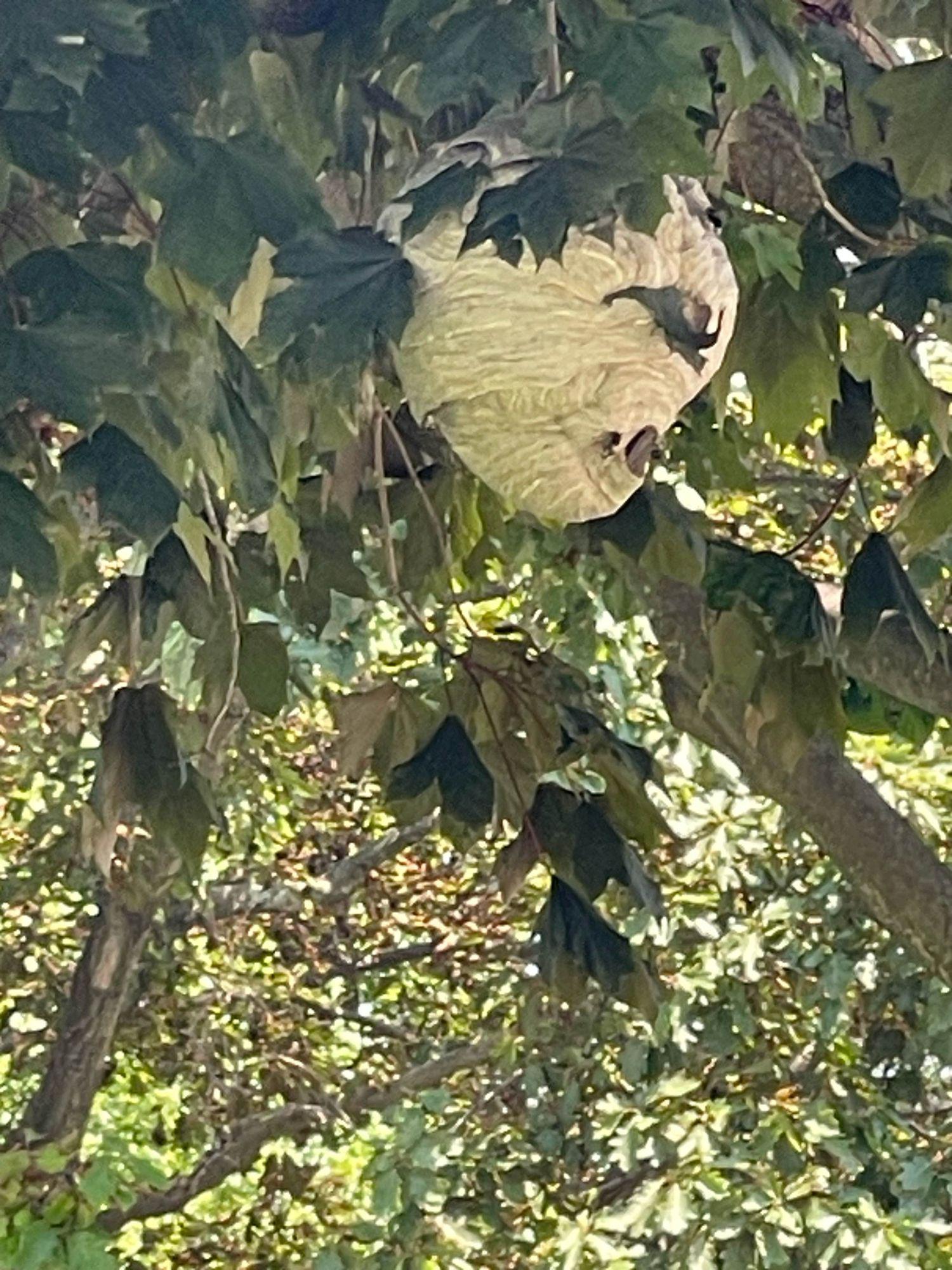
By late May the first workers have emerged and taken over construction and hunting, and the queen settles into full-time egg laying. Colony growth turns exponential right as the Miami Valley finishes leafing out, and those two events together create the defining problem of early summer: the nests grow fastest during the exact weeks they are hardest to see. A bald-faced nest that was a visible gray lump on a bare branch in March is, by June, a basketball in the making behind a wall of maple leaves.
The hidden species digs in during these weeks too. Ohio has exactly one true hornet, the European, over an inch long in chestnut and yellow, and per Ohio State University Extension it nests inside hollow trees, wall voids, and attics, preferring an entrance that sits six feet up or more. Huber Heights built its identity as America's largest community of brick homes, and those Huber ranches have aged admirably, but brick walls end at the soffit line, and sixty year old soffits, gable vents, and garage door headers offer everything a cavity-nesting queen is shopping for. The older housing in West Carrollton and Xenia runs the same math with frame construction, which offers even more doors in.
June is when the calls we wish we got do not come. Both species are established, populations are still modest, defensive behavior is still mild, and treatment is straightforward. What we get instead is silence, because the colonies are invisible and the yards feel fine. Homeowners in Clayton and Beavercreek spend June grilling twenty feet from colonies they will not meet until the ladder comes out. If there is one habit worth building from this post, it is a slow June walk around your own house, looking up at the eaves, into the big shrubs, and along the tree line, while the season can still be caught early.
July: The Month of Discovery
July is when the Miami Valley finds its hornets, and it happens for two colliding reasons. The nests finally cross the size threshold where leaves stop hiding them, and the people cross the activity threshold where they are up on ladders, trimming limbs, cleaning gutters, and living outside. Most of our Dayton hornet calls land in these weeks, and the callers almost always believe the nest is brand new. The nest is an April project that finally outgrew its camouflage.
What they have found is usually one of two insects. The bald-faced hornet builds the enclosed gray paper nest, football shaped and growing, hanging from a branch, shrub, or eave. It is black with a white face, it stings repeatedly, and the whole colony responds to a threat at once, with UK Entomology putting late season populations at 200 to 400 hornets. The European hornet announces itself differently, as steady traffic at one opening in a wall, a soffit gap, or a hollow trunk, or as the large insect thumping against lit windows on summer nights, a habit Ohio State's BYGL documents and startled homeowners in Huber Heights rediscover every July, since this is the region's one stinging insect that keeps night hours.
Geography stacks the odds in predictable places. Five Rivers MetroParks protects nearly 16,000 acres across the region, named for the five waterways that meet in Dayton, and every wooded park edge, river corridor, and preserved tree line it touches is prime bald-faced territory, from the ancient oaks at Sugarcreek near Bellbrook to the wooded borders of Beavercreek and the trails around Yellow Springs. We wrote about how Oakwood's park edges drive chigger season, and hornets respect the same boundary, which is to say they ignore it completely. A colony fifty feet inside a tree line forages across the nearest row of backyards without ever appearing on anyone's property records.
The good news about July is that discovery is still early enough. A found nest in the first half of summer is a moderate job on the cost and risk curve, well past April's golf ball but comfortably short of what late August charges. The window is real, and it is open right now.
August and September: Peak Colony, Peak Everything
From here the curve steepens. Populations crest, foraging ranges widen, and the colonies shift from building mode to defending mode. Late season hornets react faster, commit harder, and treat smaller disturbances as attacks, and the same nest that tolerated a passing mower in June may empty itself over one in September. This is also when the sting math gets serious. The CDC's stinging insect guidance documents serious reactions in people who had no allergy history at all, and a colony defense delivers dozens of stings inside a few seconds, not one.
Peak season is also when the hardware store approach fails most expensively. A twenty foot spray stream reaches the outer envelope of a bald-faced nest and the first defenders, and the remaining few hundred arrive while the can is still hissing. A partially treated colony rebuilds fast and holds a grudge, and the EPA's stinging pest guidance is blunt that established colonies belong to trained hands with real protective gear. European hornets in a wall void punish improvisation even harder in these months. Spraying the entry can push the colony deeper into the structure, sealing the hole traps hundreds of hornets inside a wall with an incentive to find your hallway, and the treat-at-night trick fails outright against the species that works the night shift.
The operator translation of all this is simple. Between August and the frost, the job is at its largest, the colony is at its meanest, and the value of professional equipment and sequencing is at its highest. September calls routinely involve nests the size of beach balls that three months earlier would have fit in a coffee mug. We do this work all the way to the end of the season, and we would still rather meet your nest in July.
October: The Frost Does the Job, Mostly
The season ends the way it was always going to. The first hard freezes typically arrive in October, the workers and founding queens die, and every nest in the Miami Valley becomes an empty paper shell that winter will shred on its own. Nests are never reused. A colony far up a back tree on a wooded lot, well away from doors, decks, play sets, and mowing routes, can sometimes simply be left to meet its deadline, and we will tell you when that is the right call rather than invent urgency.
But waiting for frost has two honest costs, and this is the part the free solution never advertises. The first is location risk. A nest over a walkway or at deck height gets larger and more defensive every week between now and the freeze, and October is a long way off when the colony is peaking outside your back door in August.
The second cost is next year. Before the frost arrives, every successful colony produces a crop of new queens, and per UK Entomology those queens leave the nest to overwinter in protected spots, frequently on the same property. A big untreated nest this fall is a queen factory for next April, which is how one hornet summer quietly becomes a tradition. Breaking the cycle means treating the colony before it graduates its queens, and following removal with a barrier application, because successful nest sites carry cues that pull scouting queens back to them in spring.
What Hornet Removal in Dayton Involves
The work follows the same logic as the calendar. First comes identification and mapping, because the species and the site dictate everything. Our technicians trace flight lines back to their source, read the roofline and the gaps in it, open up shrub interiors, scan trunks for cavities, and figure out whether the colony you found is the only one you have, since the conditions that produced one nest tend to produce company. When hornet traffic in your yard traces back to a colony beyond your fence line, we say so, because treating the yard they fly through without addressing the nest they fly home to solves nothing and we are not in the business of selling nothing.
Treatment is a matter of sequence, equipment, and timing. For an aerial colony, the colony dies before the nest moves, and not a minute sooner. Cavity colonies are treated inside the void before any opening is sealed, in that order, every time. Both finish with barrier treatment around the structure to break the site's pull on next spring's queens. All of it is backed by our guarantee, and the way we approach the work is laid out on the why Mosquito Squad Plus page.
Because a July hornet call almost never arrives from a yard with only one problem, the smart move is usually a program rather than a rescue. Our Home Shield package guards the structure's perimeter while Squad Yard Defender handles the open yard, and the full slate of pest packages lets the program fit the property.
One tool boundary worth knowing: automatic misting systems are a scheduled mosquito defense and earn their keep at that job, but no misting schedule resolves a colony inside a tree or a wall, and we will always point you at the right tool instead of the convenient one. Mosquito timing in this market has its own calendar, which we covered in our post on Kettering's trees and streets, and the full list of communities we treat lives on our areas we service page, from Kettering and Oakwood down through the southern suburbs and out to Tipp City.