Why Spotted Lanternflies Make Cincinnati Patios Sticky, and What Stops It
Posted by Mosquito Squad Plus
September 2, 2026
Spotted lanternflies feed in crowds, and the first thing most Greater Cincinnati homeowners notice is not the insect at all. It is the patio table. You set a glass down in the third week of August and it sticks. Your deck railing has a shine on it that was not there in June. The car you left under the silver maple picks up a film across the hood that your wipers smear instead of clear.
That film is the real problem, and almost none of the coverage explains it. Most of what you will find tells you to squish the adults and report the sighting. Ohio stopped taking reports in February. We have been running pest control in Cincinnati since 2013, and the calls we take on this insect are rarely about the insect. They are about the mess underneath it and the yellow jackets that arrive for the mess.
The sticky film on your furniture is insect waste
Spotted lanternflies drink sap. They do not chew leaves, they do not bore into wood, and they cannot hurt you. What they do is push a needle-like mouthpart into a trunk or a stem and pull sugar water out of the tree all day long.
Sap is a poor diet. To get enough nutrition out of it, the insect has to process far more volume than it can use, and the excess passes straight through. University of Kentucky Extension describes the result as honeydew, a sticky sugary fecal material, and notes that when large numbers are working one tree it becomes unpleasant to be outside anywhere near the feeding area.
The word honeydew makes it sound better than it is. It rains. A tree carrying a heavy population drips steadily onto whatever sits below the canopy, and in a Cincinnati backyard that is usually a deck, a set of chairs, a grill cover, or a driveway.
Volume is what surprises people. A few dozen insects produce something you would never notice. A few hundred working the same trunk produce a slow drizzle you can hear landing on a tarp on a quiet evening.
This is also why the pattern confuses neighbors. Someone two doors up from you in Hyde Park has a clean patio and yours is tacky by Saturday morning, and neither of you did anything different. The difference is what grows above and behind the two lots. Yours has something feeding over it.
Homeowners in Mount Adams and Norwood with compact lots and close tree cover tend to notice it first, because there is less distance between the canopy and the furniture.
One tree species is doing most of the recruiting
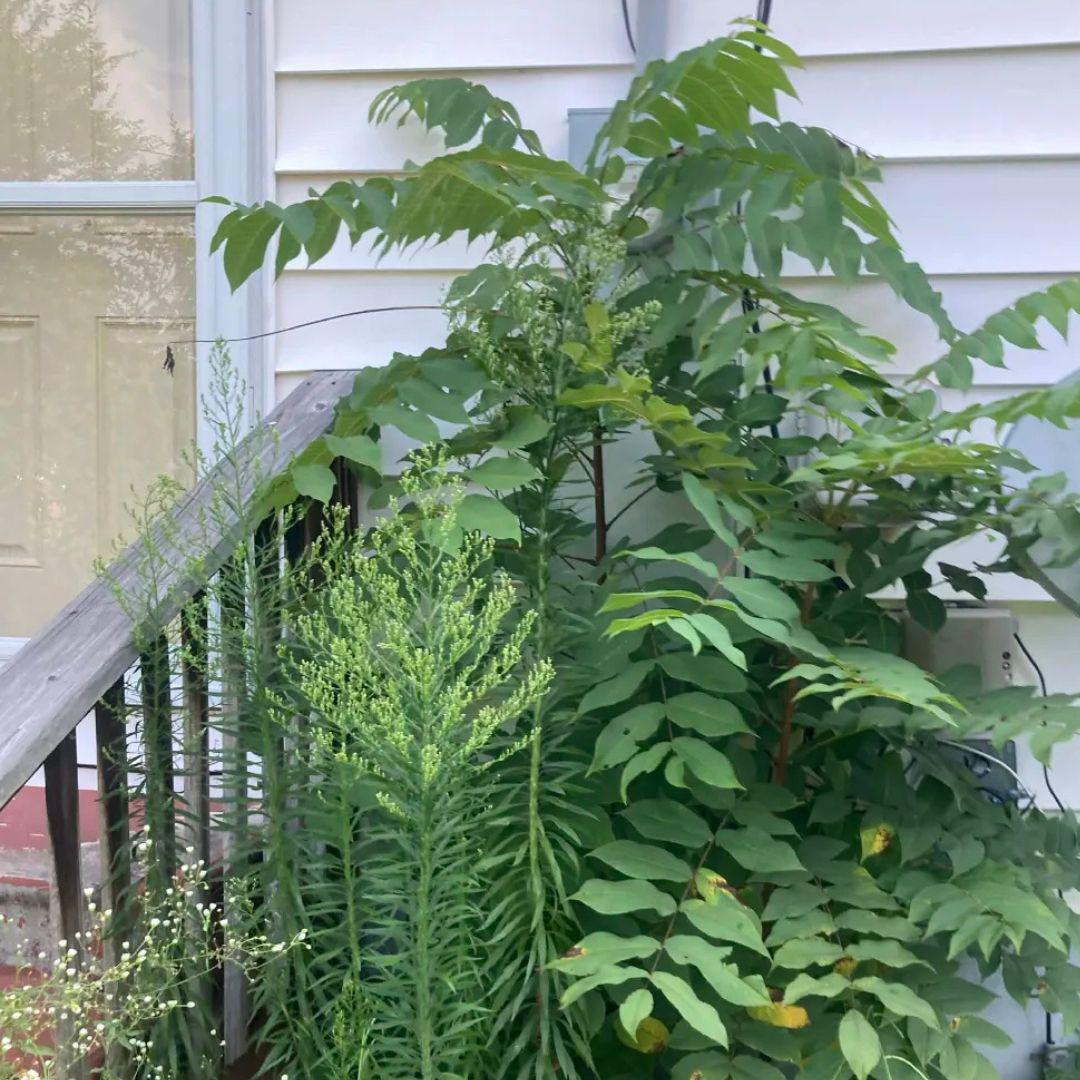
The Ohio Department of Agriculture names tree of heaven as the primary host for spotted lanternfly. It is an invasive tree in its own right, and where it grows in quantity, lanternfly numbers follow.
Where it grows is the useful part for you. UConn's integrated pest management program notes that tree of heaven is not shade tolerant and colonizes primarily disturbed and neglected areas, particularly urban landscapes, rights of way, roadsides, and woodland edges. Ohio State's forestry guidance adds that it flourishes with disturbance, throws sprouts six to twelve feet in a single year, and reaches sixty to eighty feet at maturity.
Read that description and picture the parts of your neighborhood nobody maintains: highway cut banks, the strip behind a shopping center, alley edges, rail embankments, vacant lots, and the fence line behind a church parking lot. Michigan's invasive species program notes the root shoots develop into dense thickets capable of damaging sewers and structures, so a single tree becomes a stand quickly.
None of that ground belongs to you, and none of it gets sprayed. Your August count is being set a few streets away, on land nobody is managing.
You can learn the tree in about a minute. Long compound leaves with eleven to twenty-five leaflets, smooth pale gray bark, and a strong unpleasant smell when you crush a leaf or snap a twig. Once you can see it, you will start noticing it on your drive to work.
Black film on the siding comes next
Honeydew does not stay clear. Kentucky Extension is direct that it attracts black sooty mold along with stinging insects, both feeding on the same sugar.
Sooty mold is a fungus that grows on the sugar coating rather than on the surface underneath it. It will not rot your deck boards and it will not eat your siding. It does turn everything a dull black, and on light-colored surfaces the change is hard to miss. Once it establishes on the leaves of a shrub or a small ornamental, it blocks light and the plant declines from shading rather than from anything the lanternflies did to it directly.
The surfaces that show it worst in this market are the ones you care about most, meaning painted rails, composite decking, light stone patios, and any vehicle left under a canopy overnight.
You can wash it off. Most homeowners in Madeira and Terrace Park find soap, water, and a soft brush handle it fine, and pressure washing is usually more force than the job needs. The frustration is that it returns inside a week, because the source above it never stopped producing.
Timing on the cleanup matters more than the method. Washing in early summer buys you a clean surface for a few weeks. Washing in late October, after the adults have died off and the dripping has stopped for the year, gives you a deck that stays clean until the following August. If you are only going to do it once, do it after the first hard freeze.
On the larger wooded properties around Indian Hill, the mold often shows up on pool furniture and pergola beams before anyone has spotted a single insect.
Yellow jackets follow the sugar to your deck
This is the part that ends outdoor use, and it is why most people finally pick up the phone.
Free sugar sitting in open air is exactly what late-season wasps are hunting. The University of Kentucky's Boone County horticulture agent has warned publicly that lanternfly honeydew draws stinging and biting insects into an area, and Kentucky Extension lists stinging insects alongside sooty mold as a direct consequence of a heavy feeding population overhead.
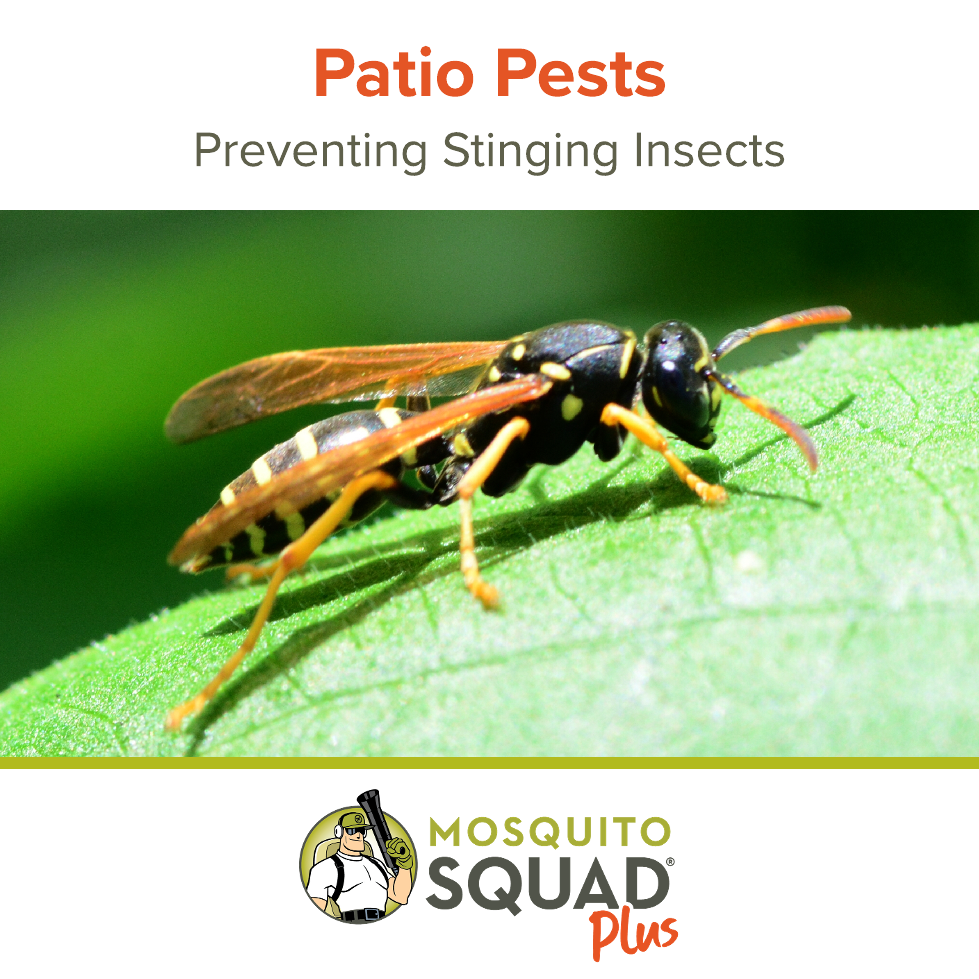
August and September are already your worst weeks of the year for wasps, hornets, and yellow jackets in southwest Ohio. Colonies hit peak size, workers shift toward sugar, and they get bolder about coming to where you are sitting. Add a canopy dripping syrup onto your deck and you have built them a feeding station.
Most homeowners never connect the two. The call we take describes a sudden yellow jacket problem with no visible nest anywhere on the property, and frequently there is not one to find. The insects are commuting in for the food. Our Cincinnati hornet guidance covers the nesting side of that season, but a honeydew problem will not respond to nest work. You would be treating a symptom while the buffet stays open.
If you have something planned outdoors in that stretch, the practical move is to get the honeydew off the hard surfaces two or three days ahead rather than the morning of. A freshly washed deck stops drawing traffic within a day or so. A deck washed an hour before guests arrive is still covered in the wasps that were already working it.
Families in Blue Ash and Loveland with kids and a pool tend to reach that point fast.
Nobody carried a lanternfly into Ohio on purpose
These are weak fliers. They hop well and they glide, and left alone they would spread a few hundred yards a year. What moves them across a state is you, and everyone else with a vehicle.
Females lay eggs on hard flat surfaces, and they are indifferent about which ones. They will use railcars, truck trailers, boats, campers, patio furniture, firewood, landscape stone, and nursery pots. A mass glued to a wheel well in Reading in October can hatch four hundred miles away in May. That is how the insect reached Ohio from Pennsylvania, and it is why isolated pockets keep appearing in places with no tree of heaven anywhere nearby.
The quarantine exists for that reason, and it helps to know what it does and does not ask of you. Ohio's statewide order regulates commerce. Trees and nursery stock leaving the state need an inspection certificate or a compliance agreement, which puts the obligation on growers and shippers. It does not restrict you from moving your own grill across town or hauling your boat to Mount Healthy.
What it does ask is a habit. Walk your vehicle before a long trip in fall, particularly the wheel wells, bumpers, grill, and roof rack. Check the underside of anything you are hauling. If you buy landscape stone or a pallet of pavers in autumn, look at the wrapping before it comes off the truck.
That habit matters more here than in most places, because you are surrounded by interstate corridors and rail. Properties near the freight lines through Evendale and the industrial edges of the Mill Creek valley sit on the delivery route whether or not anyone chose that.
What Cincinnati homeowners try first
Stepping on them works and accomplishes almost nothing. Adults jump hard and fly well enough to reach the canopy, and the ones you can catch are a rounding error against a population feeding forty feet over your head.
Sticky bands around trunks do catch nymphs climbing up. Penn State, which has managed this insect longer than anyone in the country, publishes a management calendar worth reading before you wrap anything, and any band you put up needs wildlife screening over it so birds and squirrels do not get caught in the adhesive.
Dish soap sprays are the other kitchen remedy that circulates every August. They kill what you hit and nothing else, they have no residual, and repeated applications will damage the plants you are spraying. As an afternoon's satisfaction they are fine. As a plan for your yard they are not.
Reporting is the guidance that has changed. When Ohio moved to a statewide quarantine on February 17, 2026, covering all eighty-eight counties instead of the previous eighteen, the state also stopped asking residents to report sightings. Hamilton County had already been on the old list for years. Any page telling you to photograph and submit is running on retired instructions.
Cutting the tree down is where people land next, and it backfires. Ohio State is explicit that cutting alone produces stump sprouts and root suckers in quantity, so an untreated cut multiplies the stand instead of removing it. The National Invasive Species Information Center covers why it resists removal once established. If the tree stands on your lot, that is an arborist conversation and a herbicide plan, not a Saturday with a chainsaw. If it stands on somebody else's lot, it is not your decision at all.
October through April is when you get leverage
Everything above describes a season you have already lost. The window where you can move the number sits on the other side of the calendar, in the months nobody thinks about this insect.
Adult females lay egg masses in fall, thirty to fifty eggs each, on hard vertical and flat surfaces. Tree bark, yes, but also the underside of your grill lid, the back of a shutter, patio furniture stacked against the garage, a boat cover, a trailer tongue, the wheel well of your car. Fresh masses look like a smear of gray putty. Weathered ones look like cracked dried mud, and most people walk past one a dozen times without registering it.
Those masses sit through winter and hatch in spring. Scraping one into alcohol or soapy water kills the entire cluster, and winter is the best time to do it because the population is stationary, the leaves are down, and you can see what you are looking at.
Fifty eggs sounds small. It is not, in a region still climbing rather than leveling off. University of Kentucky entomologists reported in July 2026 that northern Kentucky populations have grown larger faster than expected, and credited populations arriving from Cincinnati and southern Indiana as part of the reason. Boone County Extension has tracked the buildup from three confirmed locations in 2024 to sightings across the whole county the following summer.
Where to look on your own property is fairly predictable. Start with anything that has a sheltered underside and has not moved since September: stacked furniture, the lip beneath a deck rail, firewood, downspout brackets, the back face of a fence board. Then check the trunks of any maple, walnut, willow, birch, or sycamore you have, because those are the trees the adults feed on once the tree of heaven nearby gets crowded.
Every mass you scrape in January is a subtraction from an August you have not lived through yet. Homeowners across Symmes Township and Sharonville who walk their own outdoor storage in December are doing more for next season than anyone stomping in September.
What spotted lanternfly control in Cincinnati looks like in season
Treatment for this insect runs through Barrier Treatment Plus, built to reach lanternflies at every life stage. It helps kill on contact and keeps deterring for up to twenty-one days, and that lines up cleanly with the twenty-one day cycle our Cincinnati routes already run.
Placement is where the job differs from mosquito work. For mosquito control in Cincinnati we are treating resting habitat, the shaded undersides of foliage where adults wait out the day. For lanternflies we are treating arrival and feeding surfaces, meaning trunks, your property-line trees, the vertical structures they land on, and the perimeter they cross coming in from whatever stand is producing them.
That coverage comes packaged rather than sold on its own. Squad Home Shield includes Barrier Treatment Plus and runs year round across the structure and the yard. Complete Home and Yard carries that same coverage out across the entire yard, a better fit for larger or heavily wooded lots where your tree line is doing the work. Both address the wasp pressure the honeydew creates, so you are not booking two separate problems that share one cause.
Timing beats volume here. Nymphs hatch in May, and a program already running when they start climbing does considerably more than one that begins the week your table gets sticky. That is the same reasoning behind treating Blue Ash in April instead of July, and it holds for this insect harder than for most.
We serve Deer Park, Fairfield, West Chester, and Springdale.
Coverage runs on both sides of the river, including Silver Grove and the Kentucky communities where the buildup has been steepest.
Call (513) 839-5026 or request a quote online. Before anything gets treated, we walk your property and tell you what is feeding over it. You can read what customers say, and every visit carries our satisfaction guarantee.