How to Tell Which Mouse Got Into Your Cincinnati House, and Why It Changes the Fix
Posted by Mosquito Squad Plus
August 28, 2026
The mouse you heard in the wall last night belongs to one of two species, and they are not close relatives. One of them has lived inside human buildings for thousands of years and has no real life outside of them. The other one lives in the woods behind your property and came in because the nights got cold.
They look similar enough in bad light that almost nobody separates them. They get caught in the same snap traps. They leave droppings you would need good light and patience to tell apart. And they call for two different responses, because one of them is a structural problem with a source you can find in an afternoon, and the other is a property problem attached to habitat you do not own.
We have been handling pest control in Cincinnati since 2013. Rodent calls are where the wrong assumption costs a homeowner the most time, and the assumption almost always happens in the first five minutes.
Mus musculus came over on ships and never left
The house mouse is not native to North America. It arrived with European settlement and it now lives year round in homes, food establishments, and other structures, which University of Kentucky extension describes as a species remarkably well adapted to exactly that arrangement. It does not need woods. It does not need a field or a creek. It needs a wall, a void, and something to chew.
The white-footed mouse is native, and it needs cover. Ohio DNR describes an animal with upperparts running pale to rich reddish-brown, a white belly, and white feet, at home in brush and deciduous woodland. UC IPM states the consequence directly: because these mice prefer forests, grasslands, and agricultural ground, they are not normally found in urban and residential areas unless fields, forests, or other suitable habitat surround them.
Hold that last clause against a map of what we cover. Suitable habitat surrounds a great deal of it.
Stand in Norwood, where the housing runs unbroken for blocks and the closest real woodland is a city park, then drive twenty minutes to a wooded lot in Indian Hill where the tree line starts thirty feet from the back door. Same county. Same winter. Different mouse.
Tail color settles this faster than anything else
You get about two seconds of a look, usually in a basement, usually with poor light behind you. Two seconds is enough if you know where to point them.
The tail carries the answer. Extension guidance puts house mice as uniformly gray, tail included, with no dividing line between the top of the animal and the bottom of it. The white-footed mouse has a bicolored tail, dark above and white below, along with the white feet and white underside that give the species its name.
Everything else supports that first read. UC IPM notes house mice have almost furless tails and a flat gray-brown coat, while white-footed mice show visibly larger eyes and ears. Extension sources also point out that the native species lacks the musky odor a house mouse population produces. You register that difference immediately if you have ever emptied an infested drawer.
The nest tells you something too. A white-footed mouse builds a rounded nest of dried grass, leaves, and moss, and tucks it into a stored box, a shed, a grill cover, or equipment nobody has moved since spring. House mice shred whatever sits closest and build inside the void itself.
Breeding tells the two apart over a season. House mice produce 6 to 10 litters continuously through the year, indoors, with no off switch. An ignored house mouse problem compounds fast for that reason alone. Ohio DNR puts the white-footed mouse at two to four litters a year inside a breeding season that runs March through June. One species is on a calendar. The other one is not.
There is one more difference nobody needs but everybody enjoys. Ohio DNR notes that white-footed mice drum on a hollow reed or a dry leaf with their front paws, fast enough to produce a long musical buzzing. If you have ever stood in a quiet garage in October and heard something that sounded less like scratching and more like a tiny snare drum, that was probably not your imagination.
None of this asks you to catch anything alive. It asks you to turn the animal over before you throw it out, a small enough favor to ask of your evening.
House mice do not travel
Twenty-five feet is close to the whole story on a house mouse job. University of Kentucky extension puts their foraging range at 10 to 25 feet from the nest, and notes that where food and shelter are both adequate, that range may come down to a few feet.
Sit with the size of that. A mouse working your kitchen at night nests inside a bubble roughly twenty-five feet across, centered near wherever you are finding evidence. Whatever feeds it and whatever shelters it both sit within a short walk of the droppings on your counter. The answer sits inside a space you could pace off in roughly eight steps.
That single number rewrites the search. Homeowners tear apart a whole basement looking for a point of origin when the productive move is to work outward in a tight circle from wherever the sign is heaviest. It also explains why traps set in the wrong room catch nothing for a week while the problem gets worse, and why professionals place devices where activity is already obvious rather than spreading them evenly.
The same source records a second habit that changes how you read the evidence. House mice are nibblers, and one animal may make 20 to 30 separate visits to different food sites in a single night. A population leaving a startling volume of droppings can turn out to be a very small number of animals working very hard. That is better news than most homeowners expect when they call us, and it is one of the few times we get to walk into a kitchen and downgrade somebody's estimate of their own problem.
Two more behaviors decide whether your traps earn their keep. House mice are inquisitive and will investigate each new object placed in their foraging territory, so a device that catches nothing in three days is usually a device in the wrong place rather than a device the mice outsmarted. Move it. They also prefer seeds and cereal grains and go after foods high in fat and protein. Peanut butter has outperformed cheese in every kitchen in America for a century on the strength of that preference.
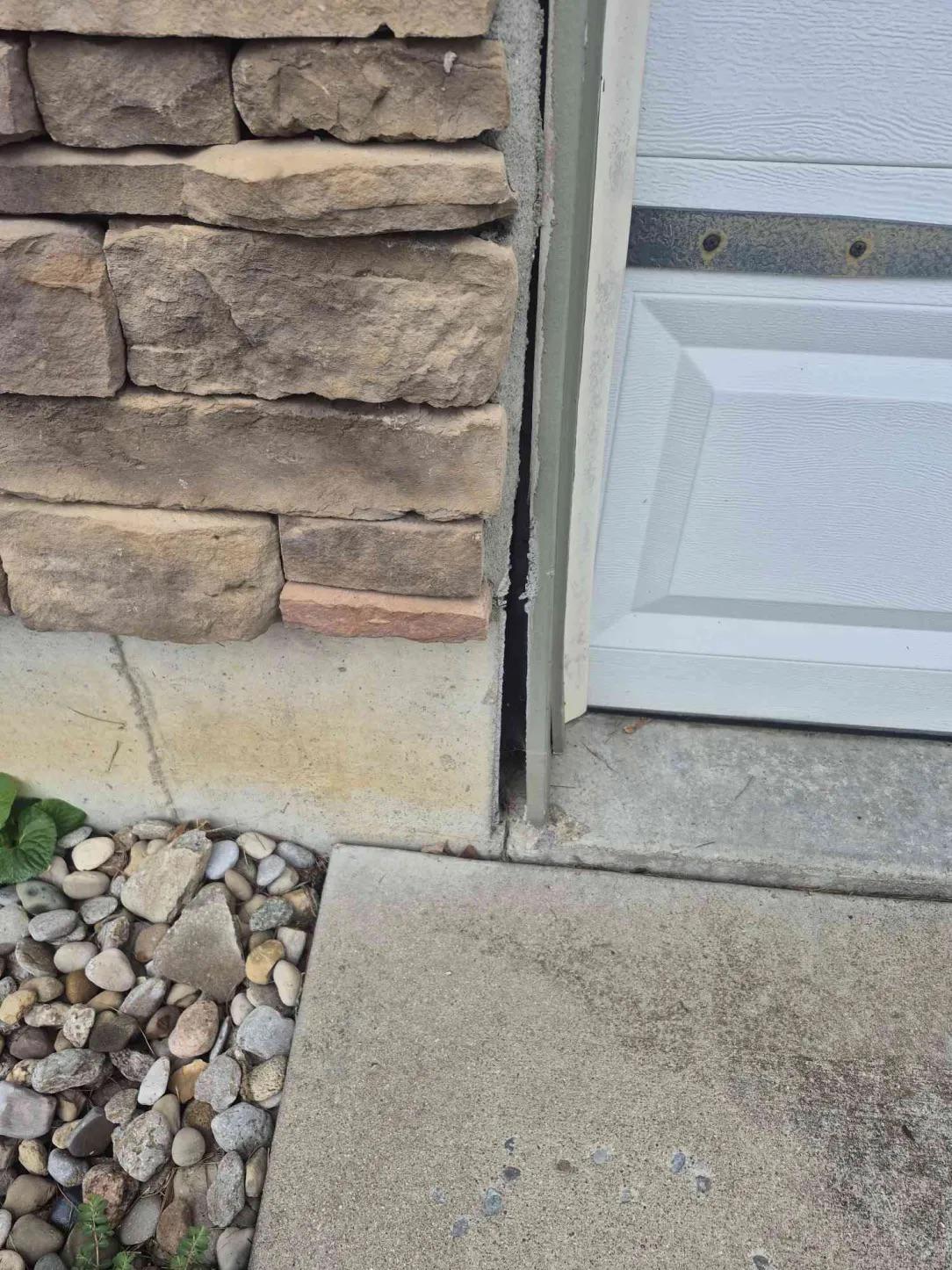
Entry is the other half. Mice pass through openings narrower than the diameter of a dime, and foundation cracks a quarter inch and wider are worth sealing. On the older housing stock in Reading and Deer Park, that describes a lot of block wall. This is the same structural picture we laid out for roaches and mice in Hyde Park, where the driver is a commercial food supply rather than a species question.
Four acres is a reasonable territory for a white-footed mouse
Now flip to the other animal, because the numbers invert.
Extension wildlife damage management guidance puts the home range of white-footed and deer mice at one third to four acres or larger, with summer densities reaching roughly fifteen mice per acre. That is not a bubble. That is a working territory that contains your house, your neighbor's fence line, the wooded strip behind both of you, and several other structures.
Your garage is a stop on that circuit. Not a residence, a stop. Which is why the homeowner in Terrace Park or Symmes Township who traps six mice in a week and thinks the job is finished gets three more the following week. The trapping worked. The territory refilled it, the way a parking space refills.
These mice also climb well, which surprises people who picture a mouse as a floor animal. They nest in trees, in stone walls, in old bird and squirrel nests, and they will run vertical pipes without difficulty. Attic activity on a wooded lot in Loveland or Day Heights is far more likely to be this species than a house mouse that somehow found the roof.
So the fix moves outward. Interior trapping still has a job to do, but on these properties it is maintenance rather than resolution. What changes the number is sealing the structure and treating the edge where the yard stops being lawn.
Only one of these mice puts ticks in the conversation
Every blacklegged tick larva hatches clean. They acquire the bacterium that causes Lyme disease from the first animal they feed on, and Ohio State University Extension identifies what those first meals usually are: in their larval and nymphal stages these ticks take their blood from small rodents, white-footed mice and chipmunks above all. The white-footed mouse is the principal reservoir for the pathogen across the eastern United States. That is where a mouse question becomes a tick question, and it is why a mosquito and tick company has opinions about your rodents.
That is one species doing two jobs on your property. The animal in your shed is also the animal maintaining the infected tick population in the cover behind it.
The Ohio picture has moved fast. The same OSU factsheet reports blacklegged ticks now established in 61 Ohio counties and reported in nearly every county in the state, with Lyme disease cases rising 17-fold over the past decade according to the Ohio Department of Health. Ohio State researchers following the state's first established tick population have since found infection prevalence climbing sharply in both ticks and the small mammals that host them.
One boundary on that last study, stated plainly because it matters. That fieldwork was done in Coshocton County, not Hamilton County, and those specific prevalence figures describe that site and not your yard. What it establishes is that the reservoir cycle is running in Ohio at levels comparable to states that have dealt with Lyme for fifty years. We are not going to translate someone else's county into a number for your back fence.
One thing that helps, since this is the question we field most: ticks do not drop out of trees. OSU Extension describes them climbing low vegetation, roughly zero to three feet off the ground, and latching on when something walks through it. That puts the risk in your lawn edge, your leaf litter, and your ground cover instead of overhead, and it means the habitat you can reach is the habitat that matters.
The practical version is simpler. If your mouse is the woodland species, tick control in Cincinnati belongs in the same conversation as your rodent work, because both problems live in the same twenty feet of habitat. The habitat work is the same ground in both cases, and we went further into local tick pressure in our posts on rising tick bite ER visits and the wooded lots of Indian Hill. Rodents also host fleas, a separate headache arriving on the same animal.
You can guess right most of the time from your address
None of what follows is a border. It is a gradient, and plenty of properties sit in the middle of it.
The dense inner ring is mostly house mouse country. Norwood, Deer Park, Reading, Mount Adams, and the interior streets of Hyde Park. Continuous housing, small lots, and older foundations full of the gaps a house mouse needs. We wrote about how tight lots concentrate pest pressure in Deer Park, and rodents follow that same logic.
That word mostly is doing real work, because the inner ring has exceptions and they run along the big parks. Ault Park pushes wooded ravine right against the eastern edge of Hyde Park, and the streets facing it behave nothing like the streets six blocks in. We took that corridor apart in our post on the ticks Ault Park sends over, where white-footed mice and chipmunks live down in those ravines and along the shaded margins beside them. A tight in-town lot facing a park like that is running the woodland problem, whatever the rest of the street is doing.
The wooded east and northeast is the other pole. Indian Hill, Terrace Park, Symmes Township, Loveland, Day Heights, and the parts of Madeira that back onto a ravine. Large lots, real tree cover, and a native mouse population that was there before the subdivision was platted.
Then there is the northern tier, and it runs both. Mason, West Chester, Fairfield, and Sharonville.
Out here you get newer construction sitting on ground that grew corn within living memory, with field edges, fencerows, and drainage corridors threaded between the developments. Blue Ash shows the same split on a smaller footprint. A house on the interior of one of those subdivisions behaves like the inner ring. A house on the outer edge, backing to a mowed field margin, behaves like Indian Hill.
The two problems also arrive on different clocks, and a single fall rodent story never quite fits either of them. The house mouse is frequently already in residence and simply becomes noticeable once you stop running the air conditioning and start hearing your house again. The woodland mouse is a genuine arrival, moving in from cover as the nights turn.
Our first hour on a rodent property goes into looking
Mouse control in Cincinnati splits into two different jobs, so identification comes first and we would rather have the animal than a description of it. If you trapped something, keep it. That one specimen decides whether we are running a tight interior job or a whole-property job, and guessing wrong costs you a month.
From there the walk depends on the answer. On a house mouse property we work close and low: the sill plate, the utility penetrations, the garage door seal and its corners, the block seams, the dryer vent, and the interior spots where warmth and food overlap. Tight circles, heaviest sign first.
On a woodland mouse property we walk the boundary before we walk the house. Where the mowed lawn ends and the cover begins, the fencerow, the woodpile, the shed and its floor, the equipment nobody moved since March. Then the structure, with more attention up high than most homeowners expect, because this animal climbs.
Recurring rodent control in Cincinnati sits inside our Complete Home and Yard program, covering inspection, prevention, trapping, and removal alongside full yard pest management, and it runs $119 a month.
Squad Home Shield at $99 a month is the year round structural program treating the foundation, windows, vents, and entry points, and it is the right call for plenty of properties, though the rodent component lives in Complete Home and Yard. Our Mosquito Barrier Treatment at $87 a treatment is a seasonal yard program and will not touch a mouse in your wall. Better to hear that from us before you sign up than to work it out over a season, and the pest packages page lays all three side by side.
One honest limit. On a property backing to real woodland, nobody can give you a permanently mouse-free yard, and anybody promising one is selling something. We can make your structure unusable to this animal and hold the boundary so that the pressure reaching your wall is a fraction of what it would otherwise be.
If something is moving in your walls, call the Cincinnati team at (513) 813-1058 or request a free quote. Bring us the mouse if you have it. Our Cincinnati reviews will tell you how that tends to go, and every visit carries our satisfaction guarantee.