Rodent Control in Knoxville: Why the Mouse in Your Garage Came From the Trees
Posted by Mosquito Squad Plus
September 2, 2026
Mice turn up in Knoxville garages every fall, and almost everyone treats them as one animal with one solution. Set a trap, seal a gap, wait. Sometimes that ends it. On a wooded lot in Hardin Valley or a ridge property outside Karns, it usually does not, and the reason has nothing to do with how well you set the trap.
Tennessee has several mice that will use your house, and they do not live in the same place, arrive by the same route, or respond to the same work. The Tennessee Wildlife Resources Agency lists the house mouse as one of only five non-native mammals in the state. The mice out in the woods behind your property are the natives. Telling them apart changes where you put your effort, and across the properties we service from Knoxville out to the county lines it changes it a great deal.
Knoxville Has More Than One Mouse
Walk the TWRA small mammal list and you will find golden mice, harvest mice, three deermice, woodrats, voles, and jumping mice, alongside the house mouse and the two rats. Most of them will never see the inside of your house. Three matter for a homeowner anywhere in our Knoxville service area, across Knox, Anderson, Blount, and Loudon counties.
The house mouse is the commensal one. TWRA describes its habitat plainly: usually found among houses, barns, and buildings. University of Nebraska Extension, in its long-running house mouse guide, puts the other half of that fact on the record, noting the species is uncommon in undisturbed areas away from farms and towns. This animal is a building specialist. It did not come down off the ridge in October because the nights got cold.
The white-footed deermouse is the forest one. TWRA calls it one of the most abundant mammals in Tennessee forests, occurring statewide. The wildlife damage literature maintained through the extension system describes the white-footed mouse as preferring wooded or brushy areas. If your back property line is trees, this mouse already lives there, in numbers, and has for as long as the trees have.
Then there is the golden mouse, the one that surprises people. TWRA has it statewide, preferring moist thickets and forest borders with vines and dense underbrush, and describes it building spherical nests of leaves and bark up to fifteen feet off the ground in bushes, vines, or hollow trees. As many as eight will pack into one nest on a cold night. That is an animal that thinks of dense vine growth as housing, and there is a great deal of dense vine growth along the back fence lines of this region.
The Rats Are a Separate Conversation
Two rats show up in Knoxville, and both are on the same TWRA non-native list as the house mouse. The brown rat, also called the Norway rat, works low. Basements, crawl spaces, burrows against the foundation, the ground floor of a garage. The roof rat climbs, so it turns up in attics, along utility lines, and out on limbs that overhang a roof.
The distinction is practical, not academic. A burrow system along a foundation in East Knoxville calls for ground-level work and a hard look at grade, drainage, and what is stacked against the house. Attic activity in a Bearden bungalow with a big silver maple over the roof calls for looking up, at limb clearance and at where the service drop meets the fascia.
Rats also change the urgency. They are larger, they chew harder, and they do more damage to wiring in less time. If what you hear overhead sounds heavier than a mouse, or your droppings are noticeably larger than a grain of rice, make the call rather than buying a trap from the hardware store.
The One That Never Left
Here is what changes your thinking about the house mouse. It breeds indoors, year round, and TWRA notes it can pass through an opening as small as half an inch in diameter. It is also described as highly migratory when conditions turn unfavorable, meaning it relocates within and between structures instead of waiting to be found.
So when a Bearden homeowner tells us the mice showed up in November, the population usually did not arrive in November. It became visible in November. Cooler weather pushes activity toward the heated core of the house, toward the kitchen and the laundry and the water heater closet, and out of the parts of the structure nobody visits. The animals were already resident in the garage, the attic knee wall, or the rim joist.
That distinction matters for what you buy. A single trap under the sink addresses a symptom of an established indoor population. It does not touch the nest, and with year-round breeding the arithmetic runs against you fast. This is the situation where interior work has to happen alongside everything else, and where a few weeks of monitoring tells you far more than a single night's catch.
Older housing stock through West Knoxville, Halls, and South Knoxville gives this species more to work with. Decades of utility penetrations, retrofitted HVAC lines, and settled foundations produce openings that were never on any plan.
What the Woods Send Toward the House
The native mice operate on a completely different logic. They are not building specialists. They are woodland animals with established home ranges, and your house sits inside or beside one of those ranges as a large, dry, warm object with food near it.
University of California's IPM program, in its deer mouse guidance, states these mice are not normally found in residential areas unless fields or forests surround them, and puts a single animal's home range between a third of an acre and four or more acres. That is the practical difference. A house mouse population lives in your walls. A deermouse population ranges across acreage behind you and sends individuals toward your house from a source you do not own and cannot treat.
You can see the pattern in where it happens hardest. Properties in Hardin Valley and Powell where new construction meets standing timber, and the wooded backs around Oak Ridge.
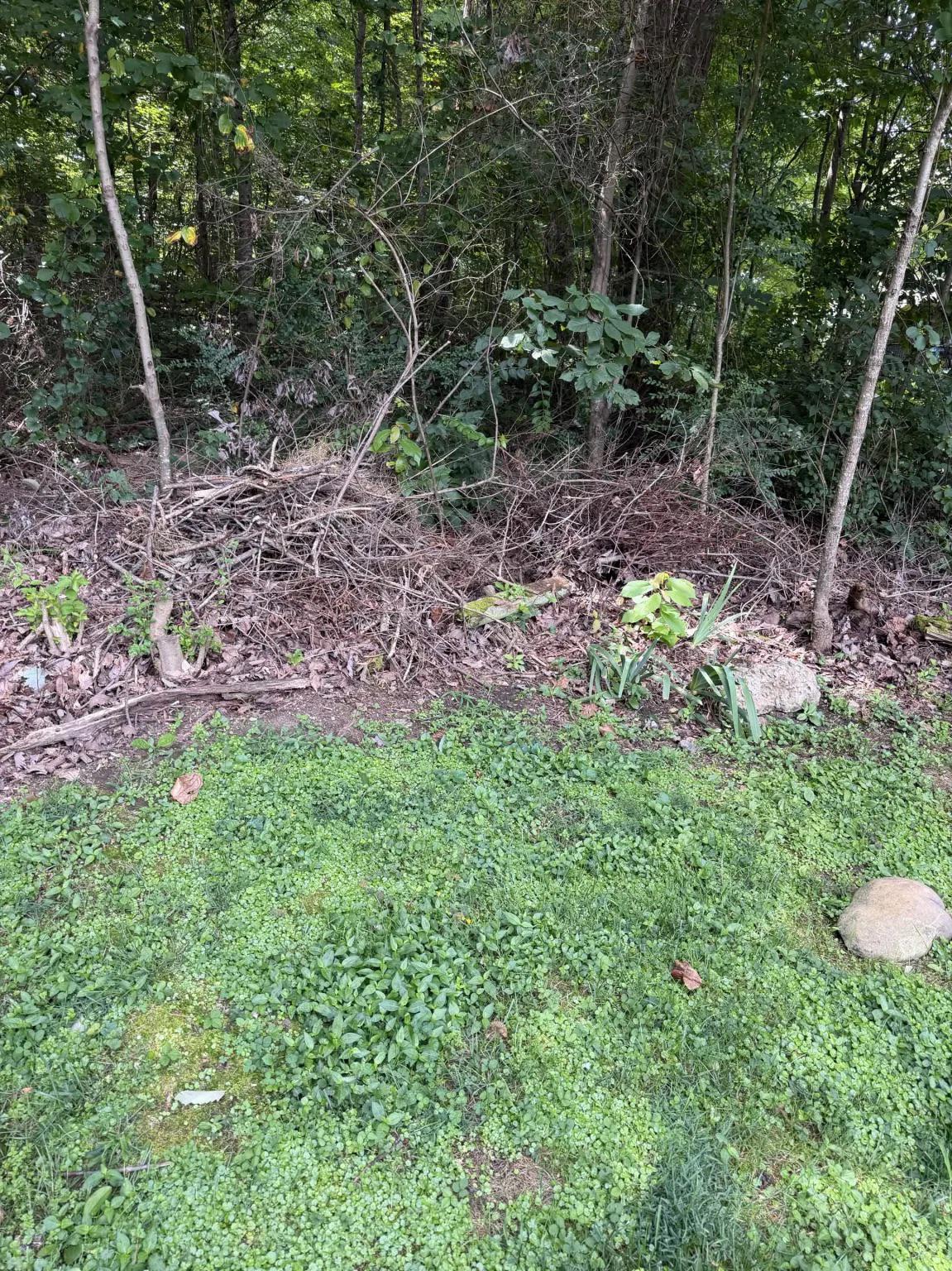
Ridge lots through Karns and the foothill properties toward Maryville run the same way. Wherever the mown line meets the unmown line, there is a population living on the far side of it.
What makes this population different from an indoor one is that it replaces itself without reference to anything you do. A woodland mouse population is tied to seed, mast, and cover across acreage you do not own and cannot treat. Remove twenty animals near the structure and the range behind it still holds the rest, and the ones you removed were occupying space that other animals will move into. That is the loop you get caught in, and it is why the work has to sit at the boundary instead of the sink.
The vine detail is the one to walk outside and check. Honeysuckle, greenbrier, and old grape tangle along a fence line works as nesting structure for the golden mouse and as cover for everything else moving along that edge. A fence line carrying fifteen feet of vine is doing real habitat work on your property, whether or not anyone planted it.
Why Sealing Alone Keeps Failing Out Here
Exclusion is real work and it is worth doing. The EPA's rodent guidance is direct about sealing holes inside and out, and about removing nesting sites like leaf piles and deep mulch from the property. The CDC's rodent control page makes the same point and adds that regular inspection of the outside of a building is how you catch this early.
None of that is in question. What fails is exclusion performed once, on a property with a forest behind it, with nothing done about the pressure arriving at the wall.
Every house here carries a garage door that opens twice a day, a crawl space vent, a dryer vent, a gas line penetration, and a hose bib, and the whole assembly moves and settles through freeze and thaw. Seal it perfectly in September and February will have opened something back up. If a woodland population is testing the perimeter nightly, the failure rate on that seal only has to be small to matter.
Crawl spaces deserve their own mention, because so much of this region sits on one. A vented crawl gives a mouse a warm, dark, undisturbed floor directly beneath the house, with insulation already in place as nesting material and joist bays running like corridors in every direction. Anything that gets into that space has reached the interior of the structure without ever entering a room, and homeowners rarely go down to look until something smells.
Fall exclusion for insects runs on a similar logic, and our lady beetle and stink bug guide covers the wall and seam side of that work for Knoxville houses in detail. Rodents differ in one specific way. The animals keep coming, from a source that regenerates, and they chew. That is also why spiders and ticks on the same wooded edge get handled on the same visit.
What Homeowners Try First
The peppermint oil, the ultrasonic plug-in, the dryer sheets in the glove box. We are not going to be unkind about any of it, because everybody starts somewhere, and the impulse behind it is sound. You want something that works without poison in a house with a dog and a toddler.
UC IPM tested this ground and found commercially sold ultrasonic and frightening devices ineffective at repelling these mice, with chemical repellents not effective enough to justify the cost. The trouble is that repellents assume the animal has a choice it will exercise. A mouse whose home range already includes your foundation is running an established route, and a smell near one end of it rarely rewrites the map.
The single-trap approach has a similar problem. One snap trap set in the most obvious spot competes against every other food source in the building and against a population that may already number well beyond what one trap can turn over. Volume and placement together do the work, and placement is the half you are most likely to skip.
Then there is the poison question, and it deserves a straight answer. Rodenticide placed loosely in a garage or crawl space is a genuine hazard to dogs, cats, and anything that eats a poisoned mouse, including the barred owls and hawks working these neighborhoods. The EPA guidance points toward removing food, water, and shelter before reaching for chemistry. If poison is used at all, it belongs in tamper-resistant stations, placed deliberately, by someone who documents where each one is.
There is also a legal wrinkle almost nobody knows about, and it is the sharpest reason species identification matters. UC IPM states plainly that no toxic baits are registered for controlling deer mice in residential settings, and that using a bait labeled only for house mice, Norway rats, and roof rats against deer mice violates the product label. The box in your garage says what it covers. If the animal on your property is a woodland deermouse, that box is not labeled for it.
The other common outcome is a partial success that reads as a failure. Six mice caught in a week, then nothing for ten days, then two more. That pattern is not a broken trap. It is usually a resident population knocked down while an outdoor population continues to arrive.
Where the Work Happens on a Knoxville Property
Our technicians spend most of a rodent job outside the house. That is the part homeowners find surprising, and it is the part that decides the outcome.
Rodents travel predictably. They run edges, they hug walls, they follow the same routes nightly, and they leave evidence along those routes. So the inspection is a full perimeter walk that reads the whole property, not the building alone. Foundation line and every penetration in it. The garage door corners, the single most common failure point on modern houses out here. Woodpiles, sheds, and outbuildings. The fence line and whatever is growing on it. Where the mown grass stops.
Traps and stations then go where the evidence puts them, on those exterior travel routes, before the animals reach the wall. UC IPM's guidance matches what our crews see: mice run along walls, so a trap set at the wall-floor juncture with the trigger turned toward the wall catches what a trap set out in the open misses, and spacing runs about ten feet apart through active areas. Getting placement right on a runway beats adding volume in the wrong spot, and it is why the photos come back from the fence line and the shed corner rather than the kitchen.
Rodent work sits inside our Complete Home & Yard package, covering inspection, prevention, trapping, and removal alongside the rest of the year-round program. In Knoxville that runs as low as $119 a month.
It also carries the insect side that Home Shield handles on its own, plus Barrier Treatment and Yard Defender through the season. If your interest is strictly rodent control, call and say so and we will talk about what your property needs.
Documentation is the unglamorous half of it. Every station gets a location, every visit gets a check, and the pattern across visits is what tells you whether you are looking at a resident population winding down or a steady arrival from outside. Two weeks of nothing at the fence line and steady activity at the garage corner is a different problem than the reverse, and you only see that if somebody wrote it down.
The frequency is the piece people underrate. We are on a property far more often than a quarterly competitor, which means a station that has gone quiet gets noticed in weeks rather than seasons.
Reading the Evidence Before You Call
You can do a useful amount of this yourself, and it will make the first conversation better.
Droppings tell you the most. The CDC notes rodent droppings are pointed at one end and often contain hair, and that they collect where rodents travel, not where people tend to look. Cabinets, drawers, the back of a pantry shelf, along the top plate in a garage.
Gnaw marks on wire, plastic, and wood are the second signal, and fresh gnawing is lighter in color than old. Sound is the third, and its timing tells you something. If you hear overhead scratching after dark that travels along a line, you are hearing a route, not a nest.
Rub marks are the signal most people miss. Rodents running the same route repeatedly leave a faint greasy darkening along baseboards, joists, and pipe runs, and that smear maps the route better than any single dropping does. Follow one and it will usually take you to a hole.
Pay attention to the dog, too. An animal that suddenly fixates on the base of a cabinet, a dryer, or one spot on a garage wall is often responding to something behind it, and that is worth checking before you dismiss it.
Then walk the outside. Look at the garage door corners with the door closed. Look at every place a pipe, wire, or line enters the wall. Look at the crawl space vents. Look at where your grass stops and something else begins.
When This Season Starts in East Tennessee
Fall is when people notice mice, and fall is later than when the work should start. By the time you are hearing something overhead, an established population has had a productive summer.
Late summer into early September is the right window across Farragut, Concord, Clinton, and Lenoir City. That timing puts exterior stations on the runways before woodland pressure builds and before the first cold nights concentrate everything toward the structure.
It also overlaps with the rest of what a Knoxville property needs. Mosquito control in Knoxville runs into October most years, and the wooded edges holding the mice are the same edges holding the ticks. Rodent control in Knoxville is the piece that carries through the winter after everything else has quieted down.
We have been treating properties across this region since 2019, and no two of these lots read the same from the street. Nothing about a wooded ridge lot in Oliver Springs matches a flat subdivision lot in Alcoa, and pest control in Knoxville should reflect that. Call (865) 625-0015 or get a free quote, and the walk starts at your property line instead of your kitchen.