Why Boxelder Bugs Cover Your Dayton House When There Is No Boxelder Tree in Sight
Posted by Mosquito Squad Plus
September 2, 2026
Boxelder bugs land on the same wall every September, in numbers that look like they came from nowhere. Black bodies, three red stripes across the back, packed shoulder to shoulder on warm siding by mid-morning. You go looking for the source, because that is the reasonable thing to do. You walk the property line. You look at every tree in your yard and every tree in the neighbor's yard. Nothing you find matches what a boxelder tree is supposed to look like, and by the end of the walk you have written the bugs off as a fact of Ohio autumn.
There is a tree feeding them, and there is a fair chance you already walked past it twice. It might even be one you looked directly at and ruled out.
The reason this search fails so reliably comes down to a piece of botany almost nobody explains to homeowners. Once you have it, the problem gets much easier to solve, and it changes when you should be treating. That timing shift is the part that saves you a fall, and it is the part most pest control in Dayton advice skips entirely.
Two Identical Trees, and Only One Is Your Problem
Boxelder is dioecious. Male flowers and female flowers grow on completely separate trees, a defining trait of the species according to the Ohio Department of Natural Resources. Two boxelders can stand twenty feet apart, same height, same bark, same leaf, and be doing entirely different things.
That distinction carries the whole problem, because these insects eat seeds. Ohio State University Extension is direct about it in its boxelder bug factsheet: the bugs draw their food from seed-bearing female boxelder trees, and they take nothing from male trees at all. The University of Kentucky's entomology factsheet reports the same reliance on seed, noting the bugs are rarely found on males. The University of Minnesota puts a date on the movement, describing how the bugs shift to female trees starting in mid-July to lay eggs on trunks, branches, and leaves.
So the question was never whether a boxelder tree stands near your house. Plenty of properties in Kettering and Centerville have one and never see a bug on the siding. The question is whether there is a female one. A male boxelder is a tree. A female boxelder is a food supply.
North Carolina State Extension puts the practical version plainly. When homeowners get hit year after year, the usual explanation is a female boxelder standing in the yard or somewhere nearby. That is a far smaller target than every tree on the block, and it is one you can find in an afternoon.
The sexes separate visibly twice a year. Ohio DNR notes that both flower types appear in early spring, before the leaves emerge, with a wispy lime-green to yellow-green look. Catching a boxelder in bloom in late March tells you what you are dealing with months before the bugs move. Miss that window and you wait for the seeds, covered next.
The Seed Clusters Give the Female Away
You can settle this from thirty feet away, in any month, by checking what hangs in the branches. Seeds outlast leaves by a wide margin, and that makes them more useful than any leaf key you could memorize.
Ohio DNR describes fruit hanging in clusters from female boxelders from summer through autumn and well into much of the winter. Each one is a paired samara, a flat seed with a long thin wing, and they spin like propellers coming down. The useful part is how long they hang on. Ohio DNR lists those dried winter fruits among the tree's liabilities, since they stay up there looking ragged after everything else has dropped.
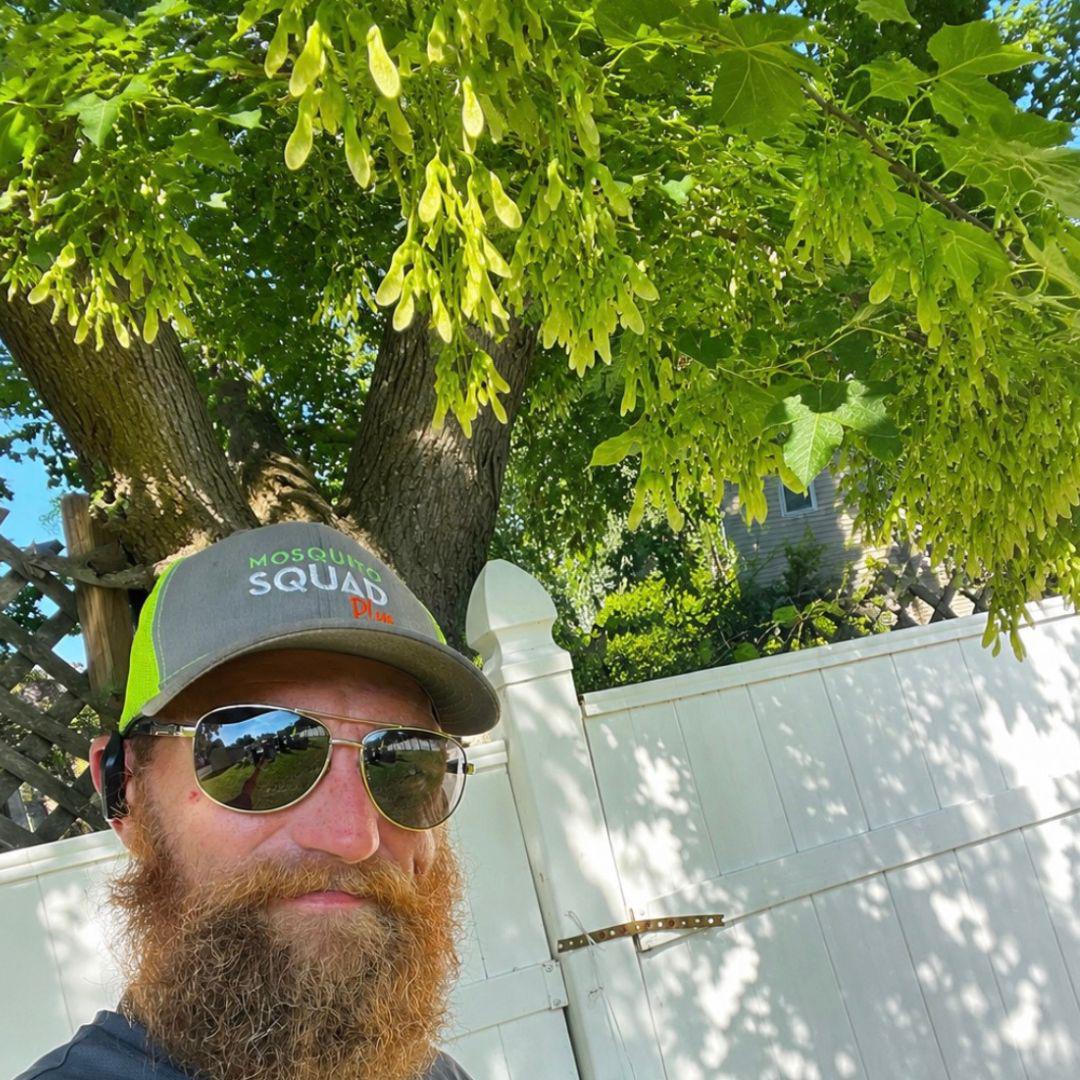
You get a diagnostic that works right now in late August and still works in February. Walk the fence lines and back corners with your eyes up. A boxelder carrying dense clusters of dried, tan, winged seeds is female, and it is your tree. A boxelder with bare twigs and nothing hanging is male, and you can stop thinking about it.
Confirming the species itself takes about ten seconds once you know where to look. Ohio DNR notes that boxelder is the only maple native to Ohio with compound leaves, usually three leaflets on a mature tree and sometimes five or more on young growth, and the tree also goes by ashleaf maple for exactly that reason. One fact explains most failed searches. You scanned for a maple-shaped leaf, and a boxelder leaf does not look remotely like one. The twigs help too, running green to green-purple in winter, sometimes with a whitish cast, on a trunk that rarely grows straight and tends to lean and branch low.
There is a reason your source tree may not have been there ten years ago. Ohio DNR reports that boxelders often live thirty years or less while growing extremely fast through their first fifteen. A seedling in a fence line becomes a seed-producing tree inside a decade, then declines and drops out. Your bug problem can appear and disappear on that schedule without anything changing about your house, so a clean inspection five years back proves very little about this fall.
If an unplanted tree behind a fence line sounds familiar, we covered a different version of it in our post on the lanternfly quarantine, where another volunteer tree drives another pest. Older lots across Oakwood tend to collect these trees along alleys and rear lot lines where nothing gets mowed.
Silver Maple Is the Host Almost Nobody Checks
A second tree sits on the list, and around here it matters more than the first one.
The OSU factsheet states that these bugs also feed on seed-bearing silver maples. Not as a footnote, as a listed host. Silver maple is everywhere in this metro. Ohio DNR describes it as a tree found throughout all of Ohio, a common shade tree in urban areas and a wet-site tree in rural ones. The USDA Forest Service silvics record places it on stream banks, flood plains, and lake edges, growing fast on moist alluvial soils and producing the largest winged seeds of any native maple.
Read those two descriptions together and you have described a great deal of the ground between West Carrollton and Tipp City. A fast-growing shade tree homeowners have planted in yards for decades, that also happens to be a native dominant along every bottomland in the valley.
This is where a lot of people come unstuck. They confirm there is no boxelder anywhere near the house, decide the bugs must be coming from somewhere unknowable, and stop looking. Meanwhile the big soft maple shading the back patio is dropping seed by the thousand. Check it before you give up on the search, especially on lots in Springboro and Xenia where a creek or a drainage cut runs behind the back line.
One honest limit on all of this. No tree inventory exists telling us which Dayton neighborhoods carry more of either species, and the city is only now building one through its urban forest master plan. What the sources support is habitat and host, not a map of your street. Treat it as a description of what to look for on your own lot.
Your Search Radius Is Two Miles, Not Two Lots
Distance explains the rest of the failed searches.
University of Missouri Extension documents that boxelder bugs have been known to fly up to two miles when they leave their host trees hunting for overwintering sites. Two miles covers an enormous amount of ground in a place like Huber Heights or Clayton, where mature trees run continuously across dozens of blocks and no single property owner controls the outcome.
That number reframes what your inspection is for. You are never going to eliminate every seed-bearing tree inside a two-mile circle, and nobody expects you to. OSU says as much, calling host tree removal impractical and unnecessary in most cases. Cornell Cooperative Extension offers a gentler option for a tree you own and want to keep, suggesting you clear fallen seed pods from the ground beneath it or replace it with a male, non-seed-bearing boxelder.
What the search buys you is a treatment map. Knowing the source is a row of silver maples along the creek behind Beavercreek tells us which side of your house takes the pressure and roughly when the migration reaches it. Knowing there is nothing seed-bearing within a mile tells us something different and just as useful. Either answer makes the work more precise than spraying a wall and hoping.
The Treatment Window Opens in Spring, Not September
September feels like the right month to handle this, because September is when you notice it. The calendar that works runs about five months earlier.
OSU Extension states that the best time to treat is spring and early summer, going after young exposed nymphs on the host trees, specifically to prevent large populations and the indoor migration that follows in autumn. Your leverage point sits there, months upstream. By the time adults are massed on your siding, you are managing a population that was set months ago on a tree you may not even own.
Elsewhere in OSU's life cycle notes sits a genuine head start. In autumn, adults and late-stage nymphs congregate in large numbers on the bark of the host trees first, and only then begin migrating toward protected overwintering sites. The tree fills up before your house does. If you know the source tree, you get a visible warning weeks ahead of the first bug on the wall.
The rest of the timeline helps with planning. OSU puts the spring exit from overwintering sites at the last week of March, egg laying in late April and early May, and hatching eleven to nineteen days later. The University of New Hampshire recommends finishing sealing work before September 10, meaning the window is open now and closing fast.
The sheer volume that arrives has its own explanation in the same factsheet. In warmer regions the species runs two generations, with July adults laying eggs that produce a second batch by early autumn, so the group arriving at your wall is the year's compounded total rather than its first wave. And only full-grown adults survive the winter. Nymphs you see on a trunk in August are not going to reach your siding, but the adults they become in September will.
One thing this piece will not tell you is that 2026 is a heavy boxelder year. OSU correlates large populations with long, hot, dry summers, and Ohio has not had one. Most of the state has sat at or near normal moisture through this season. If your wall is loaded this fall, look for a nearby seed-bearing tree rather than blaming the weather. Boxelder bugs also travel in company, so stink bugs and lady beetles usually show up on the same siding in the same weeks.
What We Do on a Dayton Property
We read the property before we treat it, and for this pest that means looking up and looking out well before looking at the foundation. Effective boxelder bug control in Dayton depends more on what stands within a couple of blocks of your house than on anything happening in your own beds and mulch.
On a first walk we locate seed-bearing trees within reach, identify which faces of the structure take afternoon sun, and find the gaps that make your particular house easy to enter. Those three answers rarely point the same direction twice. A 1955 ranch backing an alley full of volunteer growth gets a different plan than a newer build on an open lot with one planted maple out front, even when the two are a mile apart and both call in the same week. Our three rivers post covers how wall exposure sorts out across this valley. The Centerville April post walks the entry-point inspection in detail, so this piece stays on the tree side of the problem.
From there, the overwintering group gets handled as one job. Home Shield is built for the pests that come indoors, running a fall visit ahead of the migration and a spring visit ahead of the emergence. If your trouble is really a perimeter problem, Yard Defender extends an outdoor visit into ants and spiders. The full lineup sits on our pest packages page.
OSU lists housekeeping that costs nothing and moves the needle. Rake leaves, grass, and debris back from the foundation in a strip six to ten feet wide, weighted toward the south and west sides. Confirm that vent screening is sixteen mesh or finer, since anything coarser is a door.
The one approach we steer people away from is spraying indoors. OSU calls indoor insecticide control impractical and difficult, because by the time you notice them the bugs have scattered through wall voids, attic space, and window casings where no spray reaches. A vacuum handles what you can see, and the bag goes straight out. Crushing them stains walls and fabric and releases the odor these bugs are known for, so the reflex to swat is the wrong one. Everything that changes next year's numbers happens outdoors, on the tree and at the wall, months before anything gets inside.
Most households here run an outdoor program through the warm months and add structural coverage in fall. Mosquito control in Dayton works on a 21-day barrier cycle, tick control targets the rough edge at the back of the lot, and spider work tends to ride along with the fall visit. Every community we cover is listed under areas we service.
Four Checks Before the First Cold Night
Give yourself an hour on a clear afternoon and work through these in order.
Start with the seed hunt. Walk your lot line and both neighbors' frontages with your eyes up, looking for clustered winged seeds on any tree with compound leaves and on any large soft maple. Mark what you find. Keep that list. It stays accurate for years.
Second, watch the bark. If you located a likely host, check the trunk on warm afternoons through September. Heavy clustering on bark is your signal that the move to structures is close, and it is the cheapest early warning available.
Third, walk your south and west walls at mid-afternoon while they are warm and the bugs are active. Note every gap you can see daylight through from inside. Soffit seams, gable vents, window casings, and utility penetrations are the usual set.
Fourth, clear the six-to-ten-foot strip at the foundation. Leaf piles, stacked boards, and stone edging all give these bugs a staging area pressed right against the wall you are trying to protect.
If you would rather have someone else walk it, call us at (937) 783-7877 or request a quote. Current pricing and any active promotion sit on our special offers page, our guarantee covers the work, and you can read what Miami Valley homeowners say on our reviews page.