A Dozen Ways In: What One Huber Heights Rodent Job Taught Us About Brick Homes
Posted by Mosquito Squad Plus
October 22, 2026
Reviewed by Brandon Robertson
About a dozen. That's how many separate openings Joey sealed on the outside of one house in Huber Heights a couple of weeks ago. Not a dozen spots he flagged for later. A dozen or so holes he found, stuffed, and closed in one visit, on a house where mice had already moved in under the kitchen sink and through the walls.
Joey runs operations for our northern offices, and he has walked a lot of houses. What stuck with us about this one wasn't the number by itself. It was the kind of house it happened on. A brick house, in a city that built its name on brick.
If you live in Huber Heights, there's a decent chance your house is brick too, and a decent chance you've assumed that makes it hard for anything to get in. Brick is solid. Mice can't chew through it. That part is true. The part people miss is that mice were never planning to go through the brick in the first place.
Here's what that job showed us about rodent control in Huber Heights, why one sealed hole almost never fixes the problem, and what the work actually looks like when it's done right.
Why Mice Still Get Into Brick Homes in Huber Heights
A lot of Huber Heights exists because of one builder. Starting in 1956, Huber Homes put up more than 10,700 brick single-family houses here over about 35 years, and for a long time the city was known as America's largest community of brick homes. Drive the older streets around Brandt Pike and Chambersburg Road and you can still see it. Block after block of brick houses, a lot of them past the fifty-year mark.
That brick is a big reason those houses have lasted. It's also the reason a lot of homeowners here underestimate their mouse risk. When the walls are masonry, it's easy to picture the house as one sealed shell. It isn't. Every house is a shell with holes punched through it on purpose.
Think about everything that has to pass through an exterior wall. The water line. The gas line. The electrical service. The hose spigots. The dryer vent. The bathroom and kitchen exhaust. The AC line set. Cable, phone, satellite, and internet, sometimes two or three generations of each, because a house built in 1965 has been wired for every new service since. Each one of those runs through the brick, and each one leaves a gap around it unless somebody seals it properly. Then add the places where the brick stops: the line where it sits on the foundation, the garage door, the side and back doors, and the spot where a later addition or an enclosed porch meets the original wall.
Some of those gaps were sealed when they were made. Some were sealed once and have since cracked, shrunk, or been pulled loose. Some were never sealed at all, because the person running a cable line in 1998 was thinking about the cable, not the mice.
Mice don't need much. University of California IPM researchers note that house mice can squeeze under a gap a quarter inch tall, and that where mice live outdoors they often move into homes in autumn as the nights get colder. Nebraska Extension adds a detail that matters a lot this time of year: mice are drawn to buildings when they detect openings and escaping heat. A brick wall with a warm draft leaking out around the dryer vent is basically an invitation.
So when Joey found that many openings, it didn't mean the house was falling apart. It meant the house had been lived in. Decades of repairs, upgrades, and patches add up to a lot of small gaps, and mice will test every one of them.
The Job: A Dozen Openings, One Dryer, and a Second Trip
Here's how the Huber Heights job went, as close as we can tell it without giving away whose house it was.
The people living there had a real mouse problem. Not one mouse in the garage. Activity all through the house, including under the kitchen sink, a common spot because of the plumbing that comes up through the cabinet.
Joey started outside, not in the kitchen. He walked the whole exterior and sealed every opening he could find. By the end of that walk he'd closed about a dozen.
One of them was the dryer. The mice had been coming in through the dryer vent and getting into the bottom of the dryer itself, which is warm, dark, and full of lint they can use for nesting. The cover on the outside wall wasn't doing its job anymore, so Joey swapped it for a new one. He told us the part cost about fifteen dollars and took him maybe five minutes. That isn't something every service visit includes. It's what that particular house needed, and it's a good example of how a cheap fix in the right spot can matter more than anything sprayed inside.
The method on the rest of the openings is simple, and the reasoning is worth knowing. Joey packs each hole with steel wool and then seals it closed. His logic is that even if a mouse chews through the spray foam or whatever closes the hole, it can't chew through the steel wool underneath. Every truck on our northern routes carries both, so a tech never has to leave a hole open while he runs to the store.
That approach lines up with public health guidance. The Illinois Department of Public Health describes steel wool mixed with caulking compound as a good plug, finished smooth so mice can't pull it out or chew through the patch. Foam on its own is a different story, and we'll come back to that.
Then came the part a lot of people don't expect. Sealing the house keeps new mice out. It doesn't remove the ones already inside. So the job also included bait inside the house, and since that first visit, the only thing we've needed to go back for is refilling it. That's the normal rhythm of a rodent job done right: close the house first, then follow up on whatever was already living in it.
Not one dramatic visit. A sealed house and a couple of quiet return trips.
Why the Mice Inside Head for the Warm Spots
Once mice are in, they don't spread out evenly. They go where it's warm.
A different job from Joey's week makes the point. This one was in the city of Dayton, a smaller rodent problem, with one detail that stood out. The mouse was living in the stove. Joey took the top off the stove to get to it.
That sounds strange until you look at how mice pick a spot. Nebraska Extension notes that mouse nests usually turn up in sheltered places close to heat sources like water heaters, ovens, and refrigerators, and that appliances that run constantly are favorite den sites. Utah State University Extension says the same thing in fewer words: indoors, mice nest in dark corners, especially behind appliances that produce heat.
In a Huber Heights kitchen, that usually means the space behind and under the range, the void under the dishwasher, the back of the refrigerator, and the cabinet under the sink. In the basement or utility room, it's the water heater and the furnace. In the laundry room, it's the dryer, which is exactly where the Huber Heights mice had set up.
It's also why the droppings you find don't always lead you to the hole. A mouse can come in at a gap around the AC line on the back of the house and nest under the oven at the front. Nebraska Extension notes that mice seldom travel more than about 50 feet from their shelter and food, and a typical ranch house fits easily inside that circle.
What Huber Heights Homeowners Usually Try First
Most people start with what's on the shelf at the hardware store, and most of it does something. It just doesn't do enough.
Sealing the one hole they found. This is the most common first move, and it's why we led with that dozen. Finding a gap and closing it feels like solving the problem. On an older brick house, that's usually one door closed and the rest left open. The mice try the next one, often that same night.
Spray foam by itself. A can of expanding foam is cheap and quick, so it gets used a lot. The trouble is that mice can work right through it. University of California IPM lists insulating foam, rubber, vinyl, and plastic screening among the materials that don't hold up as plugs for holes mice are using. Foam is fine as the seal over something mice can't chew. It isn't the barrier itself.
A couple of traps by the stove. Traps work, and they're a good tool inside. The usual mistake is using too few of them. The Illinois Department of Public Health calls too few traps a common error for people handling it themselves, and recommends spacing them no more than about ten feet apart where mice are active. Two traps behind the range will catch a mouse or two and leave the rest.
Store-bought bait. Bait can knock a population down, but it comes with tradeoffs. A mouse that eats it can die inside a wall, and bait has to sit in a tamper-resistant station anywhere kids or pets can reach it. Illinois public health guidance puts it plainly: if you keep needing bait over and over, the real problem is that the house isn't sealed well enough.
The plug-in ultrasonic repeller. These are popular and they don't hurt anything, but the research isn't on their side. Oklahoma State University notes that mice get used to sounds that don't harm them, and that there's little evidence electronic or sound devices will drive established mice out of a building.
None of these are wrong. They're just aimed at the inside of the house, and the mice keep coming in from the outside.
What Actually Works for Rodent Control in Huber Heights
The order matters more than any single product. On a brick house in Huber Heights, here's how we approach it.
Walk the whole outside first, and keep counting. The goal isn't to find a hole. It's to find all of them. That means every pipe and wire penetration around the foundation, the dryer and exhaust vents, the AC lines, the hose bibs, the garage door edges, the side and back doors, and the seam where the brick sits on the foundation. Oklahoma State calls exclusion the most successful and permanent form of house mouse control, and on these houses it's where most of the time goes.
Close each opening with something mice can't gnaw. Small gaps get steel wool driven in tight, then sealed over so air stops moving through and the plug can't be pulled back out. Nebraska Extension recommends packing larger gaps with copper or stainless mesh and finishing with sealant or mortar to stop the airflow. Anything wider calls for hardware cloth or a metal patch. The test for every patch is the same: if a mouse can chew it, it isn't the barrier.
Deal with the mice already inside. Once the outside is closed, traps and bait stations go where the activity is: under the sink, behind the range, near the water heater, and along the walls the mice are using. Bait stays inside tamper-resistant stations. This is the population that sealing alone won't touch, and it's the reason the Huber Heights job needed return visits.
Come back and check. Return visits aren't busywork. They're where we refill bait, confirm activity is dropping, and look at the seals again. University of California IPM points out that steel wool can rust over time when it's used alone, which is one more reason the plugs get sealed over and looked at again instead of forgotten.
Clean up the right way. If you find droppings before we get there, don't sweep them up or run the shop vac over them. The CDC advises against vacuuming or sweeping rodent droppings because it can put contaminated particles into the air, and recommends soaking them with disinfectant first.
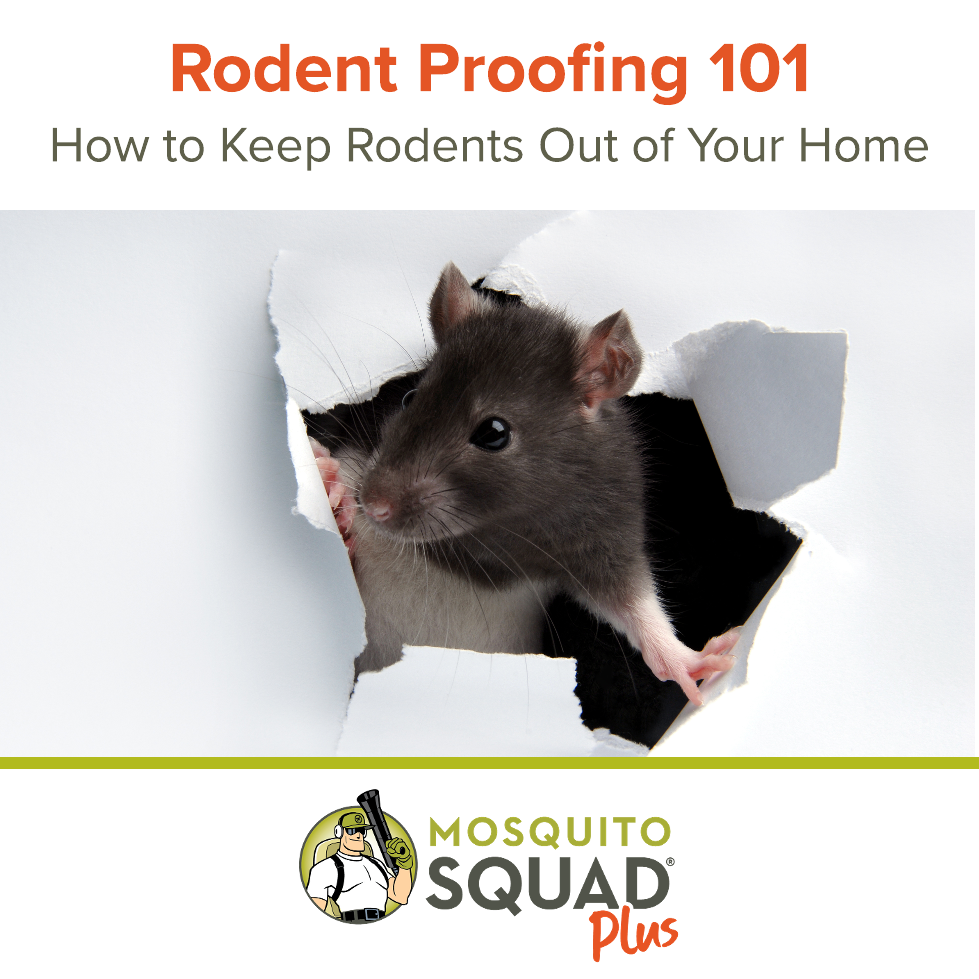
Our rodent control service runs in that same order: inspect, seal, remove, and follow up. For homeowners who want it on a recurring schedule, our Home Shield program handles rodents and also treats for spiders, ants, and the other pests that slip in through those same openings, and Complete Home and Yard adds full yard coverage on top of the structure. If you want to read up before you call, Rodent Proofing 101 covers materials and Signs of a Rodent Infestation lays out the indoor clues. And if the dog food lives in the garage, it's worth reading how pet food and pet waste pull rodents closer to the house.
The same gaps a mouse uses also let in the fall crowd. Spiders follow the insects that come through them, which is why spider control is part of the same structural work. If you've been finding bugs on the window sills this month and can't tell what they are, our ten-second stink bug and lady beetle guide will sort it out.
When to Treat in Huber Heights
The short answer is now. Across the Dayton area, rodents start looking hard for a way inside in late October, and University of California IPM ties that move to colder autumn nights. Sealing a little ahead of that push works better, while it's still mild enough for sealants to cure well and before the mice have picked their spots for winter.
That said, there's no bad time to close an open entry point. A few signs it's time to call:
- Droppings under the kitchen sink, behind the stove, or near the water heater
- Scratching in a wall or ceiling at night
- Shredded paper, insulation, or lint where it shouldn't be, including the bottom of the dryer
- Chewed food packaging in the pantry or garage
- You sealed a hole yourself and the activity didn't stop
That last one is the Huber Heights lesson in a single line. If you closed the gap you found and you're still hearing them, there's another gap. Probably several.
The same logic applies to older houses all over our area, from Fairborn to Tipp City. On the south end of the valley, Kettering's housing stock has its own version of the problem, which we covered in Pest Control in Kettering, Ohio After Sixty Years of Settling. For the spring side of indoor pests, see why pest control in Centerville is an April conversation inside your house. And if the building you're worried about is a business rather than a home, our post on commercial pest control in Dayton and our commercial services page are the better place to start.
A Brick House Can Be a Sealed House. It Just Takes Finding All of the Gaps.
Huber Heights brick has held up for decades, and it will keep holding up. The goal with rodent control in Huber Heights isn't to fix the brick. It's to find every place the house stops being brick, close it, and take care of whatever already got in.
Mosquito Squad of Dayton is veteran owned and family run, and we've been working homes in and around Dayton since 2014. Pest control in Huber Heights is part of that work on the north side of town. You can see what else we do for Huber Heights homeowners on our local page. If you're hearing mice in the walls or finding droppings under the sink, call us at (937) 226-9709 or request a free quote. You can read what our Dayton customers say first, and every visit is backed by our satisfaction guarantee.