Stink Bug or Lady Beetle? A Ten-Second ID Guide for Kettering Homeowners
Posted by Mosquito Squad Plus
October 8, 2026
Walk out to the warmest wall of your house on a clear afternoon this week and look up near the eaves and the window trim. In Kettering right now there's a good chance something is sitting there. Maybe a flat, brownish bug about the size of a fingernail. Maybe a small orange beetle. Maybe a long, lean insect with oddly flared back legs that you've never noticed before.
Those aren't random. Each one runs on its own calendar, they show up in a fairly dependable order, and each means something different for the house. Our tech who covers the Dayton side summed it up on a call this week: this is stink bug season. He's seeing them on just about every route, at about the same levels our crews are reporting in Tennessee and Alabama. Lady beetles come next.
This guide is meant to help you figure out what you're looking at in about ten seconds, then know what that bug is likely to do next. The second part matters more than the first, because the window for stink bug control in Kettering is open right now, and it closes on its own schedule whether anyone does anything or not.
The Order They Show Up In
Most fall pest advice treats "home invaders" as one event. The research doesn't. University of Kentucky entomologists lay out the sequence plainly in their stink bug infestation fact sheet: stink bugs start entering buildings in early to mid September, while lady beetles follow in October and November. A second UK fact sheet on the brown marmorated stink bug narrows the stink bug rush further, placing the heaviest movement into homes from the last two weeks of September through the first two weeks of October.
The lady beetle timing has an Ohio-specific trigger, and it's a strange one. Ohio State's multicolored Asian lady beetle fact sheet cites Ohio research showing the beetles start hunting for winter sites on the first day above 64 degrees that follows a sharp drop, usually to near freezing. In Ohio that combination tends to land in mid to late October. The same sheet notes that large populations often turn up near the end of October, which is how the insect picked up the nickname Halloween lady beetle.
So a normal Kettering fall goes something like this. Stink bugs land on siding from mid-September and peak right about now. Sometime in October a cold night comes through, then a bright, warm afternoon, and the lady beetles arrive nearly all at once. Boxelder bugs and the odd seed bug drift in along the way.
Ohio State's Buckeye Yard and Garden onLine team has the explanation for why some falls feel quiet and others feel like a siege. In a fall invaders update, they point out that the big home invasions tend to follow a long cool stretch that breaks into a real warm-up. The bugs don't fly at your house because it's cold. They fly at it when a warm day finally lets them.
Stink Bug: The One on the Wall Right Now
What it looks like. The brown marmorated stink bug is shield-shaped, wide across the shoulders and narrowing toward the back, about five-eighths of an inch long and a mottled brown-gray. The giveaway is the banding: alternating white and dark bands on the antennae, the legs, and around the edge of the body. Check the antennae first. You don't have to pick it up to see them.
When it shows up. Now. Mid-September through mid-October is its stretch, which is why stink bug control in Kettering is a September and October job, not a November one.
Does it bite, stink, or stain? It isn't a biter. Its mouthparts are made for drawing juice out of plants, and at most one might poke you if you pick it up. It does smell, though, and plenty of people say it smells like cilantro. It can stain, too. Its fecal spotting marks walls and curtains a lot like bed bugs do, and a handled bug can leave secretions that irritate skin. Grab it with a tissue, not bare fingers.
Does it breed indoors? No. The adults that come in for winter haven't mated and don't reproduce inside. Every stink bug crossing the bathroom ceiling in February got in this fall.
Why Kettering gives them so much to work with. Kentucky's entomologists list the landscape trees that carry big numbers of stink bugs through late summer, and the list reads like a walk down an older Kettering block: maple, oak, ash, redbud, honeylocust, crabapple, cherry. The canopy that went in with the postwar neighborhoods, the same one we wrote about in what Kettering's trees and old streets have to do with mosquito season, feeds them all summer. Once they land on a house, they climb. They favor the upper floors, slip in through attics and chimneys, and spend most of the winter in the unheated attic.
Asian Lady Beetle: The One Coming Next
Forget counting spots on this one. The beetle is dome-shaped, about a quarter inch long, and can be anything from pale yellow to deep red with zero to nineteen spots, which is the whole reason it's called multicolored. What doesn't change is the patch right behind the head: white, with a black mark shaped like an M or a W depending on which way you're looking. See that and you know what you have.
About the name. Plenty of people around here call these Japanese lady beetles, and that's a real nickname. University of Minnesota Extension lists it right alongside Asian lady beetle and Halloween lady beetle, though the accepted name is multicolored Asian lady beetle. Where people get tangled up is the Japanese beetle, a different insect entirely. Ohio State's Japanese beetle fact sheet describes a metallic green beetle that comes up out of lawns from the last week of June through July. Green, shiny, and July is a Japanese beetle. Orange, rounded, wearing an M, and October is the lady beetle.
It shows up on that first warm afternoon after the first real cold night, which in Ohio usually lands in mid to late October. And it comes in a wave, because once a few land, the rest follow. Iowa State Extension gives a wider flight window of mid-September through October depending on weather, so an odd year can bring them early.
Inside the house, this is the worse guest of the two. It can bite, usually when one gets caught under a shirt collar, and while it stings a little, it can't break the skin or pass along any disease. Bother one and it leaks a yellow-orange fluid from its leg joints that smells awful and can permanently stain walls, drapes, and carpet. Some people develop allergies to that fluid, even people who've never been allergic to anything.
It doesn't breed indoors either. The ones that wander all the way into heated rooms burn through their fat and starve, which is why dead beetles pile up on windowsills by midwinter.
Why Kettering draws them comes down to trees. These beetles spend the summer eating aphids in wooded areas, and the BYGL team notes that homes near woods become focal points in the fall. That's a lot of Kettering, from the older blocks under full canopy to the lots near Hills and Dales MetroPark along the Oakwood line. There's an odd bit of biology behind it, too. In Asia these beetles winter in cracks on cliff faces and are drawn to strong vertical contrast, so to a lady beetle, the side of your house looks a lot like a cliff.
Purdue's lady beetle publication, E-214, opens on the irony every homeowner feels by November: the insect we're all taught to protect in the garden stops looking so beneficial once thousands of them are crawling around the garage. If that's where you are, our Asian beetle control page covers how we handle them.
The Look-Alikes Mixed In
Boxelder bug. Black, narrower than a stink bug, with red or orange lines down the back. It runs on a different logic tied to seed-bearing trees, which we laid out in why boxelder bugs cover your Dayton house. The quickest tell: boxelder nymphs come inside along with the adults, and stink bug and lady beetle young don't. Little bright red bugs mixed in with the black ones means boxelder. Our boxelder bug control page has the treatment side.
Western conifer seed bug. Long, brown, and slender, about as long as a stink bug but much skinnier, with a flat, leaf-shaped flare on each hind leg. People mistake it for a stink bug all the time, and it doesn't help that it gives off a strong smell when bothered and buzzes loudly when it flies. It feeds on conifer seeds, so houses with big pines or spruce nearby see more of them. Ohio State has even fielded calls from homeowners who mistook them for kissing bugs. They aren't, and they don't feed on people.
You may run into two other things on an outside wall this time of year. A larger gray planthopper with black-spotted wings is a spotted lanternfly, which is its own conversation and is covered in our lanternfly quarantine post. Yellow jackets are also still hanging around, and we explained why they get so aggressive in Kettering this late in the year.
Which One Should Worry You
None of them is dangerous to the house. None eats wood, and none breeds in your walls. What matters is which clock you're on.
The stink bug is the one to act on first, because its window is open this week and it's the one most likely to spend the entire winter in your attic, wandering into living space on warm days well into spring. The lady beetle is the one to plan for next, because it's the worse houseguest once it's inside, between the bites, the staining, and the allergy potential. Boxelder bugs and seed bugs are mostly an annoyance, and the same exterior work covers them.
Why Older Kettering Houses Let More of Them In
None of these insects is trying to reach your living room. They want somewhere cool and sheltered to wait out the winter, and a wall void or attic is perfect. Some follow the warmth one step too far and end up in heated rooms.
How many make that last step comes down to how many openings the house gives them. A house with plenty of cracks and gaps can take in stink bugs by the thousands. Most of Kettering is postwar housing, and decades of settling open exactly the gaps these insects use. We walked through what that looks like, attic vents included, in pest control in Kettering after sixty years of settling, so we won't repeat it here. One number is worth remembering, though. A lady beetle can get through a gap of about an eighth of an inch, which is a lot smaller than most people picture.
Don't Crush, Don't Fog, Don't Zap
Once they're inside, everybody wants to swat. Don't. A crushed stink bug lets out its smell, and a crushed lady beetle lets out that staining yellow fluid. Either one can leave a permanent mark on a wall, a couch, or carpet.
The bug bomb is worse. A fogger doesn't reach the insects hidden in the walls, it fills your house with chemicals for no real benefit, and the dead bugs it does leave behind in the voids become food for carpet beetles and larder beetles. Ohio State and Kentucky both warn against it for exactly that reason.
Two less obvious mistakes. A bug zapper is a bad idea around lady beetles, because the charge flashes their body fluid to steam and sprays it everywhere. And a regular upright vacuum, where everything goes through the fan before the bag, turns into what Ohio State calls a bug blender and leaves the smell living in the machine. If you vacuum, use a shop vac, or slip a knee-high nylon into the hose so the bugs collect in the stocking, then toss it.
What Actually Works: Exterior Treatment Timed to the Flights
The fix happens outside the house, and timing matters more than the product.
Ohio State is specific about lady beetles. An exterior treatment on the siding, eaves, attic vents, overhangs, doors, and windows works best in Ohio in late September or early October, before the beetles try to settle in. Wait until after the first cold snap and the beetles already inside won't be touched. Go too early and the material can wear down before the flights show up, which is why a second round is sometimes needed in a long fall. Stink bugs work the same way: get ahead of them, and plan on a follow-up while they keep flying.
Put those two calendars side by side and the timing is hard to miss. Early October sits inside the stink bug peak and just ahead of the lady beetle window. A treatment now meets the stink bugs landing this week and puts protection on the wall before the lady beetles arrive. For stink bug control in Kettering, that one well-timed visit beats two frustrated calls in November.
On a Kettering house, we start with a walk around the outside, paying attention to the upper walls, soffits, gable vents, window and door trim, and every spot where a line or pipe comes through the siding. That's where these insects gather and where they get in. Then we treat those surfaces. Our stink bug treatment kills on contact and keeps deterring them for up to 21 days. Home Shield is the year-round program built around this kind of work, so the house is covered in fall and again in spring, when overwintered bugs try to find their way back out and sometimes end up in the living room instead. If you want the yard covered too, Complete Home and Yard adds that on top.
Sealing is the other half, and it's the most permanent fix there is. As the BYGL team puts it, an ounce of caulking is worth a pound of bugs. Caulk around window frames and door jambs, replace worn door sweeps and garage door seals, patch torn screens, and check your attic vents. Our Centerville post on spring pest control walks through a full entry-point check if you want the detailed version. Those same openings matter again in a few weeks, because mice start testing them as the nights get colder, and our rodent control page covers that side of the season.
When to Call
If you can see stink bugs on the outside of your house this week, the window is still open. Once they're in the wall voids and the attic, no exterior treatment will reach them, and you're vacuuming until March.
If you had lady beetles last fall, plan on seeing them again, and get the exterior handled before the cold snap that usually brings them in around mid-October. Asian lady beetle control is a lot easier on the siding than in the bedroom.
Not sure what's on your wall? Take a close photo and look for the two tells: banded antennae for the stink bug, the black M for the lady beetle.
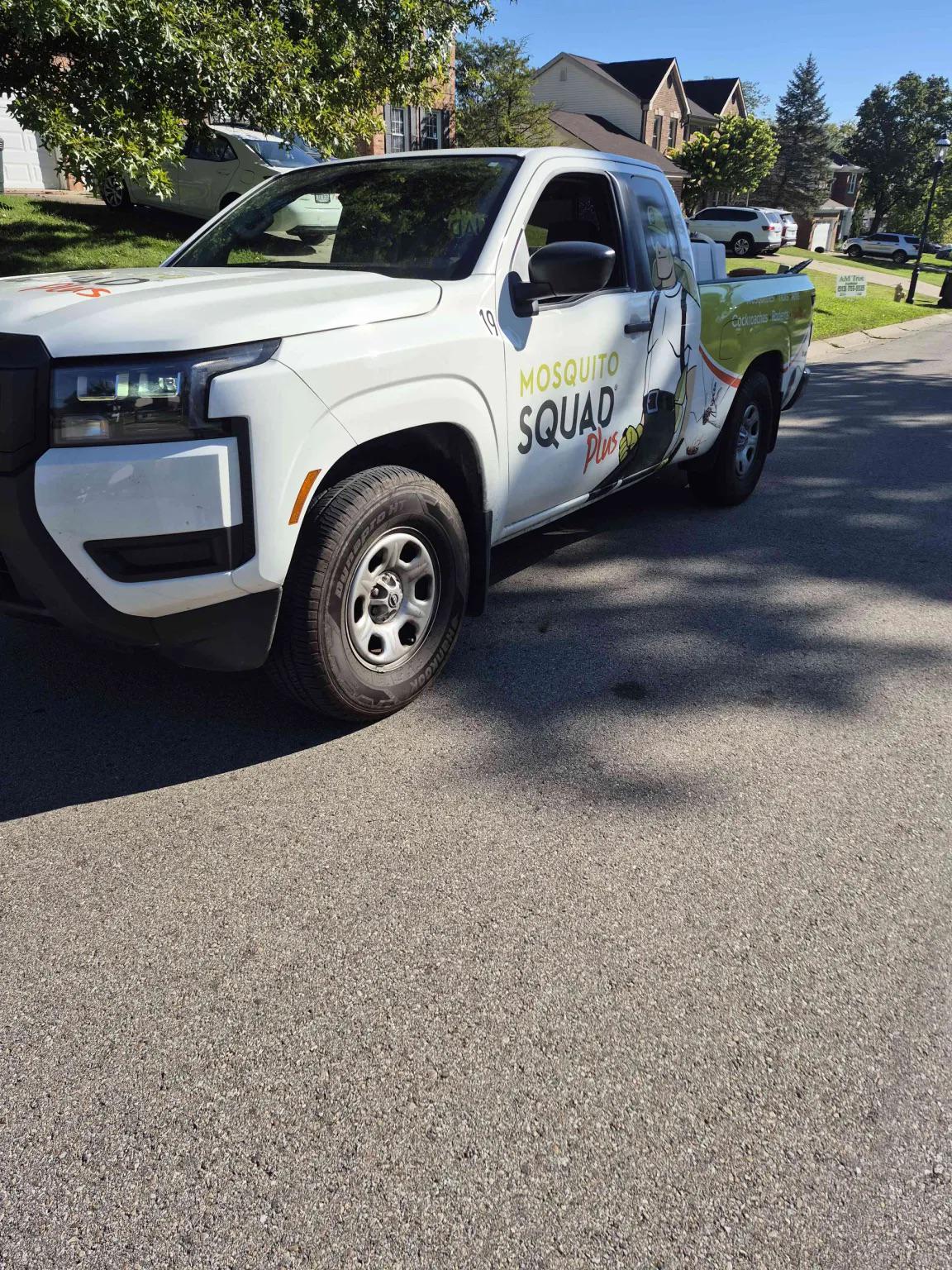
Mosquito Squad of Dayton OH has been treating Kettering homes since 2014, and we work the neighboring streets in Centerville and West Carrollton too. Stink bug control in Kettering is a short, specific job when it's done at the right time. Call (937) 761-2767 or request a free quote, and we'll walk the outside of your house before the next warm afternoon brings in more. Every visit is backed by our satisfaction guarantee, and our reviews are there if you want a second opinion from homeowners around the Miami Valley.