Where the Mosquitoes Biting You at Dusk in Madeira Come From
Posted by Mosquito Squad Plus
August 10, 2026
Mosquitoes find you on a Madeira patio right about the time the light goes flat and somebody gets up to grab a sweatshirt. Not at three in the afternoon while the kids were on the swing set. At dusk, in the same twenty minutes, on the same nights, in a yard where you already dumped the saucers and cleaned the gutters and did every single thing the checklist told you to do. Somewhere near the steps there is a citronella candle burned down to a nub, standing as a monument to the attempt.
I take that call from Madeira every summer, and it always arrives with the same edge of disbelief in it. The homeowner did the work and the work did not hold.
The timing is the answer. What bites you at dusk in Madeira is a different insect from what bites you at noon, and once you know which one you have, you know where it came from. Probably not your yard.
The Two Mosquitoes Biting Madeira Yards
Southwest Ohio homeowners deal with two mosquitoes that matter, and they keep completely different hours.
The daytime biter is the Asian tiger mosquito, which the Ohio Department of Health documents as established across nearly all of southern Ohio. That is the one that gets you at a two o'clock cookout, striped legs, coming at your ankles while you are trying to flip burgers and hold a conversation. It breeds in small containers close to home.
The dusk biter is a different animal. That is Culex, and in Hamilton County it is mostly Culex pipiens and its close relative Culex restuans. These turn up as the sun drops and keep working after dark. They are quieter about it, less frantic, and most people never register that they are separate from the afternoon crowd at all.
So run the diagnostic on your own back patio tonight. If you are getting hit while the sun is still up, look at your own property, because the source is close. If the bites start when the light fades, look past your fence, because you have something that bred somewhere else entirely and flew in to find you.
Our mosquito control routes run from the river up through the northeast suburbs, and the towns behave differently from one another in ways that surprise people who assume a mosquito is a mosquito. Madeira behaves the way it does because of what is sitting under your street.
Why Dumping Your Birdbath Does Not Stop Evening Mosquitoes
Every mosquito checklist you have read tells you to dump the birdbath, empty the saucers, turn the wheelbarrow over, and refresh the pet bowl. That advice is correct and you should keep doing it. Our own walk of a property starts by looking for exactly those things, and the CDC guidance on standing water is blunt about how little it takes.
That checklist was written for container breeders, though, and Culex pipiens does not work that way. It is not looking for the clean rainwater in your saucer.
The Rutgers Center for Vector Biology describes Culex pipiens as a species generally associated with water that has a high organic content, using temporary ground water ranging from mildly to grossly polluted, and it names catch basins and storm drains as ideal habitat. Read that with a Madeira street in mind. This mosquito wants water with something rotting in it: leaf mush, grass clippings, and whatever sediment washes off the asphalt in a hard June rain. The dirtier and more organic the water, the better it works as a nursery.
Your birdbath is too clean for it. The basin at the end of your street is perfect.
That gap never gets explained to homeowners, which is why somebody can do everything right on their own lot in Madeira and still get chewed up at seven in the evening. Adults are the easy part to see and the hard part to solve, and we wrote a separate piece on where the larvae hide for anyone who wants to go a level deeper.
The Mosquito Breeding Sites Under Madeira's Streets
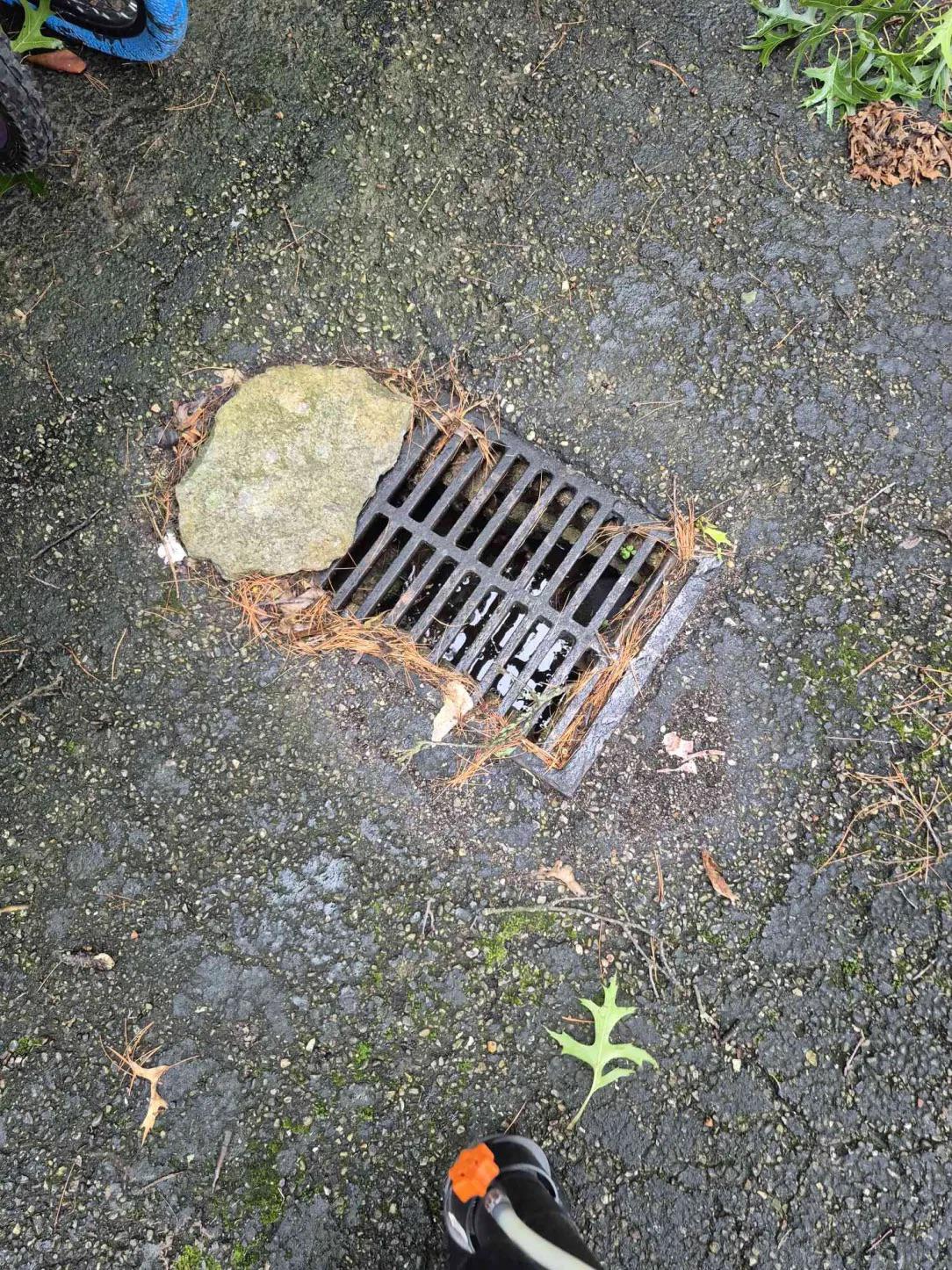
Madeira is a platted suburb with a downtown, curbs, and a real street grid. The city plows and salts 48 lane miles of roadway in the winter, and that road network carries a storm drainage system with catch basins built into it. Those basins hold a standing sump of water at the bottom by design, so sewer gas does not come up through the grate. It is a feature, not a maintenance failure, and it is the reason a basin still has water in it during a dry August.
Water sitting all summer in a dark concrete box, fed by everything that washes off a street, is close to laboratory-grade Culex habitat.
Researchers studying catch basins as larval sites describe catch basins and underground storm drain systems as key oviposition and larval development sites for Culex pipiens and Culex restuans in urban and suburban locales, and note the presence of larvae there is well documented. A separate study of larval abundance in Chicago basins identifies roadside storm water catch basins as important oviposition sites for Culex in urban areas.
Count the corners between your driveway and Miami Avenue. Every one of them is a potential production site, and not one is yours to treat. You could not legally put anything down those grates if you wanted to, and neither could we. That is a strange thing to sit with when the consequence lands on your own deck four hours after sunset.
Out in Indian Hill, a few miles east, the pressure comes off estate acreage and river corridor instead, which we covered in our post on wooded lots and summer bites. Madeira's version of the problem is engineered, public, and running right down the middle of the neighborhood.
Why Madeira Leaf Season Sets Up Next Summer's Mosquitoes
The City of Madeira runs leaf collection by zone from late October into early December, with crews picking up leaves residents rake to the street. The city says plainly that the service helps keep streets clear and prevent clogged storm drains.
Sit with that a second, because it is the most useful municipal fact in this article. A city does not build a seasonal program around keeping leaves out of the drains unless leaves get into the drains. Every basin in town takes on organic material in the fall, some gets collected, and the rest goes down the grate and settles into the sump.
That is the fuel. What decays in the bottom of a basin over winter becomes the high-organic water that Rutgers calls ideal for this mosquito. One autumn's leaf load is part of what makes the following summer's basins productive, which means the mosquito biting you in July has a longer backstory than anybody assumes, and none of it happened on your property.
It also means the pressure resets every year no matter what you do. You cannot rake your way out of it, and neither can the city.
I bring this up with Madeira customers because it reframes what a treatment is buying. Nobody is paying us to solve a water problem. The water problem is municipal, it is seasonal, and it will be back next June whether or not anyone hires anybody. What you are buying is a yard the arrivals cannot use, renewed on a schedule that matches how fast the population rebuilds. Ohio State University Extension makes the same general point about warm-season pests in Ohio landscapes, which is that habitat drives everything and habitat rarely respects a property line. Timing that treatment schedule to the calendar rather than to the thermometer is the whole argument of our Blue Ash timing post.
How Far Mosquitoes Fly to Reach a Madeira Backyard
A basin does not have to be close to bother you, and the distances involved are larger than almost anyone guesses.
Researchers ran a Culex dispersal study by enriching catch basins with a stable isotope, then recapturing the adults that emerged. They calculated a mean dispersal distance of 1.15 kilometers and a maximum flight range of 2.48 kilometers, with ninety percent of female Culex staying within three kilometers of their larval habitat.
Put that in Madeira terms. A mean of 1.15 kilometers is roughly seven tenths of a mile, which is not the corner of your block. That is most of the way across town.
The mosquito on your arm at eight in the evening may have hatched in a basin on a street you never drive down, near a house you have never seen, and flown the distance of a long walk to find you. Your neighbors could all be immaculate. The city could be doing everything right. You would still be getting bitten, because the production zone for a dusk-biting mosquito in a compact suburb is the entire suburb.
Over in Deer Park the math runs the opposite direction, where a town packed into a square mile creates short-range pressure off immediate neighbors. Madeira's dusk problem is long range and fed by public infrastructure, and the same pattern shows up in Sharonville and Norwood, which carry similar street-grid drainage.
Who Treats Madeira's Storm Drains, and What That Misses
Public health departments do larvicide storm drains, and it is one of the more effective tools in vector control, because killing larvae inside a confined basin beats chasing adults across a neighborhood by a wide margin. Hamilton County Public Health runs surveillance and response work across the county, and treating standing water on public property is part of the standard playbook for health departments in this region.
The practical limit for you as a homeowner is scale. Larviciding is a public program on a public schedule, sized to county-wide risk rather than to your Thursday evening on the deck. Treatments are periodic. Heavy rain flushes basins and resets conditions underneath. Coverage gets prioritized where surveillance shows a problem, which means a basin two streets over can go untouched all season if nothing has turned up in a nearby trap.
None of that is a criticism of the county. It is the correct way to run a public health program, and we would not want it run differently. It is simply not a service built to keep one family comfortable in one backyard, and expecting it to be is how people end up frustrated in August after doing everything they were told. We have made the same argument before about why DIY mosquito control fails: both efforts do real work, and neither one is aimed at your property line.
West Nile Virus and Evening Mosquitoes in Hamilton County
Culex pipiens and Culex restuans are the primary West Nile virus vectors in the eastern United States north of 36 degrees latitude, which puts every acre of Hamilton County inside that zone.
Hamilton County Public Health traps mosquitoes across the county through the season and sends pools to the Ohio Department of Health's Zoonotic Disease Laboratory for testing. When West Nile appears in local mosquitoes, the county says so publicly. It has happened in recent seasons, and the surveillance program exists because it keeps happening.
We are not raising this to frighten anybody. Most people bitten by an infected mosquito never develop symptoms, and the odds on any single bite are low. But it changes the arithmetic on a dusk-biting mosquito. The afternoon nuisance and the evening vector are two different problems, and collapsing them into one is how a household ends up least protected during the exact hours the risk runs highest. Our older piece on mosquito-borne disease in Ohio has the background if you want it.
Peak Culex activity in southwest Ohio runs late, deep into August and September, well after most people have mentally filed mosquito season under finished.
How Mosquito Control Works on a Madeira Property
If the water is public and the flight range is most of a mile, the obvious question is what a homeowner can do that is not futile. You stop trying to win the water. You win the yard instead.
Adult Culex do not fly all night. They rest, and they rest in specific places: shaded vegetation, dense plantings, the cool low structure around a foundation, the underside of leaves in a bed that never catches full sun. Madeira yards have a lot of that. Mid-sized lots, mature canopy, landscape beds settling in for forty years, the deep-shade corner behind the garage where nothing has fully dried out since April. A mosquito arriving from three streets over has to land somewhere before it works its way to your patio.
A recurring mosquito barrier treatment puts a residual on those resting surfaces. It does nothing to the basin at the corner, and we will not pretend otherwise. What it does is make the last hundred feet of the trip lethal, so the mosquitoes that flew in do not survive to work your evening. On a property where the source sits off-site, that is close to the only mechanism available.
Households that would rather skip a conventional residual can run our natural treatment option on a tighter schedule through the peak months. It tends to suit properties with pollinator beds, a vegetable garden, or kids who live in the grass from May to September.
Families wanting the structure covered too move to Home Shield, and yards with heavy shade exposure add tick control or chigger control to the same visit. Larger lots often run Yard Defender. Madeira service starts as low as $87 per treatment.
Timing matters. Getting on a schedule in mid-April, before the first generation establishes, consistently beats reacting in July. Our Hyde Park post makes the early-start case in detail, and the 7 T's of mosquito control lays out the framework we run on every property.
Keep doing source reduction on your own lot regardless. It handles the daytime biter, which is a real and separate problem. It is simply not the thing standing between you and a usable evening.
Mosquito Control in Madeira: The Short Version
Two mosquitoes, two clocks. Afternoon bites point at your own property. Dusk bites point at Culex, at water with organic material in it, and at basins under a street grid you do not control, from as far off as most of a mile. The fix is making your own yard a place the arrivals cannot use, on a schedule that holds through a season running well into September.
We work Madeira constantly, along with Blue Ash and Hyde Park on the same routes, plus Loveland and the rest of the east side.
If your evenings have gone unusable while your afternoons are fine, that pattern is telling you something specific, and we can fix it. Current special offers are posted online. Reach out for a free quote or call (513) 666-5354 and we will walk the property with you before the candle burns down again.