How Cincinnati Ants Get From the Mulch Bed to Your Kitchen Counter
Posted by Mosquito Squad Plus
August 17, 2026
Ants have been living in your mulch bed since May. You had no particular reason to notice them until the last week of August, when one crossed the kitchen counter and eleven more followed the same invisible line an hour later. Nothing about your house changed that week. Something about their food changed, and the shortest walk to a replacement happened to end at your sink.
That distinction matters more than it sounds like it should, because it decides whether the thing you do next works or wastes your Saturday. We have been running pest control across Cincinnati since 2013, and the late-August ant call is one of the most predictable of the year. It is also one of the most misunderstood.
The colony was never in your house
Almost none of the ants on your counter live in your house. Michigan State University Extension describes odorous house ant colonies running as large as 100,000 ants with several active queens, spread across a network of connected nests. What you are seeing indoors is a foraging crew. The nest is outside, usually within thirty feet of the wall you are standing next to.
Where outside is the part that surprises people. University of Wisconsin Extension puts the usual outdoor nesting spots in mulch beds, beneath stones, under pieces of wood, and beneath loose tree bark. Oregon State adds shallow ground nests tucked under leaf litter and low plants in shady, humid ground.
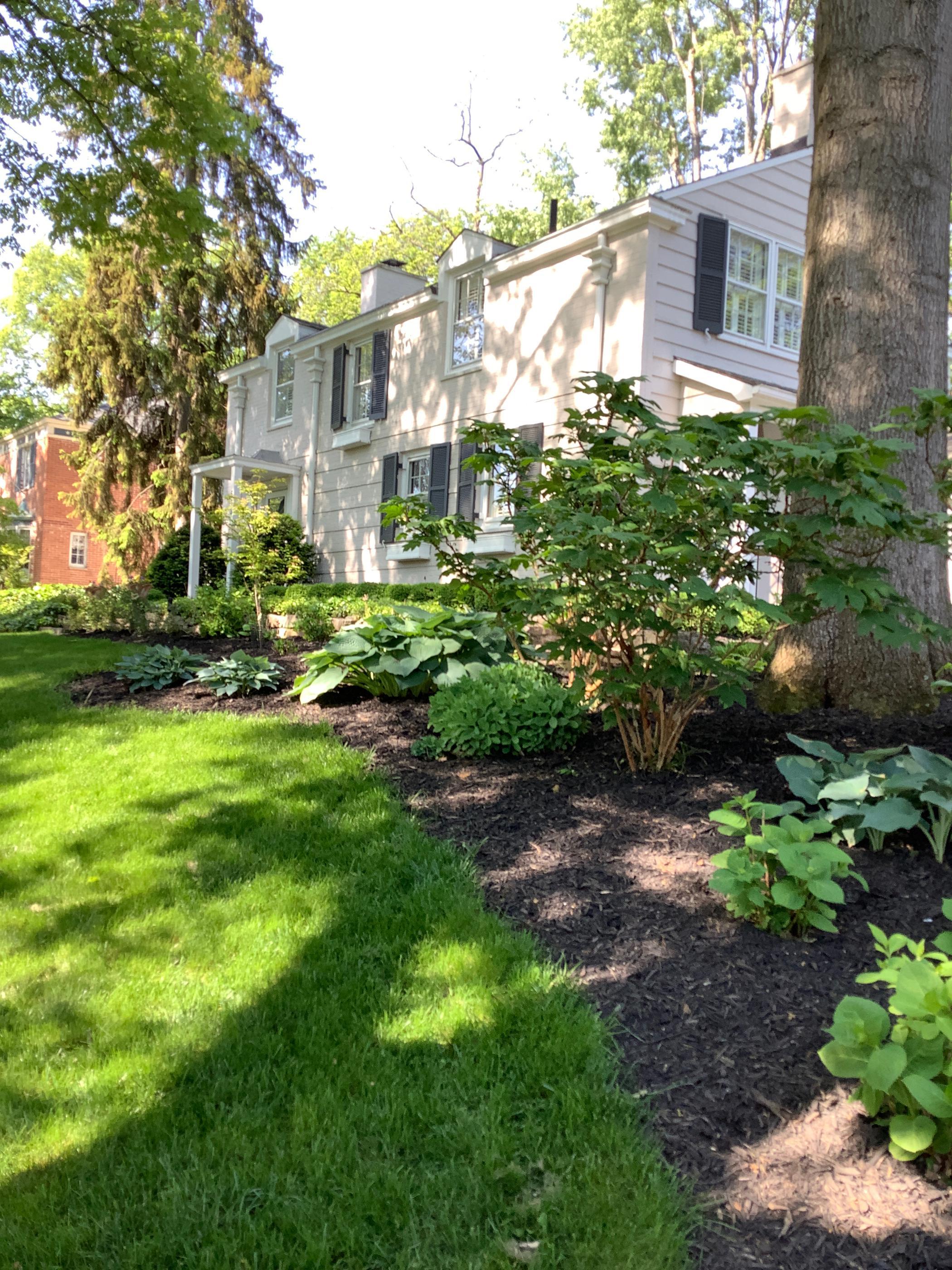
Read that list again and picture the foundation planting on the front of a house in Hyde Park or Madeira. Shredded hardwood mulch, three inches deep, packed against the block, shaded by a hydrangea, damp for most of the summer. You are looking at ant habitat that happens to touch your house.
So when your neighbor two doors down in Deer Park gets ants the same week you do, nobody tracked anything in. You both have the same beds against the same kind of foundation, and the same thing happened to both colonies at once.
What changes in the third week of August
Odorous house ants live largely on honeydew, the sugary waste that aphids, scale, and mealybugs excrete while feeding on plants. Washington State University notes that workers tend aphid and scale insects directly, farming them the way you would keep livestock.
All summer, Cincinnati's mature street canopy runs a sugar factory over your head. The big oaks and maples on the older east side streets carry aphid and scale populations, and the honeydew rains down steadily onto everything below. Your ants have no reason to look anywhere else.
Then the supply falls off. Michigan State Extension is direct about what follows, noting that these ants often move into homes after heavy rainfall or late in the season when honeydew becomes less abundant. Both triggers stack up in southwest Ohio in August. The honeydew thins out as the season turns, and the heavy end-of-summer storms flood shallow ground nests at the same time.
Wisconsin Extension notes that a disturbed colony will quickly relocate to another sheltered spot. A flooded mulch bed is a disturbed colony. The nearest dry sheltered spot is the wall void behind it.
Temperature closes the loop. Cooperative extension research puts peak foraging when temperatures sit between 70 and 86 degrees, which describes a Cincinnati late August almost perfectly. So you have a colony working at maximum foraging effort just as its food supply shrinks and its nest floods. The kitchen visit is what that adds up to.
The ants you saw in May were doing something else entirely
Plenty of Cincinnati homeowners see ants twice a year and assume it is one long problem with a quiet stretch in the middle. Two separate events are happening, and telling them apart tells you what you are dealing with.
The spring appearance is reproduction. Penn State Extension puts winged reproductive ants emerging May through July, and those flights are what people notice after the first warm rains of the season. Winged ants on a windowsill in April or May are a colony sending out queens to start new nests, not a colony moving in with you. Most of those queens fail. The handful that succeed set up in the mulch, and you never hear about it again until the following August.
The late-summer appearance is feeding. There are no wings involved and no swarm, only workers walking a line toward something they want. Same species, entirely different behavior, and a different response required from you.
There is a compounding problem in the middle. Colonies that established themselves during the May flights spend the summer growing, and by August a spring nest that started with one queen and a few dozen workers has become a mature colony with a real appetite. Every successful spring swarm you shrugged off is part of the August pressure you are dealing with now. That is why a spring exterior program does so much more work than it looks like it is doing at the time. Homeowners in Symmes Township and Sharonville who treat in April are removing colonies while they are small.
The trail on your counter started at ground level
Ants do not wander. They navigate by following continuous surfaces, and once a route pays off it gets reinforced by every worker who uses it. Extension guidance describes odorous house ants using edges and ridges as guidelines to move from one place to another.
What that means for your house is a climb. The route starts where mulch meets block, runs the foundation seam until it hits something vertical, and goes up. A downspout is the most reliable ladder on most Cincinnati homes, which is why so many first sightings happen in a kitchen directly above where one lands. From there it is a gap at the sill plate, a utility penetration that got foamed in 2009 and never looked at since, or the annular space around a hose bib.
This is why the trail looks so deliberate when you finally spot it. You are seeing the last four feet of something that began at soil level and worked upward through whatever your house offered. The ants did not find a hole. They found a ladder, and your kitchen was at the top of it.
It also explains a pattern that confuses people. Two houses on the same block, same mulch, same age, and one gets ants every August while the other does not. Walk both foundations and you usually find the difference in about ninety seconds. One has downspouts discharging into the beds and a hose bib with a gap around it, and the other has extensions carrying water out past the mulch line. Homeowners in Terrace Park and Indian Hill ask us about that split constantly, and it is almost never the yard. It is the six vertical feet where the yard meets the wall.
You may be looking at two totally different problems
Every ant on your counter looks about the same at counter distance. They are not, and the difference decides whether this is a nuisance or a repair bill.
If you want certainty rather than a guess, OSU runs a diagnostic service for exactly this. Their guidance is to collect several specimens in a watertight vial with 70 percent alcohol and submit them through your county extension office. Most people will not do that, so use the field version below.
Ohio State University Extension reports that carpenter ants are the largest ants in Ohio and rank number one in inquiries over all other ants in the state. The black carpenter ant is the common one here. OSU describes minor workers around a quarter inch and major workers around half an inch, with fine whitish hairs on the abdomen. Odorous house ants run about an eighth of an inch. Side by side, a carpenter ant is roughly four times the insect.
The behavior differs more than the size. Carpenter ants excavate galleries in wood to build nest space. OSU is clear that, unlike termites, they do not consume wood, and that they prefer wood with water damage. Carpenter ants show up where water has already been getting in, which makes them a symptom you can see of a problem you cannot.
That is a useful signal in a market with our housing stock. A carpenter ant trail coming out of a soffit corner in Norwood or Mount Adams is worth following back, because there is a decent chance you find a failed flashing detail or a gutter that has been overflowing into the fascia for two seasons.
The other identification question we get every August is whether these could be fire ants. They are not. Fire ants are a southern insect and are not established here. Ohio State entomologists put it plainly, noting that this state has ants capable of a serious bite but none that sting the way their bee and wasp cousins do. If something in your yard stung you, look at wasps and yellow jackets before you look at the ground.
Cincinnati hillsides move water onto the nests
Most cities have ants. What our terrain adds is a reliable mechanism for flooding them out on a schedule.
Cincinnati is built on hillsides, and water does what water does. Properties on slopes shed runoff quickly, and everything they shed collects in the low ground below. That pooling drives the mosquito pattern we treat all summer, and it drives the ant pattern too, because the shallow ground nests sitting in mulch and leaf litter at the bottom of a grade are the first ones underwater after a heavy August cell.
We see the split constantly on a single street. A house partway up a grade in Mount Lookout gets a light, brief round of indoor ants after a storm. The house at the bottom of the same street gets a heavier one that lasts a week. The species is the same and so is the mulch, and the only thing separating the two houses is thirty feet of grade.
The pattern repeats around retention basins and low corners in the flatter northern communities. Yards in Fairfield and Springdale that hold water after a storm are running the same experiment on a smaller scale, and the week after a Cincinnati storm tends to be busy for more than one pest at a time.
Grade is not the only variable. Older Cincinnati lots tend to have deep, established foundation plantings that hold moisture long after the surrounding lawn has dried, and downspouts on homes of a certain age frequently discharge straight into those beds rather than out past them. A bed that stays wet is a bed that floods faster and dries slower, which means the nest under it gets displaced more often across a season.
Irrigation does the same thing on a schedule. Newer construction in Mason and the Butler County communities often runs zone heads that soak the foundation beds several times a week through August. That yard is being flooded on a timer whether or not it rains, and the ants respond to it the same way.
If you want a two-minute diagnostic, walk your foundation the morning after the next real rain. Wherever the mulch stays soggy past noon, that is where you have a nest problem waiting for a trigger. Do the same walk an hour after your irrigation runs and see whether the two wet spots are the same. Usually they are, and usually that corner is where your trail starts.
The spray under your sink usually makes it worse
Worth separating two things that get lumped together, because the difference is where most homeowners lose a month.
Odorous house ant colonies reproduce partly by budding, where a queen leaves with a group of workers and starts a separate nest nearby. Wisconsin Extension describes this alongside their network of interconnected nests containing many queens. A contact spray kills the fifty workers you can see and stresses the colony you cannot. Under stress, a multi-queen colony splits.
One trail becomes three. Pest control professionals see this often enough that odorous house ant is described as the second most common pest ant they manage nationally.
None of that is an argument against treatment. It is an argument about where treatment happens. Penn State Extension points toward baits for foraging workers, which get carried back into the nest instead of stopping at the doorway, and a professional exterior perimeter application works on the colony's territory rather than on the twenty ants that made it to your counter. Indoor aerosol does the opposite. It is the same reasoning we apply to roaches indoors rather than chasing what is visible.
The prevention side is more boring and more effective. Wisconsin Extension recommends keeping plants and dense mulch away from building foundations to reduce indoor foraging. Washington State notes that removing the aphid and scale populations limits the resources available to colonies, and that aromatic cedar mulch has been shown to repel these ants. Pull the mulch back six inches from the block, cut the shrubs off the siding, and you have removed both the housing and the road.
That same perimeter thinking is what Squad Yard Defender is built around, and it holds up on properties from Loveland out to West Chester.
What an ant call looks like on our end
When we walk an ant property, the inside is the last place we look. We start at the foundation line and work the perimeter, because the trail on your counter is the visible end of something with an outdoor beginning.
We are looking for the moisture line first, then the routes. Mulch depth against the block. Downspout discharge. Where the irrigation lands. Limbs and shrubs bridging soil to siding. On older homes we pay attention to the sill plate and any spot where a utility penetration was foamed once and never checked again.
Inside, we ask you where you first saw them and what time of day. A trail that shows up under a kitchen sink points somewhere different than one that appears along a basement rim joist or behind a bathroom vanity. Extension guidance consistently places indoor nesting near warmth and moisture in wall and floor voids and crawl spaces, so the plumbing wall is usually worth more of our attention than the countertop where you noticed the problem.
Then we identify what we have, because the treatment differs on every level. If OSU is right that carpenter ants generate more homeowner inquiries than any other ant in Ohio, they also generate the most misdiagnosis, and a carpenter ant job that gets treated like an odorous house ant job comes back.
Ants are covered under Squad Home Shield, which runs year round and treats the foundation, entry points, windows, and vents on a recurring schedule rather than after you already have a trail. For properties that need the yard handled at the same level, Complete Home and Yard layers full yard pest management on top of it. Our Mosquito Barrier Treatment is a mosquito program and will not solve an ant problem, which is a distinction we would rather make now than after you have paid for the wrong thing.
Timing matters more than most homeowners expect. The exterior work that keeps ants out is far easier before the honeydew collapses than during the week your kitchen is already a highway. Homeowners in Blue Ash and Loveland who start in spring almost never make the August call at all.
If you are already past that point, that is fine. Most of our ant customers call us mid-trail. Reach us at (513) 666-5354 or request a quote online, and we will walk the property before we treat anything. You can see what our customers say about how that goes, and every service carries our satisfaction guarantee.