Spotted Lanternflies Reached Hamilton County. The Mess Shows Up on Your Deck First.
Posted by Mosquito Squad Plus
August 28, 2026
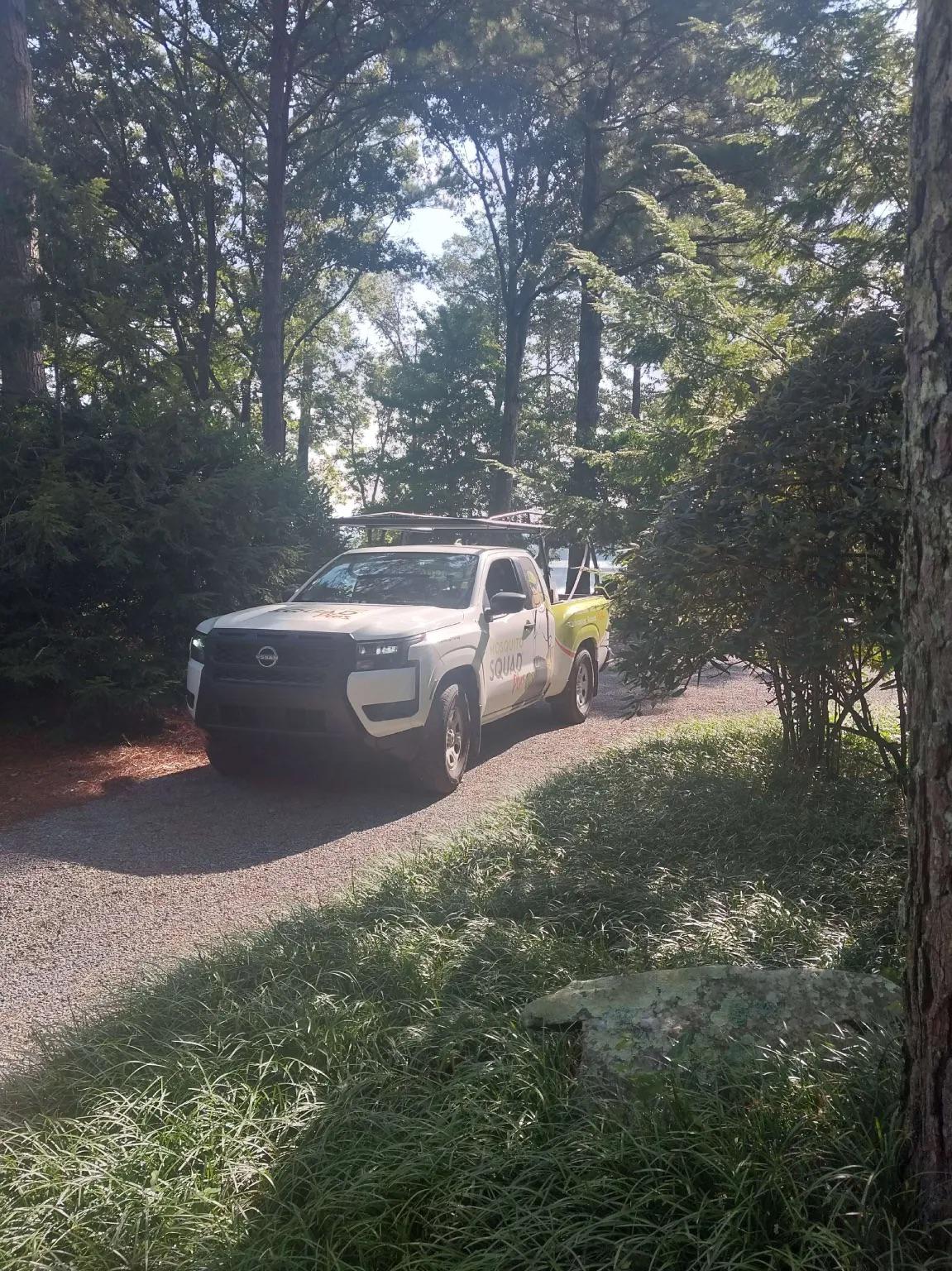
Spotted lanternflies feed by driving a needle-shaped mouthpart into a branch and drinking sap, and most of what they drink comes back out the other end. That runoff is honeydew. It is sugar water, it falls straight down, and it lands on whatever happens to be under the tree.
On a Hamilton County property, what sits under the tree tends to be a deck, a patio table, a truck parked in the shade, or the strip of grass where the dog sleeps in the afternoon. That is the part of this story most homeowners here will meet before they ever meet the insect. Spotted lanternfly calls have been coming in across this market all summer, and the sequence behind the mess is worth understanding before the next round of egg masses goes down this fall.
Hamilton County Is on the State's Confirmed List, and That Word Matters
The Tennessee Department of Agriculture keeps a running list of counties where spotted lanternfly populations have been confirmed rather than merely reported once. Hamilton County is on it, added in 2025 and still on the detection map TDA published in June 2026. Davidson and Wilson came first in 2023, Sullivan followed in 2024, and Sumner, Jefferson, and Knox arrived in the same year as Hamilton.
Six Tennessee counties carry confirmed populations heading into this fall. Six more have logged a single report with no population found behind it, so the sighting list runs longer than the confirmed list. The first mass sighting of 2026 came out of the Bristol area in early July, up on the Virginia line, and state entomologists spent this summer reporting increased plant damage in the counties where the insect has settled in.
The state's own framing is careful, and we are going to keep it that way here. TDA calls this insect detected in Tennessee but not widely established. That is a different thing from an infestation you are living inside of. Most yards in Hixson or Ooltewah have not seen one and may not this year.
The Georgia half of our territory sits in a different position entirely. Georgia's only known population was found in Fulton County in October 2024, roughly a hundred miles south of the state line, and the Georgia Department of Agriculture still describes that as the sole confirmed presence in the state. Nothing has been confirmed in Walker, Catoosa, Dade, or Whitfield counties. If your yard is in Ringgold or Fort Oglethorpe, you are watching, not treating.
So the useful posture for pest control in Chattanooga right now is recognition. Learn the insect, learn the egg mass, learn what the damage looks like from the ground, and know who to call once you find something.
Sticky Is the Word Customers Use First
Honeydew does not read as an insect problem. It reads as a maintenance problem, and that misdiagnosis can run for weeks before anyone looks up.
University of Tennessee Extension puts the mechanism plainly in its spotted lanternfly publication. Honeydew is an ideal substrate for fungal mats of sooty mold, and the accumulation blackens tree trunks and every surface beneath a feeding population, covering automobiles, porches, and outdoor equipment. That last clause is the whole residential story. The insect works in the canopy. The consequence lands at ground level.
Then a second wave arrives. The North Carolina Department of Agriculture notes that heavy honeydew production draws in stinging insects such as wasps and ants, a pattern anyone who has left a soda can on a picnic table already understands. Sugar on a horizontal surface recruits.
That is the version of this pest most likely to reach us as a service call. Nobody phones a mosquito and tick company about a planthopper in a maple. What turns this into a service call is the patio. Sugar reaches a surface people use, stinging insects find it before anybody identifies the insect overhead, and the evenings outside quietly stop. Our wasp and hornet work and our Chattanooga hornet guidance both start by reading the yard, and on a property like this the reading has to include what is dripping from above.
Sooty mold itself is not attacking your house. It grows on the sugar, not on the wood or the paint. Pressure washing takes it off. It comes back for as long as something overhead keeps feeding.
What you should watch for on your own property is the pattern, not the individual bug. If one section of your deck goes tacky and the rest stays clean, look straight up from the sticky part and see what tree you are standing under. If your car develops a film only when you park in one spot, park somewhere else for a week and see whether the film stops. If the shrubs under a particular maple start going black on their upper leaf surfaces while the same shrubs elsewhere in your yard stay green, you have found your drip zone. UT Extension notes that heavy sooty mold on foliage interferes with photosynthesis, so the plants under the canopy take the hit before the canopy shows anything.
Tree of Heaven Decides Where They Settle
Ailanthus altissima is the preferred host, and it already grows all over this valley. It colonizes disturbed ground: road cuts, rail edges, alley margins, vacant lots, and the back corner of a property where nobody has run a mower in four years.
Learning to spot the tree is the single highest-value thing a homeowner here can do this month. It grows fast and straight with long compound leaves, each leaflet carrying a small notched tooth near its base, and crushed foliage smells strongly unpleasant. Sumac looks similar enough that the two get confused constantly.
Late-stage nymphs and adults narrow their diet considerably. UT Extension lists preferred hosts for fourth instars and adults as tree of heaven, grapes, black walnut, silver maple, red maple, and willow. Silver and red maple stand in a great many yards across East Brainerd, Red Bank, and Signal Mountain, and that overlap is why this became a residential problem here and not only an orchard one.
A tree of heaven on your fence line gives this insect the thing it looks for. Removal is a job for a tree service, and cutting one without treating the stump usually multiplies it, so get advice before the saw comes out.
Telling One Apart From Everything Else in the Yard
Four life stages, four different-looking insects, and only the last one resembles the photos in the news coverage.
Early nymphs emerge black with bright white spots and no wings at all. The National Pest Alert hosted by NC State Extension describes these first three instars as tick-like in appearance, a comparison our crews appreciate more than most given how many months we spend on tick and flea control across this valley. They are under a quarter inch and they walk with the front of the body raised.
The fourth instar is the one people photograph. Bright red with black stripes and white dots, over half an inch long, molting into that coloring around June. Nothing else in a Collegedale or Apison backyard looks remotely like it.
Adults run about an inch long with tan to gray forewings carrying black spots toward the front and a pattern near the tip that UT Extension compares to a brick wall. At rest the wings fold tent-style over the body, so the bright red hindwings stay hidden until the insect moves. Most people never see the red unless they startle one.
Two habits help with identification even at a distance. They aggregate, so you rarely find one alone once a population establishes. And they are poor fliers that hop more than they fly, which is why a startled group scatters downward and sideways rather than lifting away.
Boxelder bugs, stink bugs, and cicadas all get reported as lanternflies every summer. If what you are holding is smaller than a fingernail, or shield-shaped, or making noise, it is something else.
Where Egg Masses Turn Up on a Property Like Yours
September through November brings the laying, and the substrate list from Tennessee surveys reads oddly domestic.
UT Extension's Middle Tennessee fieldwork found egg masses on railroad ties, under rock ledges, on tree of heaven, on bush honeysuckle, on poison ivy, on downed limbs and logs, under peeling bark, inside hollow trees, and on the underside of plywood and lumber. Read that list against a typical property in Soddy Daisy or Harrison and most of it is already sitting in the yard.
Rock ledges are not exotic here. Honeysuckle-choked fence lines are the default condition of a back boundary in Middle Valley. Stacked lumber under a deck, a woodpile leaning against the shed, a bass boat parked on its trailer from October to April within sight of Lakesite or Birchwood: every one of those is a flat, sheltered, undisturbed surface.
TDA adds walls, patio furniture, recreational vehicles, trailers, and smaller vehicles to the same list. A fresh mass looks like a smear of wet mud about an inch across, gray and waxy on top. As it weathers, the coating breaks up and exposes rows of eggs underneath, and that is usually the stage at which somebody finally notices.
If you want a practical route around your own property, start at the back fence and work in. Check the north and east faces of your tree trunks first, then any exposed rock, then the underside of your deck rail, then your firewood, then whatever you store on a trailer. Bring a flashlight even in daylight, because you are looking for a texture change on a shaded surface rather than a color that jumps out at you. Give yourself twenty minutes. That is enough time to cover a typical lot in Georgetown or East Ridge and to know whether you have anything.
The boats matter more than anything else on that list. This is a poor flyer that spreads roughly five miles a year on its own, per UT Extension, and everything faster than that is us moving it. A trailer that wintered in a confirmed county and launched at Chickamauga in April is the realistic transport mechanism, and it is also the one a homeowner can personally shut down with ten minutes and a flashlight.
What Homeowners Try First
Most people reach for a hose. Pressure washing sooty mold off a deck cleans the deck and does nothing about the source, and the film returns within days for as long as the population overhead keeps feeding.
The second attempt is usually a sticky band around the trunk. Skip it. UT Extension is direct that sticky bands are a poor option because of unintended trapping of beneficial insects, lizards, and small birds, and a band full of dead songbirds is a worse outcome than the honeydew ever was. A circle trap, funneling insects up into a collection container instead, is the recommended alternative for monitoring.
The third attempt is a hardware-store insecticide sprayed up into a canopy. That is ineffective at height and a reliable way to hit pollinators working the same tree. If you want the yard treated, have somebody treat the yard, the way you would for fire ants or anything else that lives in a specific zone of the property.
The question we get after all of that is whether you should take the tree down. If it is a tree of heaven, yes, and get help doing it. If it is your silver maple, no. You would be removing a shade tree to solve a problem the insect will simply relocate one yard over, and you will have traded a sticky deck for a hot one.
What does move the needle is egg mass destruction, and it earns your Saturday. Scrape masses into a bag or container of soapy water or hand sanitizer and crush each one, because eggs scraped loose and left on the ground can still hatch. UT Extension puts each destroyed mass at thirty to fifty individuals removed from next year's population. That is a real number, produced by a homeowner with an expired gift card, on a property in Walden or anywhere else in the county.
What We Can and Cannot Do About This One
Our barrier program applies a contact and residual product to yard surfaces, and that is the honest description of where it fits. It knocks down insects present on the foliage and structures it reaches and holds for about twenty-one days, covering a deck, a fence line, ornamental beds, and the lower reach of trees. Our page on spotted lanternfly control walks through the identification side in more detail.
What it does not do is protect a mature canopy or eliminate a population across a neighborhood. No company's barrier spray does that. Systemic trunk treatments and the trap-tree work described by UT Extension belong to arborists and to the coordinated programs run by TDA, USDA APHIS, and Extension.
Where we are useful is the secondary problem, and that happens to be where the customer complaint usually lives anyway. Wasps, yellow jackets, and ants recruited to a honeydew drip zone are ordinary barrier treatment targets, and the perimeter side falls under Home Shield for households that want stinging insects and rodents handled year-round rather than seasonally. Yard Defender extends the same coverage across the broader property.
Spotted lanternfly control in Chattanooga and mosquito control in Chattanooga are not the same job, and we would rather say so up front than sell a program that was never going to save your maple. If you have an event on the calendar and a sticky patio, a special event spray two or three days ahead is an honest answer for that weekend and not a fix for the tree.
Commercial properties get a harder version of this. Distribution yards and outdoor storage lots hold exactly the flat, undisturbed surfaces this insect lays on, and our commercial services team tends to see that variant before homeowners do.
From August Forward, the Calendar Tightens
Adults are out now. They will stay out through the first hard frost. Aggregation peaks in September, when a population that spent the summer scattered suddenly clusters and becomes obvious. If you are going to spot one on your own property this year, this is the stretch.
September through November is the lay window, overlapping almost exactly with the season when fall pests pushing toward the house. Walk your fence line, your rock outcrops, your woodpile, and the underside of anything flat while you are already outside doing gutters.
December through March is the best scraping window. Leaves are down, masses are visible, and nothing has hatched. Nymphs begin emerging in April in Tennessee, earlier than a lot of published guidance suggests, and they are small and black with white spots at that point.
By June the adults are back and the cycle restarts. The southern spread has been steady, with confirmed populations reaching Virginia in 2018, North Carolina in 2022, Tennessee and Kentucky in 2023, Georgia in 2024, and South Carolina in 2025 according to a Southern Region review co-authored by UT's Extension specialist. Chattanooga sits in the middle of that map rather than at the edge of it.
Report anything you find through TDA's Report a Pest form with a photo attached. Then kill it. If the yard around it has turned into a wasp problem, call us at (423) 558-0304 or request a quote, and we will walk the property with you before anybody quotes anything. More local coverage sits on the Chattanooga blog, and current pricing is on the specials page.