Rodent Control in Chattanooga and North Georgia: Start by Figuring Out Which One You Have
Posted by Mosquito Squad Plus
September 2, 2026
Mice start working their way toward warm buildings as soon as the nights cool off, and in this valley that shift begins earlier than you would file it under fall. UGA Extension says it flatly: fall is the season when houses get infested, because an animal that spent all summer content in your fence line decides your heated structure is the better deal.
The call sounds the same every year. Something is moving at night. It stops when you go look. Nobody has seen anything.
Then comes the part where your money disappears. You hear noise, you buy a six-pack of traps, you set them along the kitchen baseboard, and you catch nothing for three weeks. The animal you are listening to has been living eleven feet above your kitchen and has never once been on that floor.
Three Rodents Live Here, and They Do Not Share a Floor
Three species turn up in houses across our service area, and the useful thing about them is that they sort themselves by height.
The house mouse, the Norway rat, and the roof rat are all Georgia residents, per UGA Extension. The Tennessee Wildlife Resources Agency reports the roof rat occurring across the whole state, and describes it living in the upper stories of buildings and in trees more than on the ground. On either side of the state line, all three are on your list.
What separates them is not size. It is where they choose to be. UC IPM puts the rule in a sentence: when both rat species occupy the same building, Norway rats hold the basement and ground floor while roof rats take the upper floors. Norway rats, per UGA, generally do not climb at all. Roof rats climb for a living and use that long tail for balance.
House mice sit outside the split. They work your wall voids, your pantry, your garage, and the space under your dishwasher, and they need a far smaller opening to reach any of it.
That sorting is why this matters to you before it matters to us. Sealing your foundation line does nothing about an animal entering at the roofline. Clearing your tree limbs does nothing about one coming up through the crawl space. Pick the wrong end of your house and you can spend a full weekend on honest work and change nothing at all.
Older housing stock gives all three more options. The established streets around Red Bank, East Ridge, and Rossville have had decades for siding to shift and thresholds to wear down.
Reading the Signs Before You Spend a Dollar
Where the sound comes from is the cheapest evidence you will ever get. Most people throw it away by assuming every scratch in a house means the same thing.
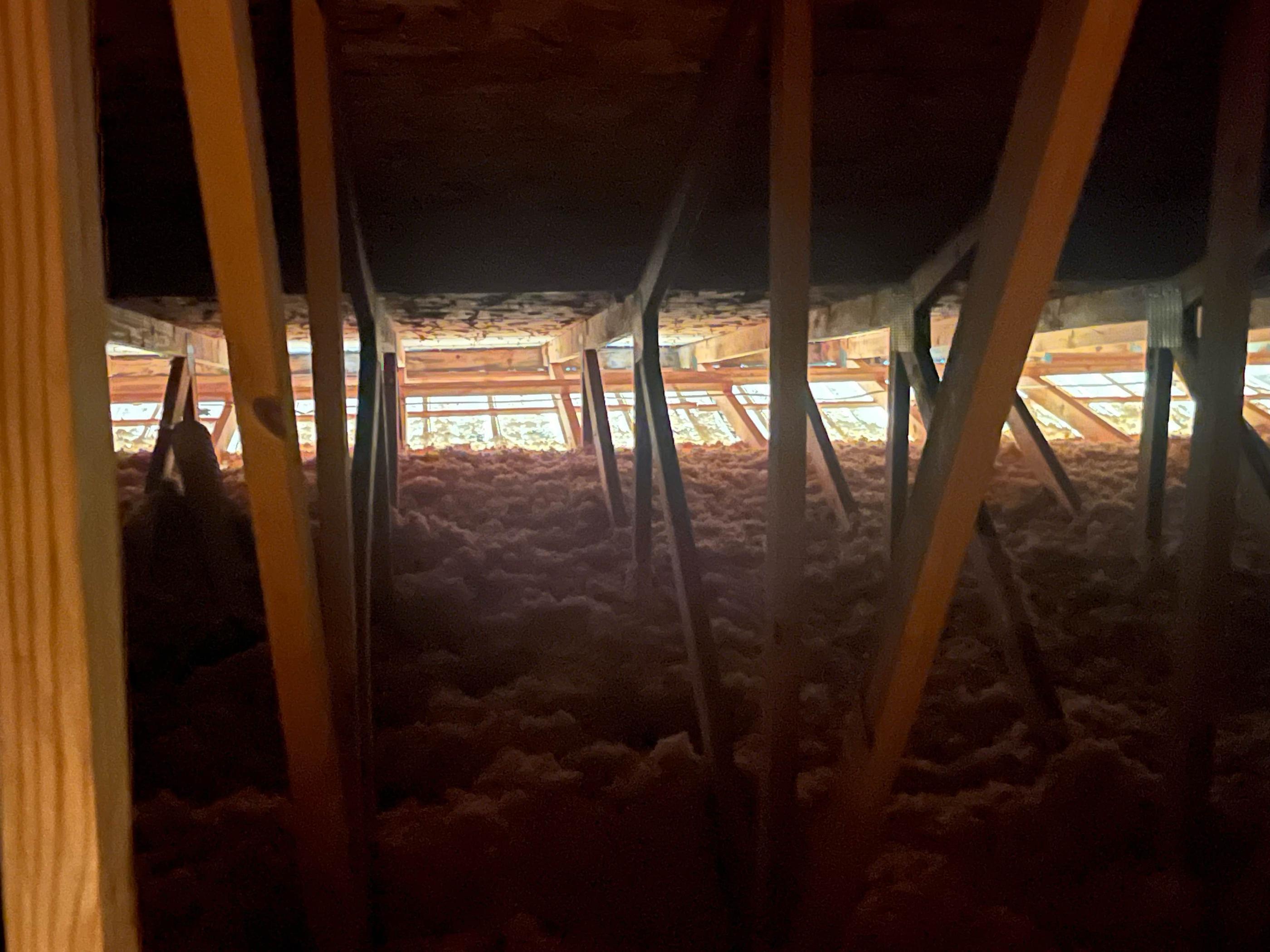
Sound overhead, in your ceiling or along the rafters, points up. Sound below your floor, in the crawl space or along the sill, points down. Sound inside a wall could be either, though in a one-story house over a crawl space it usually came from underneath you.
Droppings settle it faster. Mouse droppings run roughly rice-sized and rat droppings roughly raisin-sized in the UGA circular, a distinction you can make in your own garage with a flashlight. The same publication notes something people rarely know: a musty, urine-like odor generally means mice rather than rats.
Gnaw marks give you a third read. Rat tooth marks run about a sixth of an inch, against a mouse's scratchier marks at about a twelfth, by UC IPM's measure. On a chewed corner of cardboard or a plastic storage bin, you can see that difference.
Timing tells you less than people think, since both rats and mice hide during the day and work at night, per UGA. Rats often turn active around dusk, UC IPM notes. If you are hearing something at three in the afternoon in your attic, squirrels are worth ruling out before anything else.
There is also the flour trick, and it sounds like folklore until you find it in the UGA circular. Scatter a little baking flour or talcum powder along a wall in your attic or basement, put a cracker with peanut butter in the middle of it, and read the tracks in the morning.
None of that requires a technician. All of it changes what rodent control on your property should be aimed at when somebody does get to your driveway. It also means you can hand us something more useful than "there is something in the wall."
House Mice Are Usually Your Answer
Most rodent calls across Chattanooga and the surrounding communities turn out to be mice, because mice are everywhere and need almost nothing to get in.
Texas A&M's school IPM program puts the working number at a quarter inch for mice and a half inch for rats, and notes that mouse problems spike in fall as outdoor temperatures drop. A quarter inch is the gap under your poorly hung side door. It is the space where your dryer vent collar never quite met the siding. It is a weep hole with the insert missing.
Mice also stay put in a way that surprises people. Do not expect a mouse to travel more than five or ten feet to reach a trap, UGA advises, because a well-fed mouse may spend weeks in one corner of one room. Your traps in the kitchen do nothing for an animal nesting in your garage wall thirty feet away.
The other thing about mice is arithmetic. They breed at roughly thirty-day intervals, and females start at about two months old. Your quiet October becomes a loud February on that math alone.
If you are in a newer home and assuming you are exempt, you are not. The subdivisions filling in around Ooltewah, Apison, and Collegedale are tight and well built, and every one of them still has a garage door on a slab and a run of utility penetrations cut by three trades on three different days.
When the Noise Is Overhead, Work Your Roofline
Roof rats come in from above. That single fact changes your entire inspection.
Texas A&M notes they generally enter buildings from overhanging trees or power lines. UC IPM gets specific about your fix: overhanging limbs within six feet of a roof should come off, to keep both rats and squirrels off the roof and out of attics and soffit vents. The same guidance recommends spacing dense shrubs at least two feet from each other and from your walls, and calls out climbing ivy and honeysuckle as conditions that suit roof rats.
That has obvious implications for you on the wooded lots around Signal Mountain, Lookout Mountain, and Walden, where the canopy often touches the roof and one limb is a bridge.
Once they are up there, your openings look nothing like the ones at ground level. Gable vents with failed screening. The junction where your soffit meets fascia. Roof plumbing vent stacks, and UC IPM recommends screening any of those over two inches across. Gaps where a roofline steps down over an addition.
There is a point in UC IPM worth planning around. Rodent proofing against roof rats takes longer than against Norway rats, precisely because the climbing means your entry points can sit anywhere on the structure instead of in the first two feet above grade.
One more thing about roof rats, and it explains a great many failed weekends. They have very strong nest site affinity. Remove the animals, leave the nesting site intact, and they come back to the same spot.
TWRA notes that roof rat breeding peaks in summer and fall, with females raising up to five litters a year. Late August is not their quiet stretch.
When the Noise Is Underneath, Work Your Foundation
Under your house, both the animal and the job change.
Norway rats burrow. Their burrows run along building foundations, under rubbish, and in woodpiles, and once inside they stay in basements and ground floors, per UC IPM. They may spend an entire life inside an area only a hundred to a hundred fifty feet across, UGA notes, so your source is almost always on your property or your neighbor's.
This is crawl space country, and a vented crawl space hands them exactly the dark, undisturbed ground they want. Texas A&M also flags plumbing access points as a Norway rat route, worth remembering if your crawl space looks tight but your pipe chases were never sealed. Nebraska Extension goes further and says to grate your floor drains, with openings a quarter inch or smaller in 19-gauge wire.
The lower ground along the creek corridors near Harrison, Middle Valley, and Soddy Daisy tends to produce more of the ground-level version.
Our post on what gets into homes when the weather turns walks through the fall entry sequence in more detail. The terrain post gets into what the ground under these houses does to everything sitting on top of it. Ten minutes well spent if your crawl space is the problem.
The Georgia Side Runs the Same Species on Different Houses
Our territory crosses a state line. Your rodents do not notice it. Your housing stock does.
Down through Ringgold, Fort Oglethorpe, and out toward Dalton, lots run larger and outbuildings are far more common. If you have a detached garage, a barn, or a shed on your place, that is where a population builds long before you hear it in the house.
The same pattern holds around Chickamauga and Rome, where more open ground sits between the house and whatever backs it. Your outbuilding is the staging area, and your house is the upgrade they take when the weather makes the decision for them.
Pest control in Chattanooga and North Georgia has always meant adjusting to what your house is rather than what the map says. Rodents make that more obvious than anything else we treat.
What You Will Probably Try First, and Why It Fails
Every fall we hear about the same three moves. None of them are unreasonable. They just do not hold.
Ultrasonic plug-in devices come up constantly. Almost completely useless against rodents, UGA calls them, and it puts commercial repellents, sound, and flashing lights in the same bucket. That is an extension service saying it, not a pest company protecting its invoice.
Poison outside is the second, and it creates a problem you will not see coming. An animal that takes bait in your yard frequently dies somewhere inaccessible inside your walls, trading a noise problem for an odor problem in a cavity you cannot open. Traps beat poison baits inside a house for that exact reason, and UGA says so outright.
Cats are the third. UGA is blunt that cats and dogs may catch individuals but cannot be relied on for population control, and flags the side effect you would not expect: pet food left outdoors becomes a food source drawing more rodents onto your property. The animals your cat does catch arrive carrying fleas.
The common thread is that all three manage the animals already inside without touching the reason they can get inside at all. You are bailing the boat without finding the hole.
Sealing Is the Part That Holds
Exclusion is the one intervention with a shelf life. UC IPM says so plainly, calling it the most successful and longest-lasting strategy for rat control around structures.
Your specifications matter more than you expect. The sealing threshold is a quarter inch for both rats and mice. Rodents chew through plastic, foam, wood, and caulk, so UC IPM specifies galvanized mesh at a half inch for vent covers and rules out lightweight chicken wire entirely, since rats pass straight through the openings. Quarter-inch hardware cloth is the UGA recommendation for keeping both out.
That is less a shopping list than an explanation of why your last attempt failed. Foam alone in a hole buys you a season. Screen with the wrong opening is decoration.
Plenty of this is yours to do, and you should do it. Trimming the limbs back off your roof, pulling ivy off the wall, moving the woodpile off the ground, screening a gable vent, fitting a proper sweep on the door your garage never quite closes against. A Saturday and a ladder covers a real share of what we would flag anyway, and none of it needs a license.
The best five-minute test costs nothing. University of Kentucky Extension says to lie on the floor and look for light leaking under your exterior doors, since a gap the diameter of a pencil is enough for a mouse. Check the bottom corners hardest. That is where they go in, and it is the spot a door sweep almost always misses.
Here is how our side runs. A technician walks your property looking for evidence of activity and for the openings allowing it, from grade to roofline instead of just around your foundation, then builds a plan around sealing those entry points and treating the structure. That work sits inside Squad Home Shield, our year-round program covering rodents alongside spiders and roaches.
Ants, wasps, and the rest of the structural list ride along on the same visit. Our ant control page covers what that includes.
Want the yard in the deal as well? Complete Home and Yard stretches coverage across the whole lot, fleas and chiggers included. Yard Defender goes after the cover along a tree line that keeps restocking your yard.
There is a reason a mosquito and tick company pays attention here. Rats and mice carry fleas and ticks, the same extension circular notes. A rodent population under your floor is a delivery system for pests we already treat, and that is why tick and flea control belongs in the same conversation as your soffit gap. Yards backing to woods in East Brainerd get both problems at once.
Clean Up Without Making It Worse
Before you sweep anything, stop.
National Park Service guidance is to avoid sweeping, vacuuming, or dusting anywhere there is rodent activity, and to ventilate the space for at least thirty minutes first. Dry sweeping puts whatever is in that material into the air you are standing in. Wet it down with disinfectant, let it sit, then wipe it up with disposable towels while wearing gloves.
That applies to your attic insulation, your garage corner, and the shelf in your shed equally. A population that left that much behind has also been running ticks and fleas back into your yard the whole time.
Doing This on the Right Calendar
August and September are your cheap, quiet weeks. October and November are the loud, expensive ones.
Nothing about that is dramatic. Sealing your soffit gap in September takes the same hour it takes in December, except in September there is nothing behind it yet. Do it in December and you have sealed an animal inside your wall, which is a worse problem than the one you started with and a much more expensive one to undo. Mosquito control in Chattanooga runs on the same logic: work landing ahead of the pressure is worth several times the work landing after it.
If you are hearing something and cannot place it, start with the three questions in this piece. Where is the sound coming from. What size are the droppings. Is there an odor. Then get somebody into your attic and under your house with a good light.
Rodent control in Chattanooga comes down to finding your openings and closing them properly, and that starts with knowing which animal you are closing them against. Call (423) 726-3017 or contact the Chattanooga office and we will put somebody on your roofline and under your floor in the same visit. The full list of communities we cover sits on the areas we service page.