Hornet Removal in Knoxville: The Nests Nobody Was Home to See
Posted by Mosquito Squad Plus
July 14, 2026
Somewhere in Sevier County this week, a cabin owner two states away is reading a one-star review that mentions a wasp nest over the hot tub. The nest did not arrive with the guests. A queen started it in April, the colony built quietly through May and June while the property turned over every three nights, and the first person to look up at the deck ceiling long enough to notice was a renter with a phone and strong opinions. That sequence, or some version of it, is behind a surprising share of the hornet removal calls we take across the Knoxville market every summer.
Here is the pattern underneath it. Hornets grow on the same clock everywhere in East Tennessee, but discovery runs on a completely different clock, and that second clock is set by how often someone is around to look. A full-time home gets found out in July when the gutters get cleaned. A rental cabin outside Gatlinburg gets found out whenever a guest wanders under the wrong eave. A lake place near Kingston that sat closed since Labor Day gets found out on the Fourth of July, at full colony strength, with the whole family standing on the dock. The hornets never change. The eyeballs do, and this market has more unwatched decks, eaves, and soffits per square mile than anywhere else we service.
The Same Two Hornets, On Their Own Schedule
East Tennessee's stinging insect roster is deep. The University of Tennessee's SP341-M fact sheet counts eleven yellowjacket species in the state, and only the fall-mated queens survive winter to restart the whole enterprise each spring. For hornet removal purposes, two of those insects do nearly all the work.
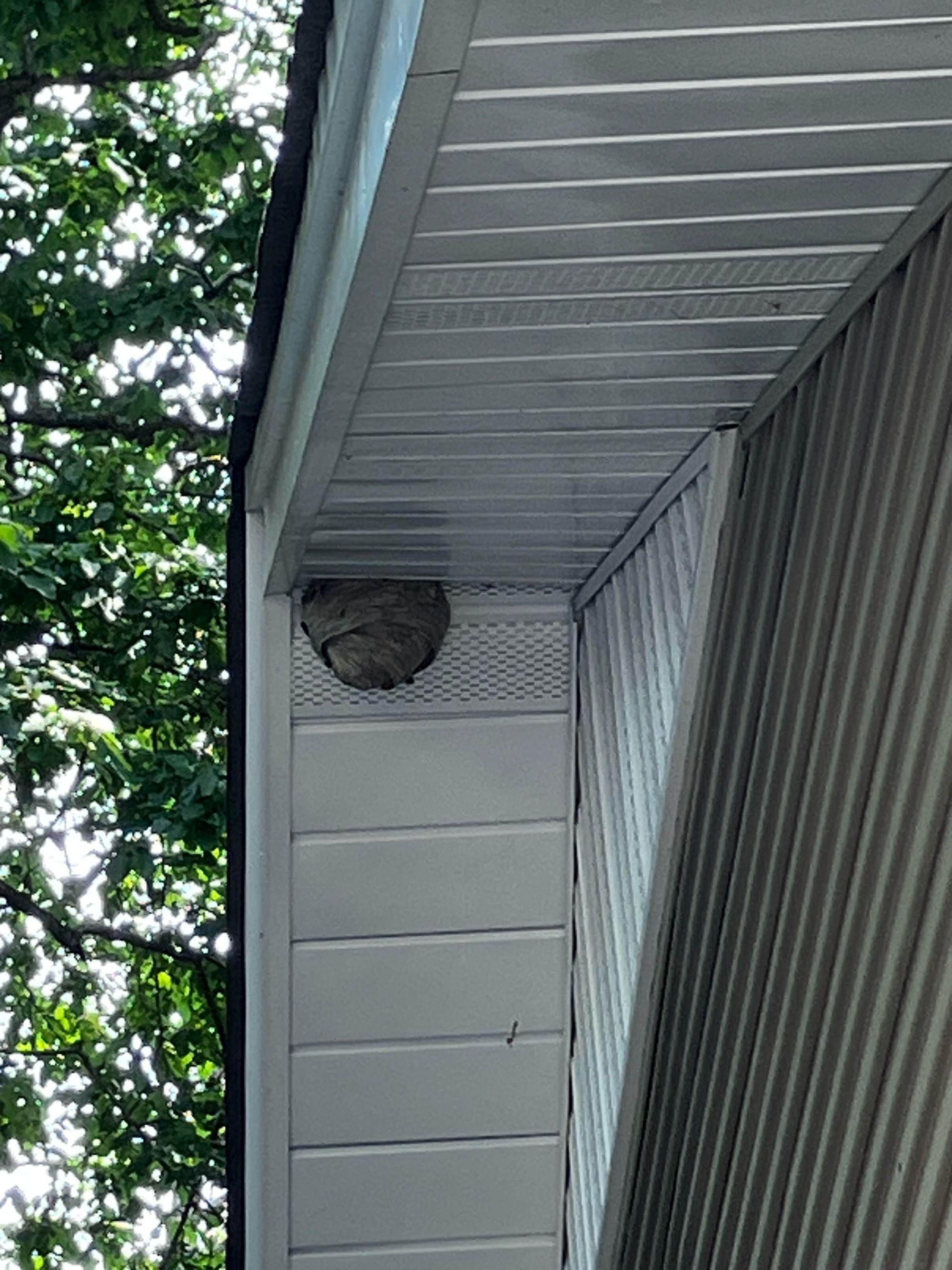
The bald-faced hornet, black with a bone-white face, hangs a closed gray paper hull from tree limbs, shrubs, deck framing, and eave corners, and the colony inside defends it as one organism. Populations run somewhere between 200 and 400 hornets once the season matures, per the University of Kentucky Entomology program, and every one of them can sting more than once. The European hornet is the bigger, quieter tenant. Tennessee's only true hornet nests inside cavities, hollow trees, wall voids, attic edges, so there is rarely anything to see beyond big chestnut-colored hornets running a steady route in and out of one opening.
Both start from a single queen in April, both peak in late summer, and both die at frost, with only the new queens slipping away to winter under bark and inside outbuildings. A woodpile at a cabin, a stacked kayak rack at a lake place, and a garden shed in a Farragut backyard all serve that overwintering purpose equally well, which is part of why properties that host a colony once tend to get a sequel. On a property where someone mows weekly and grills on the deck, human attention interrupts that arc somewhere around midsummer, and on a property where nobody is watching, the arc runs to completion. This post is organized around that difference, because in the Knoxville market, the kind of property you own predicts your hornet story better than your ZIP code does.
The Rental Cabin: Discovered by Guests, Reviewed in Public
The Smokies corridor runs on absentee ownership. The National Park Service reports Great Smoky Mountains as the most visited national park in the country, averaging nearly 12 million visits a year, with every month from June through October clearing a million on its own. The cabins that house those visitors around Pigeon Forge, Sevierville, and Kodak are, from a hornet's point of view, ideal real estate with a distracted landlord. Decks pushed out into the tree canopy put bald-faced nests at railing height. Log and cedar construction ages into exactly the openings a European hornet queen shops for, and UT Extension's own prevention guidance calls out sealing knot holes fallen out of cedar siding as a specific defense, which tells you how often the species uses them.
The management structure of a rental makes it worse. Cleaning crews are the only regular human presence, they work indoors on a stopwatch, and nobody's checklist includes standing in the yard staring at the roofline. A cabin that turns over forty times a season can host forty separate groups of people, none of whom owns the problem and none of whom looks up until the problem is at eye level over the hot tub.
So the colony builds undisturbed through the exact weeks a home-owner would have caught it, and the discovery falls to a guest, which converts a hundred-dollar pest problem into a refund, a bad review, and a scramble for same-week service during peak season. The cheapest hornet removal a cabin owner will ever buy is the one scheduled before the calendar fills with checkouts, and the second cheapest is a standing seasonal program where a technician's eyes replace the ones the property does not have.
There is a night dimension here too, and it is very Tennessee. UT Extension's SP290-A fact sheet carries the title "European Hornets Tapping at Your Window at Night?" because the question comes up that often. These hornets fly by night and navigate toward light, and a rental cabin is the best-lit structure on its ridge, porch lights burning on a timer whether anyone is home or not. Guests report giant hornets slamming the glass at 10 p.m., and the owner two states away has no idea the colony is in the wall behind the bunk room. UT's guidance includes a detail worth stealing even before treatment: swap entryway bulbs to yellow, because these hornets respond far less to the red end of the spectrum, and the nightly window show usually quiets down.
The Lake Place: Closed in April, Peak Colony by July
The reservoir towns run the same story on a different calendar. Seasonal homes around Loudon, Lenoir City, and Kingston sit mostly quiet from fall through late spring, which hands the hornets the entire founding season without an audience. A queen that picks the boathouse rafters or the gap behind a dock box in April has the run of the place until Memorial Day at the earliest, and often until the big July week when the whole family arrives at once. What they find is a colony that has been building for ninety days, at the exact point in the season when defensiveness starts climbing.
The pattern stretches down the whole chain of TVA water. Tellico Lake properties around Vonore and the Watts Bar shoreline out toward Spring City carry some of the longest owner absences in the market, second homes that sit shut for six and seven months at a stretch, and the length of the absence maps directly onto the size of the surprise waiting at opening weekend. The further the property sits from its owner's weekly routine, the more completely the hornet calendar runs without interruption.
Fort Loudoun's shoreline already shapes the pest season in this corner of the market, a story we told in the Lenoir City lake post, and the stinging insect version adds a twist: water complicates the escape routes. A bald-faced colony discovered at the end of a dock leaves people with two exits, back down a narrow walkway or into the lake, and every summer somebody in East Tennessee chooses the lake. The move for a seasonal property is an early-season sweep, deck framing, boathouse, eaves, dock structures, shed, before the family calendar starts, because opening weekend is a terrible time to meet ninety days of uninterrupted construction.
The Full-Time Home: Watched, But Not All of It
Owner-occupied properties in Farragut, West Knoxville, Powell, and our home base of Oak Ridge are the best-defended properties in the market, and they still produce steady hornet work, because every watched property has unwatched zones. The back tree line where the yard meets the woods. The shed nobody opens between March and September. The crawlspace vents, the far gable, the north eave you cannot see from the driveway.
East Tennessee's ridge-and-valley terrain presses woods up against backyards across this whole market, and a bald-faced colony thirty feet up the tree line forages your patio all season while remaining technically invisible from any window in the house. Neighborhoods backed up to ridgelines, the way much of Halls sits against its wooded slopes, carry a permanent version of this blind spot, since nobody surveys the woods behind the fence until the woods send something over it.
The fix is a habit, and homeowners here already have the model for it. The same slow walk around the structure that catches termite mud tubes on a foundation, the habit we push in our Farragut termite post, catches hornet traffic on the roofline when it is aimed upward once a month from June on. Watch for a steady stream of large insects working one point on the eave, one knot in the siding, one gap at the soffit. Traffic like that always leads somewhere, and finding it in June instead of August is the difference between a routine visit and a project. Our termite control inspections already put trained eyes on those same lines, which is one reason bundled inspections keep paying for themselves in this market.
Why the Spray Can Fails Harder When You Are Not There
The over-the-counter approach has all the problems here that it has everywhere, plus one this market invented. A twenty foot stream against a mature bald-faced hull knocks down the closest defenders and mobilizes the remaining few hundred, and the EPA's stinging pest guidance is unambiguous that established colonies are a job for proper protective equipment. Spraying a European hornet entry can drive the colony deeper into the cabin wall, and sealing the hole while it is alive gives several hundred hornets a reason to find the interior. The CDC's stinging insect guidance adds the medical floor under all of this: serious venom reactions show up in people with no allergy history, and colony defenses deliver stings in volume, not singles.
The market-specific problem is delegation. A remote owner cannot spray a nest from Nashville or Atlanta, so the job rolls downhill to whoever is nearby, a cleaning crew, a handyman, a brother-in-law with a ladder, none of whom signed up to fight several hundred stinging insects on a steep lot. UT Extension's own guidance notes that European hornet colonies are far easier to eliminate in spring while they are small, which is the polite way of saying that a peak-season cavity colony is not a favor to ask of anyone. If the nest is at a property you cannot see from where you are standing, the responsible version of DIY is a phone call.
What Hornet Removal in Knoxville Involves
The work starts with finding everything, since the property that grew one unwatched colony has usually grown two. Our technicians follow flight lines to their sources, cover the rooflines and soffits, check deck framing and dock structures, look into the tree line at the yard's edge, and use the species and the site to set the plan, because a hanging colony over a Gatlinburg hot tub and a cavity colony inside a Powell wall void are different jobs with different sequences.
Aerial colonies are put down fully before any nest is touched. Cavity colonies are treated where they live before any opening closes, in that order without exception, so nothing gets driven inside. A barrier application around the structure finishes the job, since proven nest sites recruit next spring's queens, and rental properties that hosted a colony once are strong candidates to host again.
For unwatched and half-watched properties, the honest recommendation is standing coverage rather than emergency response, because the entire problem is the absence of eyes, and a scheduled program is eyes on a calendar. Our Home Shield package works the structure's perimeter where cavity nesters get in, the broader pest packages lineup fits programs to properties from quarter-acre lots to cabin portfolios, and our guarantee stands behind all of it.
One boundary stated plainly: automatic misting systems are a strong scheduled answer for mosquito pressure on rental and lake properties, and they do nothing about a colony in a wall or a tree, which needs targeted work at the nest. We will tell you which problem you have before we sell you anything, which is the approach the why Mosquito Squad Plus page describes and the reason property managers keep our number. Our areas we service page carries the full roster of communities, from the Smokies corridor to the lake towns to the Knoxville suburbs.