The Bait Keeps Disappearing: What That Tells Homewood Homeowners About Their Rat Problem
Posted by Mosquito Squad Plus
September 30, 2026
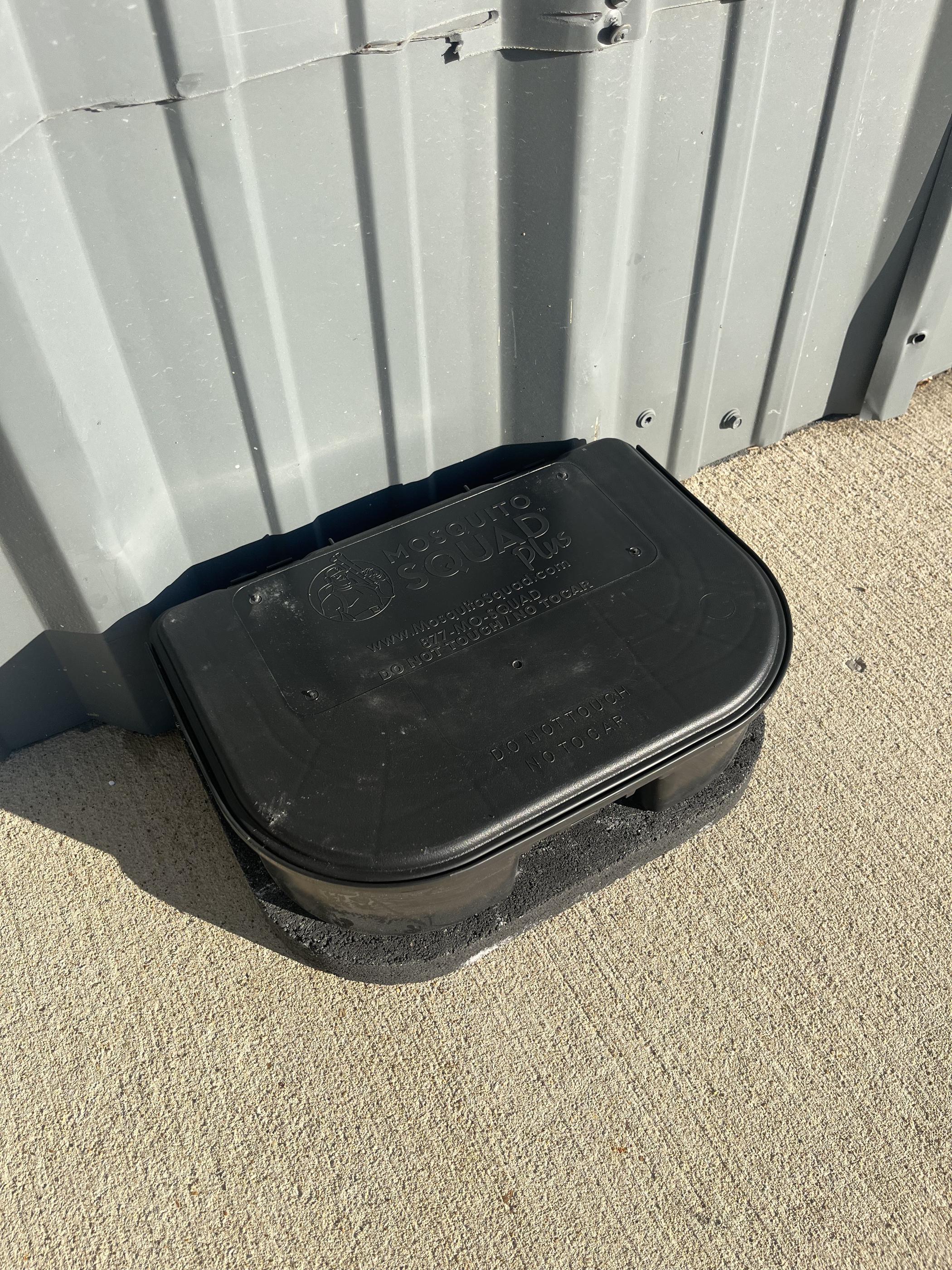
There is a house on one of our Homewood routes where the bait station will not stay full. Every visit, the tech opens the lid, finds the blocks chewed down or gone, and restocks it. Nobody in the house has reported seeing a rat. Nobody has mentioned noises. By every measure a homeowner would normally use, there is no problem at that address.
The station says otherwise.
That gap, between what people see and what is actually moving across the property after dark, is the most misunderstood part of rodent control in Homewood. Most homeowners wait for a sighting before they take rats seriously. On a lot with trees behind it, where the rats live outside and visit the house at night, that sighting may never come. What you get instead is evidence. Bait that vanishes. A smooth hole under the deck. A chewed corner at the bottom of the garage door.
This post is about reading that evidence correctly, and about why the answer to an empty bait station is almost never more bait.
You Are Not Supposed to See Them
When we asked Tav, who runs our Homewood routes, what he is seeing with rodents this month, his answer was that he mostly is not. There are probably a lot of them, he said, but they are gone by the time he shows up to spray.
That is not a sign of a small problem. Rats do most of their moving at night, which UC IPM's guidance on rats lays out plainly. Our visits happen in daylight. So does most of the time a homeowner spends in the backyard. The two groups of people who look at your property the most are looking during the wrong hours.
Rats also stay out of the open. Utah State's IPM manual for rats and mice describes them hugging edges, the base of a wall or the outside of a foundation, where their whiskers keep contact with a surface. It says they rarely cross the middle of a room or a field, because open ground exposes them to predators. In a Homewood backyard, the edges are the fence row, the tree line, the strip of ground behind the garage, and the dark space under the deck. Those are exactly the spots nobody stands in.
A lot of our customers never meet the tech at all. They booked through the office, they are at work when the truck comes, and the service happens without a conversation. Those households can go a full season without seeing a single rat while the station on the side of the house gets worked every visit.
What an Empty Bait Station Is Actually Telling You
Bait stations are a standard part of our rodent control service. They are locked boxes set along the routes rats are likely to travel, usually against the foundation. Most people think of the station as the treatment. It is more useful to think of it as a gauge.
Rats distrust anything new in their territory. The same UC IPM guidance notes that they tend to avoid new objects and new foods, often staying away from traps and bait for several days and sometimes for weeks after placement. It adds that this caution is thought to run stronger in roof rats than in Norway rats. Utah State's manual says a two-week wait before approaching a station is not unusual.
That changes how you read what is happening in the box.
A new station that goes untouched for the first couple of weeks tells you very little. The rats may simply not trust it yet.
A station that starts getting eaten after that tells you rats are using that route regularly enough to have accepted the box as part of the landscape.
A station that empties every single visit, month after month, tells you the supply of rats is not running out.
That last pattern is the one at the house we started with, and it is worth thinking through. If the bait were working through a fixed group of rats, consumption would climb, peak, and then fall off as that group died. When it keeps going at the same pace, new animals are arriving to replace the ones that ate. The bait is doing its job. The property is doing its job too, which is drawing rats in and giving them a comfortable way to live close to the house.
University of Missouri Extension makes a related point most homeowners never hear: rat sign and sightings are of limited value for estimating how many rats are actually around. Seeing none does not mean there are few, and seeing one does not tell you how many are behind it. The usual signs of a rodent infestation are still worth knowing, but steady bait consumption across several visits is one of the more honest readings you can get.
Why It Starts at the Back of the Lot
When we asked Tav where he looks first on a Homewood rodent call, he did not start at the front door. He pointed to the back of the garage and the side of the house that faces the woods. Many of our customers in Homewood and nearby Vestavia Hills have a tree line or a wooded slope right behind the house, and that is one of the first places he checks for holes and openings.
That lines up with what wildlife researchers have documented about how rats use a neighborhood. The Internet Center for Wildlife Damage Management notes that roof rats will travel 100 to 300 feet for food when they need to, and that they may live in the landscaping of one home while feeding at another. On Homewood lot sizes, 300 feet is several backyards. The rat eating the bait on your foundation may be living in ivy on the wooded slope behind your neighbor's house, and commuting to yours because your garage is where the food and cover line up.
Roof rats are built for that commute. A UC ANR extension Q&A on rats describes them as agile climbers that usually nest above the ground in shrubs, trees, or dense growth like ivy. Older Homewood streets have a lot of that: overgrown fence rows along the back property line, ivy climbing into the canopy, shrub borders nobody has cut back in years.
Where they end up is a different question from where they start. In older Homewood, much of the rodent activity we find ends up at the gutter and soffit line. Our post on why roaches and mice turn up inside Birmingham homes in the fall covers that roofline route in detail. The back of the lot is where it begins. Knowing which direction the traffic comes from tells us which side of the house to take apart first.
The garage deserves its own mention. It is where people keep birdseed, grass seed, dog food, and trash cans, often in bags or plastic bins. The Jefferson County Department of Health's pest guidance specifically tells residents not to leave pet food open in yards or garages, and to keep garbage in tight, rodent-proof containers. Door seals wear out along the bottom corners, and the slab and the wall separate a little over the years. A garage left open through a Saturday of yard work gives a rat from the tree line a short, sheltered trip to a meal.
The Other Rat Lives Under Your Deck
When customers do come out to talk to our techs, they point to the same few places: the patio and the pool. Tav sees the most activity where water collects under decks and patios, in the shade, with plants growing up around the edges. He was talking about insects when he said it, but those same conditions suit the other rat in this story just as well.
The Norway rat is a burrower. It lives at ground level and it wants water close by. University of Nebraska-Lincoln Extension describes rat den entrances as roughly 2 to 3 inches across with the ground around them worn smooth from use, often with extra escape holes nearby. Missouri Extension says runways and burrows turn up next to buildings, along fences, and under low vegetation and debris.
Now picture a deck on a sloped Homewood lot. The underside stays dark all day. The ground stays damp after every storm because the grade holds water there. Shrubs screen the edges. There is a pool or a hose bib a few feet away. There may be lumber, pavers, or an old grill stored underneath. That is close to ideal Norway rat housing, and it sits right against your house.
If you want to check, get low with a flashlight. You are looking for a hole with smooth, packed edges instead of loose dirt, fresh soil pushed out onto the grass, a narrow path worn through ground cover, or dark rub marks along the foundation where something passes repeatedly.
This matters because the two rats come at the house from different directions. Roof rats come down from above. Norway rats come up from below and along the ground. Alabama Extension's rodent guidance reflects this in where it tells you to put traps. For roof rats, that means along beams, rafters, and other elevated travel routes. For Norway rats and house mice, it means low and next to a wall. If you do not know which one you are dealing with, anything you place is a guess.
What Homewood Homeowners Usually Try First
Almost everyone does something before they call, and most of it makes sense on the surface.
They add more bait. The station keeps emptying, so the homeowner buys a bucket of bait blocks and scatters a few around the yard. Beyond the obvious risk to dogs and wildlife, there is a bigger issue. UC IPM advises reducing the ways into the building before baiting outdoors so poisoned rats do not come inside to die. Baiting heavily around a house that still has open entry points is how people end up with an odor in a wall they cannot reach.
They move the station. It seems logical to put it where the activity is. But because rats are so wary of anything new, relocating a station can reset their suspicion and cost you another week or two of useful information.
They set traps on the ground for a rat that lives up high. The researchers at ICWDM point out that baiting or trapping at ground level catches very few roof rats unless it happens exactly where the rats climb down to reach food. A snap trap behind the garbage cans may be perfectly placed for a Norway rat and useless for a roof rat.
They cancel because nothing is happening. No sightings, no noises, so the service must not be needed. On a property backed by woods, that usually means the pressure is still there and nobody is measuring it anymore.
Every one of these goes after the rats. None of them goes after the reason the rats keep coming.
Why Exclusion Turns the Station Into a Scorecard
Rodent exclusion means finding the ways into the structure and closing them, and the basics are laid out in our rodent proofing guide. Jefferson County's health department makes the same point from the other side, noting that pesticides and poisons are only a temporary fix without the sanitation work around them.
On a Homewood property, the inspection and the sealing run in different directions. The inspection starts where Tav starts, at the back of the lot, because that is where you learn which way the rats are coming from. The sealing runs roof down, the same way we work every structure in this market:
- The roofline and any limbs touching the house, since in older Homewood that is where we find the most activity.
- Utility lines, pipes, and vents on the rear walls, especially on older homes where the original openings were never tight to begin with.
- The back wall of the garage, its door seals, and anywhere the slab has pulled away from the framing.
- The deck skirting and the gap between the deck and the foundation.
This is where the bait station becomes more valuable, not less. Once the house is sealed, the station stays in place and keeps getting checked. If consumption drops over the following visits, the exclusion worked. The rats are still living in the woods, but the house is no longer part of their route. If consumption holds steady, there is an opening we missed or the pressure is concentrated on one side of the property. Either way, the station's location tells us where to look next.
That is the real difference between the two approaches. Baiting alone is an expense that never ends, because a lot backed by woods will always have rats nearby. Exclusion paired with monitoring is a problem that can actually get smaller, and the station is how you prove it did.
For the structure itself, Home Shield keeps the foundation and entry points covered on a recurring schedule. If most of the pressure comes from the landscape, Yard Defender works the harborage side. Complete Home and Yard combines both, from the house out to the back fence.
There is plenty you can do on your own, too. Cut back ivy and overgrowth along the back property line so the tree line does not run straight to your foundation. Trim branches so nothing touches the roof. Keep birdseed, grass seed, and pet food in metal cans with tight lids, and keep the garage door closed in the evening. Clear out whatever is stored under the deck and fix the drainage so water does not sit there. That same wet ground is behind the problem we covered in how damp ground keeps ticks alive in Homewood yards.
One more thing from our routes. When the problem is outside, the tech can set and service stations without ever talking to you. When it is inside, the most useful thing you can do is tell him exactly where you have seen droppings, heard something, or found damage. That conversation decides where the inspection starts.
When to Deal With It in Homewood
The best time to start rodent control in Homewood is while the rats are still living outside and commuting in. That describes a lot of Homewood lots right now. The stations are taking bait, the sightings have not started, and nothing has nested inside a wall yet. Sealing a house in that window is straightforward. Sealing it after a litter has been born in the garage ceiling is a much bigger job.
Fall is also when other things start moving toward the house. Tav says spiders are everywhere on his routes right now, with big webs stretched across walkways, and he expects the complaints to start once the weather cools. If your deck and patio are already covered in webs, spider control is worth adding to the same conversation.
If you are in a newer home, do not assume you are exempt. Our techs see rodent pressure on newer builds too, because the trees are the common factor. The age of the house affects how many openings there are. The tree line affects how many rats are nearby to find them.
Getting It Handled
If the station on your house keeps emptying, or you have never had one and suspect you should, we can walk the property with you from the roofline to the back of the lot. Rodent control in Homewood, done our way, means stations, exclusion, and a straight explanation of what the bait consumption is telling us.
Call (205) 900-3528 or schedule a Homewood property inspection online. Mosquito Squad of Greater Birmingham covers Homewood, Mountain Brook, Vestavia Hills, and the full list of communities we serve. You can also read reviews from Birmingham-area customers, many of them on the same streets you drive every day.