Striped Mosquitoes and Ankle Bites: Why Mosquito Control in Dayton Has a Daytime Problem
Posted by Mosquito Squad Plus
August 3, 2026
A mosquito that works your ankles at two in the afternoon has already told you something specific about your property. Dayton homeowners have been trained by every health flyer and every local news segment to think about dusk. Dawn and dusk, long sleeves, get inside after supper. That advice is sound for the species it was written about. It does very little for you at noon.
We take that call constantly from June through September. Somebody is mowing, or pulling weeds out of a bed, or watching kids on a trampoline in the middle of a hot afternoon, and the biting will not let up. They have already walked the yard looking for standing water and found none. They want to know what they missed.
Most of the time they did not miss anything in the places they looked. They were hunting for a puddle. What produces these mosquitoes holds about half an ounce and often sits three feet off the ground.
The Mosquito Working Your Ankles at Noon
Two mosquitoes in Ohio bite aggressively in daylight, and both of them behave nothing like the dusk species most Dayton mosquito advice was written around.
The first is the Asian tiger mosquito. It is small, black, and marked with hard white stripes down the legs and a single white stripe running down the head and thorax. OSU Extension documents it as common in southern Ohio and collected in 41 of the 80 Ohio counties where surveillance has been conducted. It feeds mostly from early morning through late afternoon, prefers shade and cloud cover over open sun, and goes for legs, feet, and ankles.
Extension describes it as aggressive, opportunistic, and persistent, striking a target repeatedly to finish a blood meal. If you have swatted at the same mosquito four times and it keeps coming back to the same ankle, that behavior is diagnostic. The dusk species does not usually work that hard for it.
The second is the eastern treehole mosquito, native to Ohio, and the Ohio Department of Health calls it an aggressive daytime biting mosquito commonly found in wooded areas. You will meet it along the shaded margins of a property in Oakwood or Beavercreek well before you meet it out in an open lawn. It is easy to confuse with the tiger mosquito at a glance, since both are dark and both are on you in daylight. The white stripe down the back of the head and thorax is what separates them.
Neither one shows up in the standard advice. Both of them are on your property in the middle of your day.
Your Own Property Is the Hatchery
Both daytime species are container breeders, and that one fact separates them from everything else living in a Dayton yard. The Asian tiger mosquito does not lay eggs in soil, marshes, or flooded ditches. It lays them on the inside walls of things that hold water, above the waterline, and waits for the water to come up. ODH is equally blunt about the treehole mosquito, noting that it breeds exclusively in containers of water and does not breed in stagnant pools on the ground.
The river does not matter to either of them. The catch basin at the end of your street, which drives so much of the dusk pressure across Kettering and Centerville, is not the source of your two o'clock bite either. Something you own is.
The numbers are what make it hard. OSU Extension reports that tiger mosquito larvae can finish development in half an ounce of water, roughly what sits in the cap end of a one liter bottle. The eggs tolerate drying for up to a year and overwinter here in Ohio, which means a container that has been bone dry since last September is not empty in any meaningful sense. It is loaded. They hatch once that container refills and temperatures reach 60 degrees. Egg to biting adult can run seven days.
Seven days. One thunderstorm on a Tuesday afternoon, a fresh generation of biting adults the following week, and nothing out in your yard looks any different than it did before the rain came through.
Two Hundred Meters Is the Entire Problem
Every mosquito conversation in this market has been a landscape conversation. Watersheds, canopy, floodplain, drainage. Those are real, and our Great Miami Valley post for Centerville covers that side of it properly, as does our Little Miami piece for Bellbrook.
Daytime mosquitoes do not read maps that large.
OSU Extension notes that an adult tiger mosquito generally does not travel more than half a mile after emerging, and often stays inside 200 meters. UGA Extension puts the practical version of that in one line: because they do not fly far from where they developed, you may be raising them in your own yard.
Two hundred meters is shorter than most Dayton blocks. It means the mosquito on your ankle at noon developed somewhere you could walk to in ninety seconds. It also explains the thing homeowners find maddening, which is that your yard has become unusable while the neighbor two doors down has no complaints at all. With a dusk species drifting in off shared infrastructure, that difference would make no sense. With a container species, it makes complete sense. Your neighbor is not lucky. Your neighbor owns fewer buckets. We wrote about that gap between adjacent properties in more general terms in why your yard attracts more mosquitoes, and daytime species are the sharpest version of it.
The pattern holds everywhere from Huber Heights down through West Carrollton, Patterson Park, and out to Springboro. What is sitting behind your garage matters more here than which part of the metro you live in.
Why You Notice It in July and Not in April
The dusk mosquito is an early season story in this area, and the sister posts on this blog have that timeline covered.
The daytime species run on a different calendar, and knowing where yours sits changes what you do about it. Their eggs need a container to refill and temperatures to hold at 60 degrees before anything hatches. From there the population compounds, because each generation takes about a week in summer heat and each female that feeds goes on to load more containers. That is why April feels fine, June gets irritating, and late July through September is when your phone comes out and you start looking for somebody to call.
Public Health of Dayton and Montgomery County frames its own mosquito season as running from early May until the first frost, and that is a reasonable window to hold in your head. The daytime half of that season is weighted heavily toward the back end of it.
There is a daily pattern too. Tiger mosquitoes feed from early morning into late afternoon and prefer shade and cloud cover to direct sun. So the worst stretch on your property tends to sit in shade rather than open sun: the shaded side of the house, the covered patio, the bed under the maple, and any overcast afternoon once a storm has moved through. If your family has quietly stopped using one particular corner of the yard, that corner is telling you where to look.
Ohio Leads the Country in La Crosse Virus
This is the part of the daytime story that deserves more attention than it gets around Dayton.
La Crosse virus is endemic in Ohio. According to the Ohio Department of Health, Ohio reports more cases than any state in the country, averaging about 20 human cases per year, and more than 90 percent of Ohio cases occur in children younger than 15. The vector is the eastern treehole mosquito, the daytime biter.
The CDC explains that this mosquito normally lays eggs in tree holes but will also use containers holding standing water, discarded tires in particular, and that infected females pass the virus to the eggs they lay. Rutgers' Center for Vector Biology describes the same association with scrap tires and places Ohio at the top of the national case list. University of Florida Extension identifies it as the primary vector of La Crosse virus, the most common cause of pediatric arboviral encephalitis in North America.
We are not raising this to frighten anybody, and you should not read it as a reason to keep your kids inside. Twenty cases across a state of nearly twelve million people is a small number. What it should do is change how seriously you take the tire behind the garage, and where you put your attention on a summer afternoon. The exposure window for this one falls in the middle of the day in a shaded backyard rather than in the hour after sunset, which is the opposite of what most families have been told to plan around.
The practical read is simple enough. If your children play in a shaded back corner of the yard, along a wooded edge, or anywhere near stored containers, that is the ground worth clearing first. Wooded property margins carry more than one problem at once, and we walked through a related version of that edge effect in our Oakwood chigger post. Properties backing to park land or old fence rows in Beavertown and the older sections of the metro get the closest look from us on this.
What Public Health Sprays, and What It Cannot Reach
Public Health of Dayton and Montgomery County runs a countywide mosquito program, and it helps to understand what it does. The department traps mosquitoes across the county from early May through the first frost, sends specimens to ODH for identification and testing, and sprays selected areas when trapped mosquitoes come back positive for West Nile virus.
That work matters, and we would rather homeowners know about it than not. It is also built, correctly, around West Nile and its dusk-active vector. The spraying happens at dusk, in a defined public area, after a positive trap result.
When a trap comes back positive, the department has sprayed named public sites around the city, places like Wegerzyn Gardens and Sandalwood Park. That is real work on real ground, and it lowers real risk.
It is also public ground on a dusk schedule. UGA Extension makes the mechanical point plainly: evening ULV spraying works on mosquitoes flying at that hour, while the day biting species have already settled into foliage and protected spots by then and are far less exposed to it. The bucket behind your fence is on neither the county's map nor the county's clock. It stays where it is until somebody on your side of the fence deals with it.
The Containers We Find on Dayton Properties
When we walk a property in July, we are not looking for a pond. We are looking for the twenty things nobody counts as water.
Corrugated downspout extensions holding an inch at the low end. Tarp folds over a woodpile, a boat, or a stack of patio furniture. Kids' toys, wagon beds, sandbox lids, the underside of a trampoline pad. Plant saucers, especially the ones under the big pots that never get moved. Grill covers. Trash cart lids with a warped rim. Gutter runs above a shaded section of roof. Tires, on a swing, behind the garage, or stacked along a fence line. A tire is the finest mosquito habitat anyone ever invented by accident, which is roughly how the Asian tiger mosquito reached this country in the first place. Unused fire pits. Wheelbarrows parked flat instead of tipped.
None of those look like a mosquito problem when you walk past them. All of them hold more than half an ounce.
The species stays the same across this metro. What changes is the inventory, and the inventory tracks the age of the housing.
Dayton's oldest residential ground carries the heaviest list. South Park is the city's largest historic district, a 24-block area of more than 700 structures built between the 1880s and the early 1900s, and the Oregon Historic District east of downtown was platted earlier still. Housing of that age comes with service alleys, detached garages, cellar window wells, original gutter runs, and well over a century of objects set down behind a garage and never picked back up. St. Anne's Hill and the other inner east districts read the same way. Every one of those properties has at least one water-holding container that predates the current owner.
Postwar neighborhoods through Northridge and Patterson Park trade the alley for a bigger lot and a detached shed, and the list shifts toward tarps, tires, and gutter runs under mature trees. Newer builds out toward Springboro and Beavercreek carry a third version: rain barrels, playsets, trampoline pads, irrigation boxes, and boat covers. Same mosquito, three different shopping lists.
Then there are the ones you cannot empty. Tree holes in mature hardwoods across the older parts of the metro out through Clayton. Corrugated pipe already buried. A neighbor's collection of five gallon buckets sitting comfortably inside your 200 meters, on ground you have no say over.
Emptying and scrubbing containers is the highest-value thing you can do on your own, and it is the first thing we ask of you. It is also incomplete by itself, which is why effective mosquito control on these properties has to work both halves at once. If you want the homeowner side of that in detail, we covered it in supporting your mosquito treatment.
Seven Days Is Why the Schedule Matters
That seven day cycle is the number that should drive your thinking, because it drives ours.
Empty every container on your property on a Saturday and you have removed the current generation. Eggs already glued to the walls of anything you tipped out rather than scrubbed are still viable, still waiting on water, still ready at 60 degrees. Miss one container, catch a Thursday storm, and you have biting adults again inside a week. Homeowners who do a thorough cleanup and then get chewed up nine days later usually assume the cleanup failed. It did not. Container control is less a chore than a subscription.
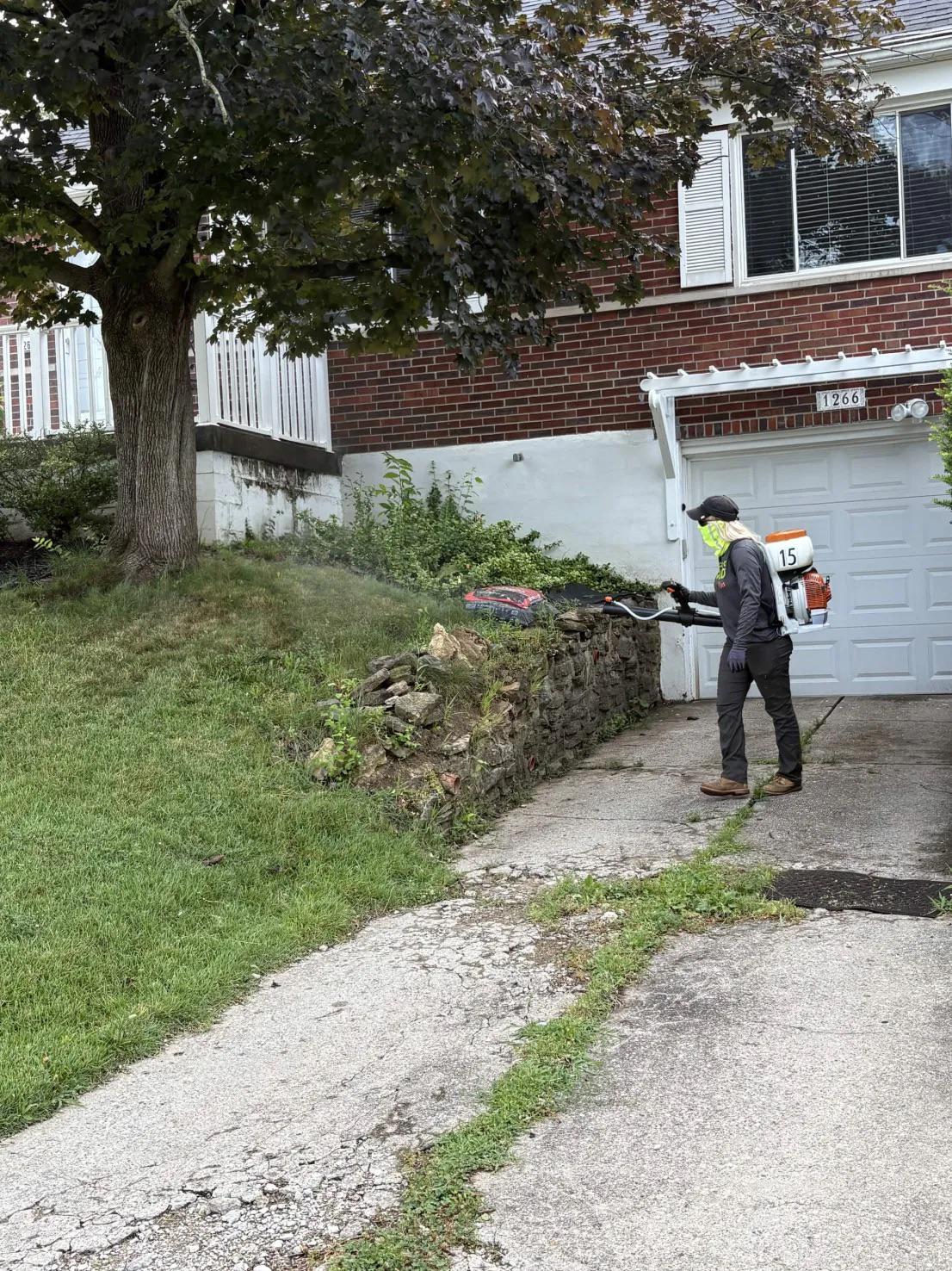
Treatment has to run against that same clock. Our mosquito barrier treatment is applied on a recurring schedule for exactly that reason, so the population never gets a quiet stretch in which to rebuild.
Where it goes matters as much as when. CDC guidance for these container species directs residual applications at container surfaces and adjacent resting areas, low on structures instead of broadcast across open ground, and into garages and other dark protected spots where the adults land. That is a different target than a dusk species treatment, and it is the reason a property with a daytime problem gets walked differently than one without. For yards where the containers cannot be removed, larval control adds a second layer working before anything reaches the biting stage, and our Yard Defender and Home Shield packages extend the same logic to the other pests using the same harborage. The shaded edges that hold daytime mosquitoes tend to hold ticks as well.
If you want the broader version of why a treatment program beats reaching for a can, we wrote about that in when bug spray falls short.
The Part of the Map You Control
You cannot drain the Great Miami. You cannot rebuild a 1955 storm sewer or dry out a MetroPark boundary in Xenia. Plenty of what drives mosquito pressure across this metro sits well outside your property line and always will.
The daytime problem is the exception, and that is the good news buried in all of it. A mosquito with a 200 meter range is a mosquito whose entire world is your yard and a few of your neighbors'. That is a problem cut down to a size you can do something about.
We serve the whole Dayton area, from Tipp City down through South Dayton and out to Yellow Springs. If your afternoons have quietly stopped being usable, call us at (937) 226-9709. We will walk the property with you and go container by container before we treat anything.