Why Northshore's Mosquitoes Don't Stop at the Property Line
Posted by Mosquito Squad Plus
August 3, 2026
The mosquito working your ankles at eight o'clock on a Northshore porch hatched within about two blocks of where you are sitting, and quite possibly closer than that.
Most people picture it differently. You look down toward the water from the top of Frazier, you think about the river and the greenway and all that shade coming off Stringer's Ridge, and you assume the problem is arriving from somewhere large and green and outside your control. Those are reasonable guesses about the wrong species for late July.
The call we take from this neighborhood almost always sounds the same. Nobody tells us they are getting chewed up at noon. They tell us they finally sat down outside after dinner, once the heat let go and the light went long over the bridge, and they were back inside well before the light was gone. The complaint is narrow and specific. They are losing the one hour of the day anybody over here cares about.
We have been treating properties across Hamilton County since 2012, and the Northshore version of this call has its own shape. Some of the smallest yards we service generate some of the loudest complaints, because on these blocks the yard was never the thing producing the mosquitoes.
Both halves of that come back to one species. It breeds in objects rather than in landscapes, and it cannot fly far from where it was born.
Which means mosquito control in Northshore works differently than it does in Ooltewah or Hixson. On a hillside lot laid out before anybody owned a car, your fence line has almost nothing to do with the size of your problem.
The One Biting You After Dinner Is a Container Breeder
Two species carry most of the load on a Northshore block, and they work opposite shifts.
The first is the Asian tiger mosquito, Aedes albopictus. Black body, hard white racing stripe down the back, small, fast, and rude about it. Clemson's extension service describes it as the most common daytime biter across the Carolinas, and East Tennessee is no different. The Illinois Department of Public Health notes that this species feeds during daylight hours rather than at night, which is where most homeowners get thrown. It does not behave like the mosquito they grew up swatting.
So the bites show up while you are gardening at four in the afternoon, or unloading groceries in the driveway. People often assume they are dealing with no-see-ums or gnats because the timing feels wrong for a mosquito. The timing is fine. This species runs on a different clock than the one most of us grew up expecting.
The after-dinner pattern falls straight out of that clock. On July 27 the sun goes down in Chattanooga at 8:48 in the evening, and tiger mosquito activity runs hardest in the couple of hours leading into sunset. You eat around seven, you carry a glass out to the porch around seven thirty, and you have walked directly into the front of the peak. It is not bad luck and it is not your yard being uniquely cursed. It is a schedule.
The second species is the southern house mosquito, Culex quinquefasciatus, and it takes over once the light is gone. Rutgers' vector biology program describes Culex as decidedly urban, reaching its highest numbers in built-up centers rather than out in the woods. This is the one that matters for disease. The Tennessee Department of Health tracks Culex as the primary West Nile virus vector in this state, and the back half of summer is when that surveillance gets interesting.
So the porch hands off from one species to another somewhere around nine. Thinking about where mosquitoes come from at the species level changes how we treat a property, because a Northshore lot means working two habits, two schedules, and two sets of breeding sites at the same time.
Two Hundred Meters Decides Everything
The tiger mosquito is a weak flyer, which is the most useful thing you can know about your property line.
European disease-control researchers put the species' dispersal range at roughly 200 meters on the wing. Everything past that comes from people moving containers around, not from the mosquito flying. Two hundred meters is a little over two hundred yards. Picture the Northshore street grid. Blocks are short, lots are narrow, and houses sit close enough that you can hear a screen door two doors down. That radius covers your place, the neighbors on both sides, the alley behind you, and the backs of the houses on the next street.
Call it two blocks. Everything producing the mosquitoes on your porch is inside that circle, and your lot is a small fraction of it. Run the arithmetic and a typical Northshore lot covers well under one percent of the ground inside that circle. You can do everything right on your piece of it and still lose the evening.
Stand on your own porch some evening and count what you can see from where you are. Your gutters and your plant saucers are in view, along with the birdbath in the yard next door and the pot on the porch across the street, and behind you there is an alley where the pavement dips and holds water for three days after every storm. Every one of those sits inside your circle, and only a handful of them are yours to do anything about.
Now hold that against a property in Ooltewah or out toward East Brainerd, where an acre lot might put most of that 200 meter circle inside one owner's control. Those properties have real pest pressure, and we have written about what drives it out there. But the owner of a big lot who does thorough source reduction is working on a meaningful share of the breeding radius. A Northshore homeowner is working on a sliver of it.
Small yards get bitten worst for that reason, not because they breed more mosquitoes than large ones. A small yard is simply a smaller share of the circle that counts.
What Frazier Avenue Adds to the Equation
The commercial spine changes the math here in a way it does not in a purely residential neighborhood, and it cuts both directions.
Frazier and the streets feeding into it carry patio seating, planter boxes, umbrella stands, dumpster corrals, delivery alleys, and the sort of stacked and stored objects every restaurant accumulates out back. All of that sits inside the flight radius of the houses behind it. And the houses, with their gutters and saucers and garden pots, sit inside the flight radius of the patios.
So the patio operator on Frazier and the family three streets up on a hill are drawing from a shared basin whether either of them thinks about it that way. Neither one can solve it alone.
This is part of why a commercial pest program in a walkable district looks different from one in a strip center out on a highway, where the nearest residential container might be a quarter mile off. Restaurants here are also fighting flies and gnats around the same corrals and drains that hold water, so the outdoor pest picture on a Northshore patio is rarely just mosquitoes.
We treat both kinds of property in this neighborhood, and the outdoor dining season and the porch season run on the same calendar. A patio losing its seven-thirty turn and a family giving up on the porch at the same hour are usually drawing from the same containers.
The Containers Nobody Counts on a Hundred-Year-Old Lot
Northshore was built out after the Walnut Street Bridge opened in 1891, back when this side of the river was still called Hill City, and the housing stock here spans more than a century. Early bungalows and Craftsman houses on tight hillside lots, detached garages off the alley, deep poplar canopy, plus newer infill dropped in between. That building history produces a specific inventory of water.
Delaware's natural resources agency keeps a checklist of tiger mosquito breeding sites, and it runs to clogged gutters, birdbaths, and tires, down to objects as small as a bottle cap. On these blocks that list gets longer.
Old box gutters on a hundred-year-old roofline hold water in the sag long after the downspout stops running. Detached garages along the alley collect buckets, wheelbarrows, and the coiled hose nobody has moved since spring. Alley pavement settles and ponds. Add plant saucers on a shaded porch, a tarp over a woodpile, a folded patio umbrella standing upright with an inch in the base, and the condensate line dripping off the air conditioner into the same low corner all summer.
Corrugated downspout extensions deserve their own mention. They run along the ground, they hold a little water in every ridge, and almost nobody thinks of them as containers. Same with the saucer under a heavy pot that has not been lifted in three years.
When we quote a property over here, the walk takes longer than the lot size would suggest. We are not measuring square footage so much as counting objects, and the object count on a hundred-year-old lot with a detached garage, an alley, and a century of accumulated yard equipment runs high. Square footage is a poor guide to how much work a Northshore property needs.
None of it looks like habitat. That is the problem with container breeders. The USDA's invasive species center flags this species for its aggressive daytime biting and its ability to vector disease, and it thrives here precisely because nothing it needs looks like a swamp. The canopy finishes the job, because tiger mosquitoes want shade and humidity to rest in through the hot part of the day, and mature poplars over narrow lots deliver exactly that. We see the same dynamic in the older sections of Red Bank and along the lower streets of Signal Mountain.
Why Dumping Water Only Gets You Partway
Source reduction is real. We are not going to talk you out of it, and the 7 T's of mosquito control exist because tipping containers works.
Walk your property once a week in season. Dump the saucers. Flush the birdbath. Clear the gutter, and on an older roofline check the flat runs and the sag near the corner, not just the downspout. Turn the wheelbarrow over. Store the umbrella base on its side. Look at your air conditioner and see where that water ends up. Every container you eliminate is a container that stops producing, and on a small lot you can get through the whole inventory in twenty minutes.
Then remember the circle. You have handled your share of a two-block radius, and your share is small.
This is also why the gadgets underperform in a neighborhood like this one. We have gone through whether mosquito traps are worth it and what bug zappers really do before, and the short version is that a device sitting on your patio is trying to solve a problem being generated across four properties. It is aimed at the wrong scale.
What a Barrier Treatment Does on a Small Lot
People assume a tight lot means less to treat. It usually means more, because the surfaces that matter are all packed together.
A barrier treatment does not go into open air. It goes onto the vegetation where adults spend the hot hours before they come looking for you. Foundation plantings on the shaded side of the house. The underside of the deck. Ivy and liriope along a retaining wall. The hedge on the property line, the shrubs against the garage, the low canopy where the yard meets the alley. On a Northshore lot those zones are dense and close, and there is very little wasted ground between them.
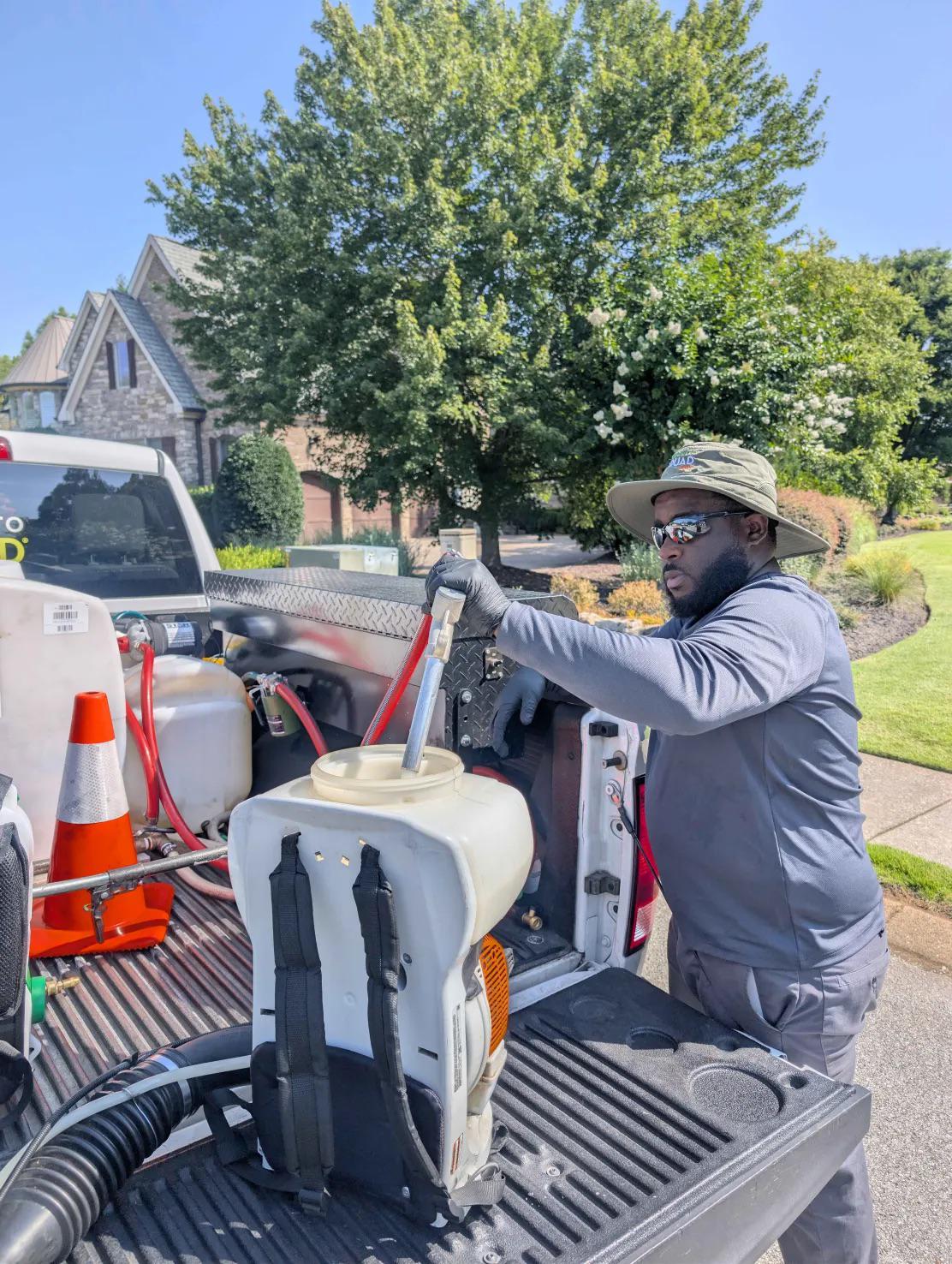
That density is the good news for us. Adults resting on your property get intercepted before dusk, which is the hour you care about. We time our routes with that in mind, and we would rather put product on the shaded north side of a house and the strip along the alley than waste it on open lawn where nothing is resting anyway. Treatment runs on a 21 day cycle, because that is how long residual protection holds and because it keeps the schedule ahead of the next generation reaching biting age.
For households that want the yard work paired with perimeter coverage, Home Shield handles the structure alongside the vegetation. Complete Home and Yard extends that to the full pest list, and Yard Defender covers the ground-level pests that come with heavy shade. If you keep a vegetable bed or a pollinator garden, which a lot of houses over here do, ask about the natural treatment option instead.
Late July Is the Wrong Week to Wait It Out
There is a temptation to ride out August and hope September fixes it. September does not fix it, and the back half of the season deserves more respect than it gets.
Chattanooga's July normals from the National Weather Service run highs around 90 with light daily rainfall averages, which describes the pattern most of us recognize from the porch: heat, then a pop-up storm most afternoons, then more heat. Those short storms do not flush anything out. They top off every container on the block and leave the rest to the sun. Then it happens again three days later. For a container breeder, that is not a disruption. That is a delivery schedule.
Meanwhile the disease side of the calendar is loading up. Culex numbers build through late summer, and West Nile surveillance across Tennessee runs hardest from now into September. Illinois public health describes Culex laying egg rafts on still water in containers and structures alike, which on these blocks means the same neglected inventory feeding the tiger mosquito is feeding the species that matters more.
You also have the good part of the year in front of you. Football starts, the evenings finally cool off, and the porch becomes the best room in the house. Starting treatment now means you own October instead of writing it off. Pest pressure here does not stop when the mosquitoes thin out either, which is why we get into whether winter pest control matters in this market.
If you have something specific on the calendar, a party in the backyard or an event on the patio, we run special event sprays for a single date. Properties with dogs cutting through shaded edges should also look at tick and flea control, though tick pressure on these tight urban lots runs lighter than it does on the wooded properties east of town.
Getting It Handled
If you are in Northshore, North Chattanooga, or anywhere across Hamilton County, call us at (423) 403-3513 or request a free quote. First treatment gets scheduled within 48 hours.
You can read what your neighbors say about the work, and current offers are here.