Why Stink Bugs Pick Vestavia Hills Homes Before the Rest of Birmingham
Posted by Mosquito Squad Plus
October 8, 2026
Nobody in Vestavia Hills has called us about stink bugs yet. Not one complaint so far this fall, and our techs would be the first to hear about it. What one of them has noticed is the bugs themselves. They're showing up on the outside of houses right now, including at his own place, sitting on siding and door trim in ones and twos. None inside yet.
That gap between what's on the house and what's in it is the reason for this post. It doesn't last long, and it's the only stretch of the year when stink bug control in Vestavia Hills is a simple exterior job instead of a winter spent pulling bugs off the ceiling fan.
The weather is doing what it usually does this time of year. Mornings on the mountain have started to run cool, and by mid-afternoon it's back to 80-something with a little breeze. Most people would call that a perfect fall day, and nobody connects it with pests. For a stink bug, that pattern is a cue that the season is turning and it's time to find somewhere to spend the winter.
We'd rather write about it now, while the phones are quiet. A month from now this post would just be a list of reasons the bugs are already in your attic.
What a Cool Morning Tells a Stink Bug
The insect behind nearly all the trouble around houses is the brown marmorated stink bug, an invasive species from Asia. Alabama Extension notes it was first introduced in the state in 2010 and has since established itself across much of Alabama. A graduate study out of Auburn had it confirmed in 29 counties by 2018.
Its whole year is organized around winter. According to the same Alabama Extension publication, the life cycle starts with an adult overwintering in a protected spot: leaf litter, tree bark, dead weeds, outbuildings, barns, or houses. When spring warms up, those adults head back out to feed and breed through the summer, and the next generation of adults goes looking for shelter again in fall.
What sets that fall search in motion is the season itself. An EPA entomologist writing for the Northeast IPM Center points to the fall equinox, around September 22, as the trigger for the annual fall stink bug migration. University of Illinois Extension puts the start of movement toward overwintering sites in September, peaking in late September and October in their part of the country.
The detail that lines up with what we're seeing on our routes comes from Washington State University Extension, which notes that large numbers of adults are drawn to the outside of buildings on warm fall days while they search for protected places to spend the winter. So the cool mornings tell them it's time. The warm afternoons are when they're out flying, landing on houses, and checking for a way in. A stink bug on your siding at three in the afternoon on an 80-degree day is a stink bug shopping.
Birmingham's fall comes on gradually, and stink bugs move on that same soft calendar. That gives Vestavia Hills homeowners a little more runway than people farther north get. It doesn't give them unlimited runway.
Why Vestavia Hills Gets Picked First
Plenty of Birmingham neighborhoods have stink bugs. Vestavia Hills has a couple of things working against it that most of the metro doesn't.
The first is elevation. The Northeast IPM piece describes a USDA Agricultural Research Service study on how these bugs disperse, and the finding was that they favor higher elevations, then narrow their choice down to specific features of buildings. We want to be careful with that one. The research was done in the mid-Atlantic, and nobody has run that study on Shades Mountain. But as a description of where a dispersing stink bug would rather end up, it fits Vestavia about as well as anywhere in the metro. Most of the city sits up on Shades Mountain and down its back slopes, well above the Homewood valley. If the research holds here, the ridge streets are the first stop, not an afterthought. That's a big part of why stink bug control in Vestavia Hills is worth thinking about earlier than it would be on a flat lot down in the valley.
The second is the woods. The ravines that run behind so many Vestavia lots are the stink bug's natural winter housing. USDA researchers surveying eastern forests found adults overwintering in large, dry, dead standing trees, with oak and locust as favorites. A wooded ravine with a few dead oaks in it can hold exactly the population that ends up on the back of the house beside it. The same USDA work found that homes in mixed woodland settings tended to collect the most stink bugs in fall.
Put those together and you get a lot of homes sitting high, backed up to hardwood ravines, many of them built in brick or stone. It's the same terrain that makes tick season in Vestavia Hills hit so hard, and it's shared to a degree with Mountain Brook next door and the wooded parts of Hoover. We see the over-the-mountain difference on our routes with a lot of pests, and our post on the Red Mountain divide gets into why the two sides of the ridge behave so differently.
What You're Actually Looking At on the Siding
Before you do anything, it helps to know which bug you have, because Alabama has more than one kind of stink bug.
Alabama Extension lists the brown stink bug, the green stink bug, and the southern green stink bug as the traditional group that has been in the state for a long time. Those natives are mostly field and garden insects, and you will find them on tomatoes and beans in a backyard bed. The brown marmorated stink bug is the newcomer, and it's the one with a reputation for showing up on houses in numbers once fall arrives.
Telling them apart is easier than it sounds. Per Alabama Extension, the adult brown marmorated stink bug runs about half to two-thirds of an inch long, brown-gray, with alternating white bands along the edges of its abdomen and on its antennae. Look at the antennae first. Those light bands are the giveaway, and you can usually see them without picking the bug up.
None of this is a threat to the house itself. The WSU fact sheet is clear that it doesn't damage the house, doesn't reproduce indoors, and doesn't bite. The catch is that attics are a common winter spot for large numbers of them, and they can wander down into the living space on warm days through the winter and early spring. If you have ever had stink bugs walking across a window in February, those bugs got in the previous fall.
What Most Homeowners Try
Most people in Vestavia Hills do what most people anywhere do, which is nothing, until the bugs are inside. That's understandable. A few bugs on the siding don't look like a problem, and on a nice afternoon nobody wants to think about pest control.
Once they're inside, the next move is usually a shoe or a paper towel. That works exactly once. Crush a brown marmorated stink bug and you find out how it got its name. The odor is a defense, and it's strong enough that, as an Auburn entomology researcher once put it, even the birds won't eat them.
Vacuuming is better, and it's what our own stink bug control page recommends for the ones already indoors. Illinois Extension adds a practical tip: use a shop vac you don't mind dedicating to the job rather than your everyday vacuum, because the smell can settle into the filter and canister.
Then there's the bug bomb, which is the one we would steer you away from. WSU recommends against foggers for this insect, because stink bugs killed inside wall voids and other spots you can't reach will smell, and they can attract carpet beetles that come in to feed on them. You end up trading one pest for two.
All three have the same flaw. They start after the bugs are already in the house, and by then you're managing them until spring instead of keeping them out.
What Actually Works: Getting to the House First
The research and our field experience agree on this one. UConn's Home and Garden Education Center sums up control in homes as two things: prevent entry, and vacuum up whatever gets in anyway. Prevention means sealing cracks and openings around windows, doors, siding, pipes, and chimneys, and repairing torn screens.
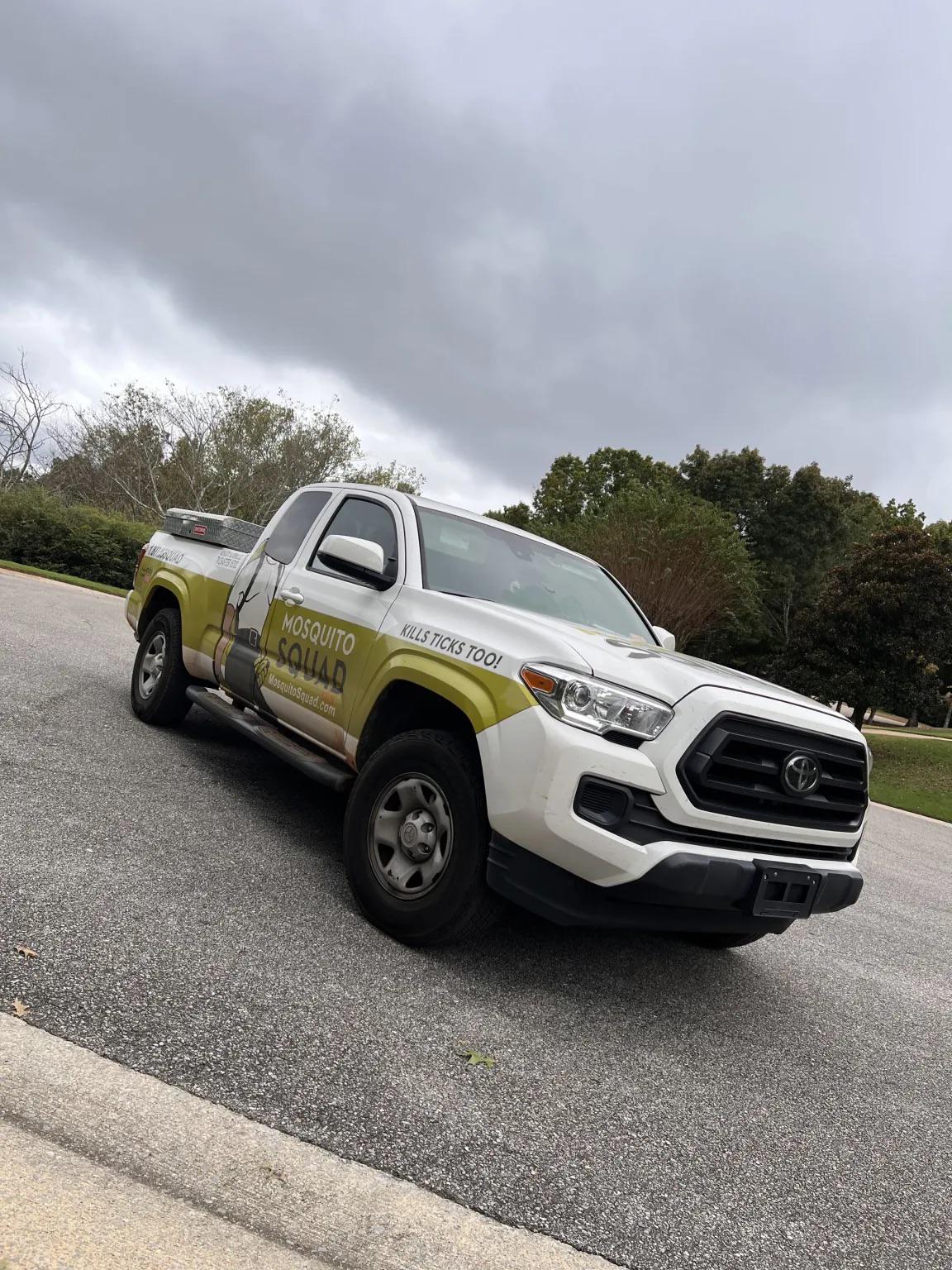
That's exactly how our tech approaches stink bug control in Vestavia Hills. A visit starts with a slow walk around the outside of the house, looking at the foundation line, window frames, door trim, vents, eaves, and every place a pipe, cable, or line passes through the wall. On a hillside lot that walk usually takes longer than people expect, because the downhill side of the house often has more exposed foundation and more places for gaps to hide. Then he treats. He puts down a dust and a spray together on the same visit. The spray goes around entrances and any holes in the house. The dust goes into the cracks and gaps. In his words: "Any cracks, any access points, anything that a bug can go in, I'm looking for those."
There's a reason for using both. A spray treats the surfaces where bugs land and walk, like door frames, window trim, and the siding around them. Dust settles into the narrow places a spray can't really reach and stays there, so a bug working its way into a gap crawls through treated material on the way. Our treatment kills on contact and keeps working on treated surfaces for up to 21 days, which matters when new bugs keep arriving every warm afternoon.
You can do some of the scouting yourself, and right now the bugs will do most of it for you. Step outside around three on one of these warm afternoons and look at where they're actually sitting. A cluster around one window frame, a dryer vent, or the corner where a deck ledger meets the house isn't random. That's a bug that found a draft of warm air and is working out how to follow it in. Note those spots, check the screens on any window you've been leaving cracked on cool nights, and cut back on porch lighting after dark, since stink bugs are drawn to light. Then you know exactly where to point us, or your caulk gun.
If you'd rather have this on a schedule, Home Shield is how we keep a house covered. The program runs year-round and treats the foundation, windows, vents, and entry points, so the exterior is already treated when stink bugs show up in fall and again when rodents start looking for a way in. For properties where the yard needs attention too, Complete Home and Yard adds full yard pest management on top.
When to Treat for Stink Bugs in Vestavia Hills
Right now, and not because we want to fill the schedule. The best time for stink bug control in Vestavia Hills is the stretch we're describing, when bugs are on the outside of houses and not yet inside them. Once a stink bug has worked its way into a wall void or an attic, no exterior treatment is going to reach it, and you're down to vacuuming until spring.
The window stays open as long as the warm afternoons keep coming. Each sunny, 80-degree day brings another round of bugs to the siding. Each cool night pushes more of them to commit to a hiding spot. The first real cold snap is when that staging period ends, and after that most of the ones that were going to get in have already gotten in. The tricky part around here is that the cold snap doesn't keep a schedule. Some years it shows up in mid-October, some years we're still in short sleeves at Thanksgiving, and a warm week after the first chill can pull the stragglers right back out onto the siding. Don't wait on the calendar. Watch the house.
There's a practical bonus to doing it now. Our tech expects rodents to start pushing toward houses in the next couple of weeks as the nights cool further. Many of the gaps a stink bug uses, a mouse will use too, so the same exterior visit that handles one sets you up for the other. Our post on why roaches and mice start turning up inside Birmingham homes in the fall covers that side of the season, and you can read more about rodent control if you're already hearing something in the attic.
The Mosquitoes Haven't Left Yet
Even with stink bugs showing up, most of the work on our Vestavia Hills routes right now is still mosquitoes and ticks. As our tech put it, in Vestavia mosquitoes are "just a big thing."
That isn't surprising given the terrain. The damp, shaded folds of a hillside lot keep breeding sites going well into fall, which is why we usually treat through October and sometimes later when the season stays warm. Our post on where Vestavia Hills mosquitoes come from explains why treating only the tree line misses most of them, and our Cahaba Heights mosquito post covers that corner of the city specifically. Ticks stay active any time it's warm enough, so tick control on a wooded lot doesn't stop just because the calendar says October.
So a homeowner who is already on mosquito control doesn't need a separate trip for stink bugs. The same visit that's still handling the yard can handle the house.
Getting Ahead of It
We'll say it plainly: we haven't had a single stink bug complaint in Vestavia Hills this fall. That's exactly why now is the time to look. The bugs are on the outside of houses, the afternoons are warm enough to keep them coming, and none of it has turned into a winter-long indoor problem yet.
Mosquito Squad of Greater Birmingham has been treating Vestavia Hills homes since 2018, and stink bug work fits naturally into the pest control in Vestavia Hills we're already doing on these streets. If you want someone to walk the outside of your house and treat the openings before the cold sets in, request a free quote or call (205) 900-3528. Every visit is backed by our satisfaction guarantee, and you can see what neighbors say in our Birmingham reviews.