Why Mosquito Season Hits Differently in Cahaba Heights
Posted by Mosquito Squad Plus
April 15, 2026
Cahaba Heights was built on a floodplain and that’s not a figure of speech. When the Birmingham Water Works sank its Cahaba pumping station into this stretch of the river in 1887, the small settlement that grew up around it sat so close to the water that the community eventually had to move half a mile west just to get out of the flood zone. The neighborhood renamed itself, grew up the hillside, and became what it is today: one of the more established, canopy-heavy residential pockets in the Vestavia Hills area, with older bungalows and ranch homes sitting on lots that have had decades to develop dense shade, deep leaf litter, and root systems that hold moisture long after the rain has stopped.
The Cahaba River is still right there. It has always been right there. And that proximity, combined with the character of the lots themselves, is why mosquito season in Cahaba Heights runs longer and starts earlier than most homeowners in this neighborhood expect.
Why the Cahaba River Changes the Equation
The Cahaba River is Alabama's longest remaining free-flowing river and one of the most biodiverse waterways in North America according to the Cahaba River Society. That biodiversity is a point of pride for this part of Jefferson County, and it is also a signal of what the river system actually does: it moves, pools, recedes, and leaves standing water in its margins across a wide floodplain corridor.
The shallow creek buffers and low-lying drainage areas that connect residential Cahaba Heights to the river system stay wet well into spring. They sit under partial shade from the established canopy that lines this part of the corridor, which slows evaporation significantly compared to open suburban lots. According to CDC guidance on mosquito habitat, standing water held in shaded, organically rich environments produces mosquitoes faster and in greater volume than standing water in open sun, because slower evaporation extends the window that allows larval development to complete. Mosquito larvae require standing water for a minimum of seven to ten days to reach the pupal stage under typical spring temperatures, and shaded environments extend that window considerably.
That is the specific character of Cahaba Heights. The yards are older. The trees are established. The shade is real and consistent. And the drainage from those lots flows toward a river system that has been shaping this landscape for well over a century.
What the Lots Themselves Do
Homes along Cahaba Heights Road and the streets that run off it sit on lots that have had 40, 50, or 60 years to develop organic layer depth. Leaf debris accumulates under shrubs and along fence lines. Root systems from established oaks and pines create microtopography in the soil, low pockets that collect and hold rainwater for days after the surface appears dry. Gutters on older homes clog faster and more completely than gutters on newer construction, and a clogged gutter section holding two inches of stagnant water is one of the most productive mosquito breeding sites on a residential property.
This is part of what distinguishes Cahaba Heights from newer residential areas nearby. Communities like Homewood and Mountain Brook have their own canopy and creek drainage character, but Cahaba Heights sits at the river itself, and the lots here reflect generations of organic accumulation that newer subdivisions simply do not have yet.
The Asian Tiger mosquito, which Alabama Cooperative Extension identifies as the dominant pest mosquito species in suburban Alabama, does not need a pond or a swale to breed. It needs a container. A section of clogged gutter. A low spot under a tarp. A bottle cap holding a tablespoon of water in a shaded corner of the yard. The older the lot, the more of those micro-sites exist, and the harder they are to find and eliminate on your own.
Aedes albopictus also bites during the day. Not at dusk. Not in the evening. During the day, particularly in the morning and late afternoon. If you are getting bitten while you are out in the yard on a Saturday morning in March, that is the Asian Tiger mosquito, and it means the season started without you.
What Homeowners in Cahaba Heights Usually Try First
The instinct is to look for obvious standing water and eliminate it. That is the right instinct and worth doing. But in a neighborhood like Cahaba Heights, the obvious sources are rarely the whole problem. The low corner of the backyard that stays wet after a rain. The drainage from the neighbor's lot that crosses the property line. The area under the deck where air circulation is low and moisture lingers. The birdbath that gets refreshed but not scrubbed. The section of fence line where leaves have been composting since November.
None of these looks like a mosquito problem. All of them are.
The Alabama Department of Public Health documents West Nile virus as an ongoing concern in Jefferson County, and the mosquito species responsible for West Nile transmission in Alabama, Culex quinquefasciatus, breeds in exactly these kinds of organic-rich, low-flow water environments. The stormwater drainage systems that carry water off Cahaba Heights Road and surrounding streets toward the river corridor create a steady supply of those conditions from late February through October.
Eliminating the sources you can see is a reasonable first step. It is rarely enough on its own.
When Treatment Logic Follows the Terrain
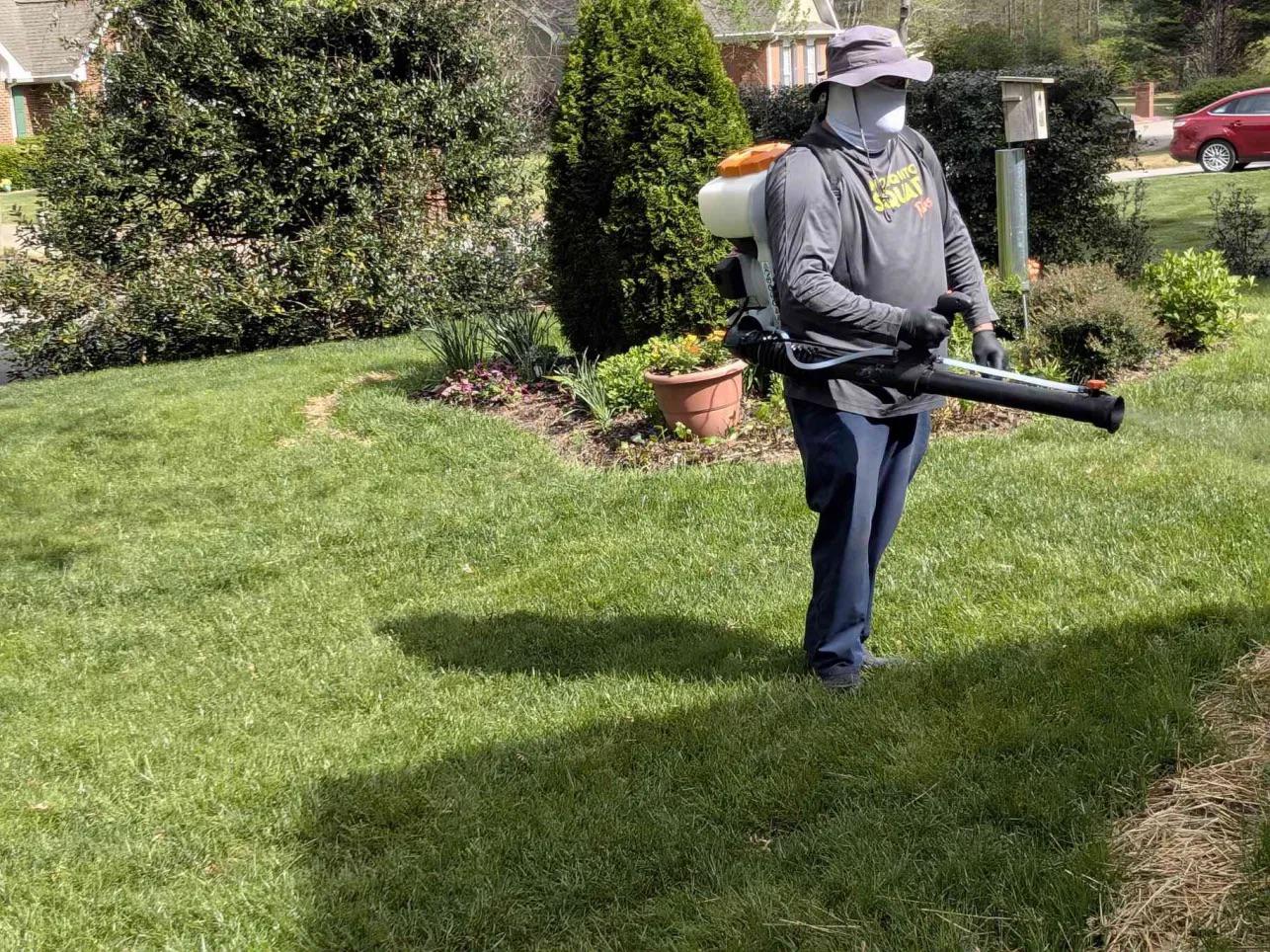
The shaded structure of Cahaba Heights is where adult mosquitoes rest during the heat of the day. They concentrate in the lower canopy, on the undersides of leaves, along dense shrub borders, and in the vegetated edges where the lawn transitions into something less managed. Those are the zones that drive population density on a residential lot, and those are the zones where mosquito barrier treatment is applied.
Treatment in a neighborhood like Cahaba Heights follows the shade. Dense shrub beds along foundation plantings. The canopy edge where the yard meets a wooded buffer or an overgrown fence line. The areas under decks where moisture and shade combine. The lawn-to-leaf-litter transition zones that older established lots produce naturally. Treating those areas on a recurring schedule keeps the resting population down and breaks the cycle before it builds.
A program that starts in late February or early March, before the first generation of the season establishes, consistently outperforms one that starts in April after the population is already active. The EPA's integrated mosquito management guidance makes clear that early-season intervention is significantly more effective than reactive treatment once populations peak.
The Timing That Actually Works Here
Late February is the right window for most years in Cahaba Heights. Here is what tells you conditions have arrived whether or not you are ready.
The low areas of your yard are still holding water four or five days after the last rain. The drainage buffer at the back of the property has that thin film of organic debris on the surface. You notice bites while gardening in the morning in early March, which is the Asian Tiger mosquito and not a seasonal fluke. The canopy is still bare or just beginning to bud, but the ground temperature has crossed the threshold that triggers egg hatching in overwintered mosquito populations.
By mid-April in a neighborhood with the water and canopy character of Cahaba Heights, a population that was not treated in February or March is already established and cycling. Getting on a barrier treatment schedule before that point is the difference between managing the season and reacting to it.
The 280 Corridor Does Not Behave the Same Way Everywhere
The mosquito pressure along Highway 280 does not follow a single pattern because the terrain does not follow a single pattern. The story along Meadowbrook and the broader 280 corridor is about how the season has shifted with canopy growth and creek drainage over time. The story in Chelsea is about new construction stormwater infrastructure and compacted fill soils pressing into the Cahaba watershed headwaters.
The story in Cahaba Heights is different from both. This is an older neighborhood sitting directly on a river floodplain, on lots that have had generations to develop the shade, organic depth, and moisture retention that make early-season mosquito pressure persistent and hard to manage without a consistent treatment program.
Mosquito Squad serves Vestavia Hills and communities throughout the greater Birmingham area. If the backyard in Cahaba Heights is not usable the way it should be, the greater Birmingham mosquito control team is available now. The Cahaba River does not wait for April, and neither should your treatment program.