No River, No Creek, Plenty of Mosquitoes. Welcome to Day Heights.
Posted by Mosquito Squad Plus
May 19, 2026
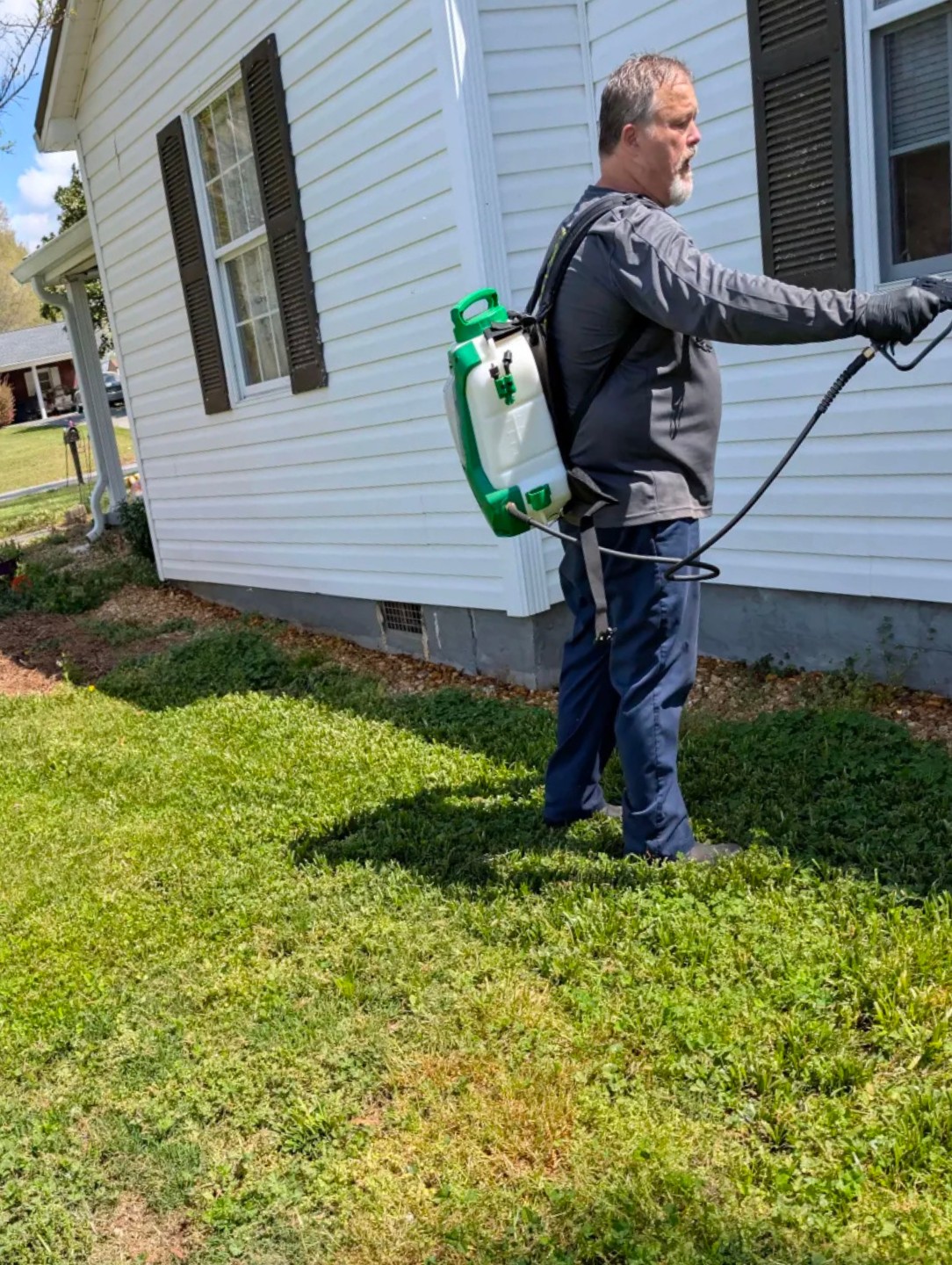
Pull off US 50 onto a Day Heights street in late April and the first thing you notice is what is not there. No river. No creek running behind the lots. No retention pond at the entrance to a new subdivision. The yards look like they should be easy. Mowed turf, mature trees, a back fence, a side-yard hose bib, and a porch that catches the late afternoon sun. You could not pick a less obvious mosquito neighborhood out of a lineup.
Walk to the back fence anyway. The grass is greener than it should be in the corner where the lot dips. The mulch under the rhododendron is dark and damp three days after the last rain. There is a low pocket along the property line that holds standing water for 36 to 48 hours after every storm, and the homeowner has stopped noticing it because it has been doing that since 1978.
That is the Day Heights mosquito story, and it is why mosquito control in Day Heights has to look at what the lot is doing rather than what the map shows. Effective mosquito control in Day Heights is not about the obvious water feature. There is no obvious water feature. It is about the 60 years of suburban hydrology that nobody planned and most homeowners do not see.
Day Heights Wasn't Built. It Grew.
Miami Township records its own history as a "tremendous growth since 1960 as the township transformed from a rural countryside to a bustling suburban community." Day Heights, originally called Pleasant Hill and sitting at the intersection of US 50 and Pleasant Hill-Wolfpen Road, is one of the four unincorporated places inside the township. The two-room schoolhouse on that corner was built in 1889, closed in 1953, and burned down in 1965. By the time it was gone, the postwar suburban expansion that turned old Clermont County farmland into Day Heights was already underway.
What that means for a homeowner in 2026 is that the lot you are standing on was probably surveyed and graded somewhere between 1965 and 1985. The clay subsoil under your slab was farmland soil before that, and the grading job that turned it into a residential lot was done to 1970s suburban-builder standards. The drainage that works on your property today is whatever drainage that 50-year-old grading happens to produce now that the trees have matured and the neighbor's lot has been regraded twice.
That is the part homeowners inherit without realizing it. The yard you own and the yard the original buyer bought in 1976 are not the same yard, but the underlying hydrology is the same. Mosquito control in Day Heights starts with the lot's history, not with the lot's current landscaping, and that history is what makes the Day Heights mosquito control conversation a different one than the conversation on a newer build.
The Little Miami Is Downhill. That Matters.
The Little Miami River runs through Loveland just to the northwest, and the river corridor mosquito story along that valley is its own conversation. Loveland sits at the river. Day Heights sits up on the ridge above it.
That ridge matters for two reasons. It puts Day Heights properties above the floodplain dynamic that drives Loveland's mosquito calendar, which is a real advantage. It also means the surface water on a Day Heights lot has somewhere to go, but it does not always get there fast. Water that lands on the ridge moves downhill toward O'Bannon Creek and the Little Miami drainages, but the path it takes runs across 50-year-old graded yards, under aging suburban driveways, through neighbors' redirected downspouts, and along property lines that were drawn before stormwater management was a thing anyone designed for in unincorporated Clermont County.
Properties at the top of the ridge usually do not have a visible water problem. Properties on the slope and the lots downhill from them often do, and the water that produces mosquitoes is not the water you see crossing the lot during the storm. It is the water that stays in the low corner for two and a half days after the storm passes. That is why effective mosquito control on a Day Heights property starts with walking the ridge and the slope, not assuming the elevation is doing the work.
What Old Farm Clay Does to a Suburban Yard
The soils across most of Clermont County are derived from glacial till deposits, with significant clay content. USDA Natural Resources Conservation Service soil surveys for southwestern Ohio document the clay-rich subsoils that characterize the region as slow to drain, with seasonal high water tables that sit close to the surface through wet months. Clay does not absorb water the way sandy or loamy soils do. It sheds water across the surface and pools it in any low spot.
A Day Heights lot that was originally farmland still has that clay subsoil underneath it. The 1970s and 1980s builders graded the surface, added a thin layer of topsoil, planted sod, and called it done. They did not change the clay. The result is a residential yard that looks normal until you actually pay attention to what happens after a hard rain. Water sits where the grade dips. Mulch beds along the foundation stay damp longer than they should. The corner where two old fence lines meet holds moisture under the leaf litter even into July.
The makes clear that mosquito larvae require water for a minimum of seven to ten days to complete development in typical late-spring temperatures. A Day Heights low spot that holds water for 36 to 72 hours does not, by itself, produce mosquitoes. But that same low spot under a shrub canopy that slows evaporation, combined with the leaf litter accumulating in it through every season, retains the moisture that the surrounding organic matter holds. That is where the production happens. Not in the pool. In the moisture the pool leaves behind. Mosquito control on a clay-subsoil lot has to address those moisture-retention zones, not just the visible standing water that catches a homeowner's eye after a storm.
The Canopy Filled In Around You
The Day Heights neighborhoods built in the 1970s and 1980s came with newly planted trees. The oaks, maples, sycamores, and pines that went into those yards as 8-foot saplings are now 50 to 70 feet tall. The canopy that makes the streets look the way they do also slows evaporation in the shaded corners of every lot, retains moisture in the leaf litter along fence lines, and creates the kind of microclimate that adult mosquitoes use to rest during the heat of the day.
The Ohio State University Extension Asian Tiger Mosquito fact sheet identifies the species as a common mosquito throughout southern Ohio that thrives in shaded, vegetated residential settings. Peer-reviewed research on Aedes albopictus habitat preference in urban and suburban environments has consistently found that the species concentrates in areas with tree cover and shaded vegetation. Shaded property edges and dense canopy in residential lots significantly increase the resting habitat available to adult mosquitoes, and the moisture-retention effect of mature canopy is one of the strongest predictors of where mosquito control problems concentrate on suburban properties.
For Day Heights specifically, the canopy story is not a story about a wild forest edge. It is a story about ornamental landscape trees and foundation shrubs that have been growing for 40-plus years. The yard looks landscaped. It is also producing exactly the resting habitat the Asian Tiger mosquito needs, and the homeowner is not looking for it because it does not look like a problem. That gap between what the yard looks like and what the yard is producing is what mosquito control in Day Heights has to close.
What Homeowners Try First
The instinct on a Day Heights property is to assume there is no mosquito problem because there is no visible water source. No creek. No pond. No retention basin. Most yards have gutters that drain properly and grading that looks reasonable. The homeowner waits until the bites are noticeable, which usually happens in late May or June, and then either tries an over-the-counter spray or schedules a one-off treatment to handle the immediate problem.
Both approaches treat the symptom and not the source.
The Asian Tiger mosquito, Aedes albopictus, which Ohio State University Extension identifies as one of the most significant mosquito species in southern Ohio's residential neighborhoods, breeds in extremely small water volumes. The CDC's container habitat documentation makes clear that the species can complete its lifecycle in less water than fits in a soda cap. On a Day Heights lot, the gutter that overflows once a month, the saucer under the back-deck planter, the shaded corner that stays damp under the shrub border, the dog bowl that gets refilled but not scrubbed, and the section of mulch that holds moisture for four days after every rain are all producing the species through the active season.
Treating reactively in June means the population has been building for six to eight weeks. The recurring mosquito barrier treatment program that addresses the resting and harborage zones across the entire property, on a schedule that does not let new generations establish between visits, is the strategy that consistently produces a usable yard. Reactive mosquito control almost never does.
Treatment Placement on a Ridge-Top Suburban Lot
A mosquito barrier treatment on a Day Heights property works the same general principle as a treatment anywhere else: target the resting and harborage zones where adult mosquitoes spend their daytime hours, intercept them on the surfaces they actually use, and treat on a recurring schedule that does not give new generations a window to establish.
The placement reflects what a Day Heights lot actually is.
The foundation plantings around the older 1970s and 1980s ranches and split-levels are usually the first surface to treat. Mature foundation shrubs against a 50-year-old foundation produce one of the most consistent harborage zones on a residential lot. The shaded back fence line, particularly where the lawn transitions to a wooded buffer, a neighbor's overgrown property line, or any natural edge, is the second priority. The third is the low spots that the homeowner has stopped noticing. The corner of the side yard that stays damp. The mulched area behind the garage that does not get walked through. The strip of grass along the driveway where runoff settles.
For properties with the half-acre and three-quarter-acre lots common in the older Day Heights neighborhoods, the program often expands to include the back third of the property where the canopy is densest. For households that prefer a botanical product, the natural mosquito treatment option works the same placement logic on the same recurring schedule with essential oil active ingredients. The mosquito control philosophy is the same. The chemistry changes.
For larger properties or homes with permanent outdoor living areas, an automatic misting system can supplement the recurring program by addressing the active-hour windows for Aedes albopictus, the morning and the late afternoon, in the immediate area around the deck or patio. For the outdoor wedding, the graduation party, or the summer cookout that involves more people than the recurring program was sized for, a special event treatment applied one to two days before the event provides a tighter knockdown on top of the recurring barrier treatment.
Tick pressure on Day Heights lots, while not as visible as in the more wooded estate neighborhoods, is real enough that pairing mosquito control with tick control on the same schedule is worth a conversation, especially on lots with dogs or wooded back property lines. A combined mosquito control and tick program on a recurring schedule handles both pressures without scheduling two separate visits.
When to Treat in Day Heights
The Cincinnati-area mosquito control calendar starts in late March or early April once daytime temperatures hold consistently above 50 degrees. On a Day Heights ridge-top lot, the start of the season tends to track slightly behind the river corridor properties downhill in Loveland and slightly ahead of the more exposed open-lot neighborhoods west of Cincinnati. The shaded mature canopy and clay-retained moisture in the low spots support egg hatching as soon as ambient temperatures stay reliably warm, which in most years means a first application is appropriate in the first half of April.
The signs that conditions have arrived in the yard are practical. The mulch beds stay damp into the afternoon for several days in a row. The shaded corners of the lot do not dry out the way the sunlit middle of the lawn does. The first daytime bites show up while you are working in the yard on a Saturday morning, which is the Asian Tiger mosquito announcing the season has started. If you are seeing any of those signs, the population is already building. The most effective mosquito control programs in Day Heights start before those signs appear, not after.
A recurring mosquito control program through October, applied every 21 days, covers the full active season. The fall window in Day Heights runs through the first hard frost, which is typically mid-October to early November in most Ohio Valley years.
The Bottom Line for Day Heights Properties
Mosquito control in Day Heights does not look like mosquito control in Loveland, in Fairfield, or in Madeira, because Day Heights does not look like any of those communities. It is an unincorporated ridge-top CDP that grew out of 1960s farmland, sitting above the Little Miami corridor with no major water feature inside its borders. The mosquito story here is built into the lots themselves: clay subsoil that holds moisture, 60 years of grading and regrading that nobody coordinated, mature canopy that slows evaporation in the shaded corners, and an Asian Tiger mosquito population that does not need a river or a creek to produce.
The homeowner's assumption that "no water nearby means no mosquito problem" is the assumption that keeps the production zones running quietly through the active season. A recurring mosquito barrier treatment placed where the production actually happens, on a schedule that intercepts each generation before it establishes, is the difference between a yard you avoid in June and a yard you can use. That is the entire frame for mosquito control on a Day Heights property.
The Mosquito Squad of Cincinnati team handles mosquito control across Miami Township and Clermont County, including Day Heights and the surrounding communities of Owensville and Loveland. If the yard does not look like it should be a mosquito problem but it keeps acting like one, reach out and we will walk it with you. Effective mosquito control on a ridge-top suburban lot gets walked, not guessed.