How East Brainerd's 1990s Stormwater Systems Became Termite Infrastructure
Posted by Mosquito Squad Plus
May 19, 2026
Anyone who lives in East Brainerd knows what happens after a heavy rain. The yard holds water. Not for an hour. For days. The clay does not let it through. You notice it because the dog tracks mud into the house, or because the kids cannot play outside until Wednesday even though it rained on Saturday. What you might not notice is what that same clay is doing 18 inches below the surface, where subterranean termite colonies stay active year-round because the moisture never really leaves.
East Brainerd sits at 741 feet elevation in the Lower South Chickamauga Creek watershed, on Valley and Ridge geology that puts heavy East Tennessee red clay on top of Ordovician limestone bedrock. That combination creates a moisture retention problem that landscape contractors know well and that termite control has to account for differently than in Cleveland or Ooltewah. The subdivisions that went up after Hamilton Place Mall opened in 1987 were built with engineered stormwater systems (retention ponds, french drains, storm sewers) that were supposed to manage the water the clay could not absorb. Thirty years later, those systems are not managing water anymore. They are delivering it directly to the places where termites forage.
This is not about construction quality. It is about what happens when you build 1990s brick ranches on ground that does not drain, and then wait long enough for the buried infrastructure to develop gaps. Effective termite control in these conditions requires understanding how that infrastructure fails and what termites do with the access it creates. The approach to termite control that works in elevated neighborhoods with better drainage will not hold up here.
What East Brainerd's Ground Actually Looks Like
The Valley and Ridge province runs diagonally across East Tennessee from Virginia to Georgia. Chattanooga sits where that valley floor drops to its lowest points between the Cumberland Plateau to the west and the ridge systems to the east. East Brainerd is in the bottom of that trough. The elevation puts it low enough that groundwater does not have far to rise, and the bedrock geology puts limestone under everything, which creates karst potential and high water tables even in areas that look well-drained from the surface.
The clay on top is the residual soil from weathered bedrock. It is fine-grained, dense, and nearly impermeable when saturated. When May 2025 delivered 12.02 inches of rainfall (the wettest May in Chattanooga's 147-year weather record) the water did not percolate down through the clay. It pooled on top of it, ran across the surface into storm drains and retention ponds, or sat in yards until evaporation and plant uptake could remove it. That is the visible part. The invisible part is that the interface between the saturated clay and the limestone bedrock below stays moist all year, and that interface is where subterranean termite colonies build their gallery systems.
A 2020 peer-reviewed study published in MDPI's Sustainability journal documented urbanization patterns in Chattanooga using satellite imagery from 1986 and 2016. The Lower South Chickamauga Creek watershed, which includes East Brainerd, showed the largest urban growth of any watershed in the study area. Impervious surface increased from 24.2 square kilometers in 1986 to 48.5 square kilometers in 2016, a 100 percent increase. That growth was not evenly distributed. Within 30 meters of streams, the watershed added 1.35 square kilometers of impervious surface. Within 90 meters, it added 5.63 square kilometers. The majority of that development was residential, and the majority of it happened during the 1990s building boom that followed the opening of Hamilton Place Mall.
When developers cleared farmland and graded it for subdivisions, they installed stormwater infrastructure to handle the runoff that the new roofs, driveways, and streets would create. That infrastructure included underground pipes, catch basins, retention ponds, and perimeter french drains around foundations. The systems were designed to move water away from homes and into the watershed. They were not designed to account for what happens when PVC joints shift, when backfill around pipes settles, or when tree roots find the moisture inside a drainage line and grow into it. Thirty years later, those systems are full of gaps. Water still moves through them, but so does everything else. Including termites.
What 1990s Infrastructure Actually Does Now
The median construction year in East Brainerd is 1996. That puts most of the housing stock right in the middle of the Hamilton Place era, when subdivision development was moving faster than it ever had in Chattanooga's history. Homes from that period were built to code, inspected, and finished with the materials that were standard at the time. Brick veneer over wood framing. Monolithic slab foundations with perimeter beams. Vinyl-clad windows. Asphalt shingle roofs. The construction itself is not defective. It is just old enough now that the transitions between materials have started to move.
Slab foundations crack where the slab meets the perimeter beam. Expansion joints between the slab and the brick veneer open up as the wood framing settles and the masonry does not. Every pipe that comes through the slab, every conduit, every HVAC line set, the sealant around those penetrations is thirty years old. It has degraded. The gaps are there. You cannot see them from inside the house. A termite colony foraging in the soil around the foundation sees all of them.
The stormwater systems that were buried during construction are developing the same kinds of gaps. French drains installed along foundation perimeters were wrapped in landscape fabric to prevent soil intrusion, but that fabric degrades over time, especially in the presence of moisture and organic matter. Once the fabric fails, fine clay particles wash into the gravel bed and reduce drainage capacity. The water that is supposed to flow through the system starts to pool instead. Termites do not need flowing water. They need moisture, wood, and a way to move between the two without desiccating. A clogged french drain that is holding water next to a foundation is exactly what they use.
Retention ponds are another feature of 1990s subdivision design. These are engineered basins that capture stormwater runoff and release it slowly to prevent downstream flooding. They work as designed when the outflow structures are clear and the basin vegetation is managed. When the outflow gets clogged with sediment or debris, the pond holds water longer than it should. When the basin vegetation is not maintained, woody plants establish themselves along the edges and their root systems extend into the saturated soil. Termites forage along those root systems. They do not live in the retention pond. They live in the soil around it, and they use the consistent moisture to extend their foraging range farther than they could in drier ground.
The same thing happens with storm sewer lines. These are the buried pipes that carry runoff from streets and yards into the watershed. They were installed in trenches that were backfilled with soil, and in many cases that backfill included construction debris (wood scraps, cardboard forming tubes, untreated stakes) that was buried rather than hauled off. As long as the pipes stayed intact, the buried wood stayed dry enough that termites did not find it. Once the pipe joints separate or the pipe sidewalls crack, water leaks into the trench backfill. The buried wood absorbs the moisture. Termites find it, consume it, and establish foraging tunnels through the trench backfill that can extend 50 or 100 feet in either direction from the original food source.
What the Three Tennessee Species Are Actually Doing Here
Tennessee has three native subterranean termite species, and all three are active in Hamilton County. Reticulitermes flavipes is the most common. It swarms in late March through May, typically on warm afternoons following rain. Reticulitermes virginicus swarms in April through June and again in the fall. Reticulitermes hageni swarms in late summer and early fall, usually August through October. The species have slightly different biology, but their foraging behavior is the same. They build colonies in the soil, they forage outward from the colony in search of cellulose, and they follow moisture gradients because they cannot survive prolonged exposure to dry air.
According to University of Tennessee Agricultural Extension publication PB1344, subterranean termites can enter a structure through cracks as narrow as 1/32 of an inch. They do not need a visible gap. They need any discontinuity in the building envelope that allows them to move from the soil into the wood framing without crossing open air. That includes the joint between a slab and a perimeter beam, the gap around a plumbing penetration, the void behind a brick veneer, or the space inside a weep hole that was not screened.
The clay soil in East Brainerd complicates termite control in ways that are specific to the region. Termiticides applied to clay soil do not distribute the way they do in sandy or loamy soils. Clay particles are so small that they pack tightly together, leaving very little pore space for the liquid termiticide to move through. When a technician drills through a slab and injects termiticide into the soil below, the chemical does not spread laterally the way it would in more porous soil. It tends to pool in the drill hole or move downward along the path of least resistance. That means the treated zone can have gaps in it, and termites can find those gaps.
The University of Georgia Extension publication B1241 notes that subterranean termite colonies can contain tens of thousands to hundreds of thousands of individuals, and that those colonies send out foraging tunnels in every direction. The foraging tunnels follow moisture, temperature, and food gradients. In East Brainerd, the moisture gradient leads toward foundations, because that is where the engineered drainage systems are holding water. The temperature gradient leads toward the same place, because the thermal mass of a slab foundation moderates soil temperature swings and keeps the ground around it slightly warmer in winter and slightly cooler in summer than the open ground farther from the house. The food gradient leads there too, because that is where the wood framing is.
What Actually Holds Moisture in the Soil Year-Round
The Lower South Chickamauga Creek watershed covers 31,415 acres, according to the City of Chattanooga's watershed management documents. It drains from the Georgia state line north through East Ridge, Brainerd, and East Brainerd before joining the Tennessee River. The watershed is heavily urbanized in its lower sections, and the stream itself is listed as impaired under the Clean Water Act. The impairment is related to sediment load, habitat loss, and stormwater impacts, but the hydrology that created those impairments is the same hydrology that keeps the soil saturated and makes termite control more challenging than in elevated areas like Signal Mountain.
The USGS maintains a stream monitoring station on South Chickamauga Creek. The data from that station show consistent base flow even during dry periods, which indicates that the creek is receiving groundwater discharge from the limestone aquifer below the valley floor. That groundwater discharge is what keeps the water table elevated, and it is why yard drainage problems in East Brainerd do not resolve themselves even in years with below-average rainfall. The water is not just coming from the surface. It is coming from below.
Limestone bedrock dissolves slowly when groundwater moves through it. Over geologic time, that dissolution creates cavities, conduits, and fractures that increase the permeability of the rock and allow groundwater to move faster. The Valley and Ridge province in Tennessee has karst features (sinkholes, caves, springs) that are evidence of this process. East Brainerd does not have visible sinkholes the way some parts of Hamilton County do, but the bedrock geology is the same. The limestone below the clay is fractured and permeable, and the groundwater that moves through it rises close to the surface in low-lying areas.
When developers install a foundation and grade the lot to drain away from the house, they are working against that groundwater pressure. The perimeter french drain around the foundation is supposed to intercept water before it reaches the footing and direct it away to a discharge point. That works if the french drain stays functional. If the drain clogs, or if the discharge point becomes obstructed, the water has nowhere to go. It backs up into the gravel bed around the foundation, and it stays there. Termites find it. This makes termite control a recurring need rather than a one-time treatment in properties where drainage infrastructure has failed.
What Homeowners Try First and Why It Does Not Work Long-Term
Most homeowners in East Brainerd do not know they have termites until they see swarmers inside the house, or until they notice damage that has progressed far enough to be visible. By the time that happens, the colony has been feeding on the structure for months or years. The call goes out to a pest control company. Someone shows up, does an inspection, quotes a treatment.
Two approaches get recommended. Liquid soil treatment, where termiticide goes into the ground around and under the foundation to create a barrier. Or a bait system, where monitoring stations go in around the property and get checked until termites show up, then the monitors get swapped for bait stations. The termites feed, carry it back, share it with the colony, population drops, infestation dies out. Both work under the right conditions. East Brainerd does not always provide the right conditions.
Both approaches to termite control can work, but both have limitations in East Brainerd's clay soil and high water table conditions. Liquid termite control treatments are difficult to apply uniformly in clay because the chemical does not distribute evenly through the dense soil matrix. If the treated zone has gaps in it, termites can find those gaps and continue foraging. The high water table can also dilute the termiticide over time, reducing its effectiveness. Bait systems avoid the soil distribution problem, but they depend on the termites finding the bait stations and feeding on them. If the colony is already feeding on the structure, there is less incentive for foragers to explore the bait stations. The bait system can still work, but it takes longer, and during that time the termites are still consuming wood.
The other limitation is that neither approach to termite control addresses the conditions that allowed the infestation to start. If the perimeter french drain is clogged, if the retention pond is holding water longer than it should, if the storm sewer trench is full of moisture and buried wood, the active infestation might get eliminated but the conditions that attracted it are still there. Another colony will find them. Effective termite control in East Brainerd requires fixing the infrastructure that created the problem in the first place.
What Actually Works for a 1990s East Brainerd Property
Termite control in East Brainerd has to account for the geology, the hydrology, and the age of the infrastructure. That means starting with a termite inspection that looks at more than just the house. A thorough termite inspection in this area includes the foundation, the crawl space or slab perimeter, the utility penetrations, the french drain discharge points, the retention pond if there is one on the property or adjacent to it, and the storm sewer access points in the yard and street.
The termite inspection identifies three things. First, whether there is current termite activity. That includes live termites, mud tubes, damaged wood, or swarmers. Second, whether there are conditions that are conducive to termite activity. That includes moisture problems, wood-to-soil contact, buried wood debris, or gaps in the building envelope. Third, whether the existing stormwater infrastructure is functioning the way it was designed to. That includes checking french drain discharge points to see if water is flowing, checking retention pond outflows to see if they are clear, and checking for standing water in areas that should be draining.
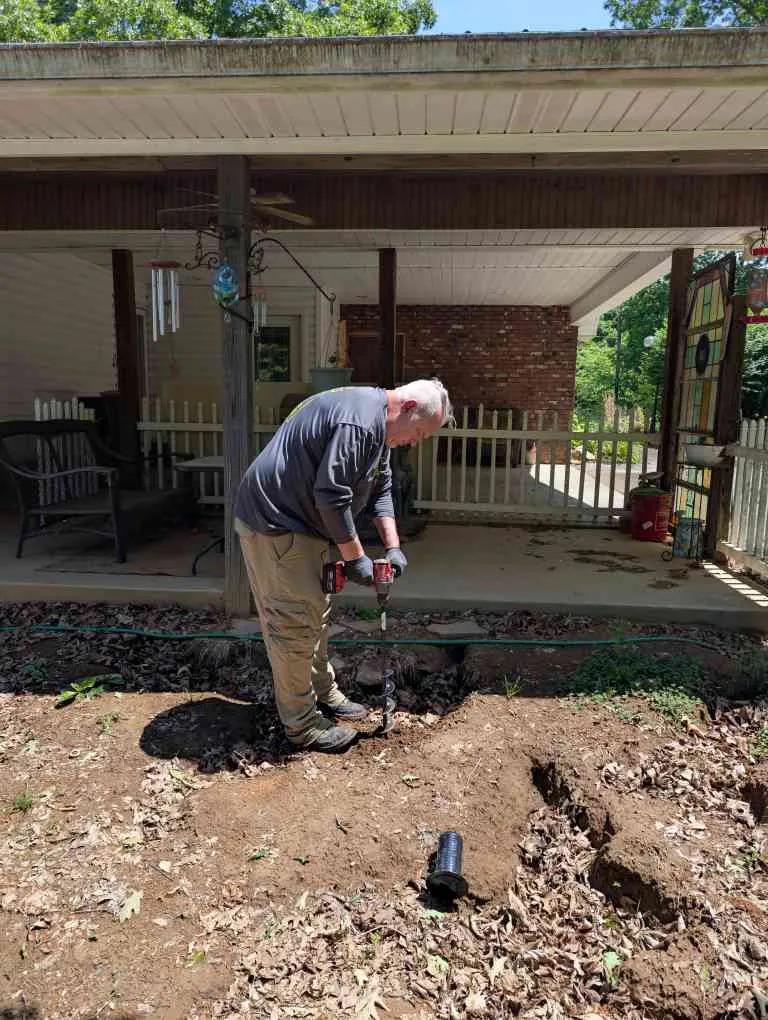
If there is an active infestation, termite control has to be applied. The treatment method depends on the specific conditions on the property, but in most cases in East Brainerd, a liquid soil treatment is the faster option if it can be applied correctly. That means drilling through the slab at intervals around the interior perimeter and injecting termiticide into the soil below, and trenching along the exterior foundation perimeter and applying termiticide to the soil in the trench before backfilling. The goal is to create a continuous treated zone that surrounds the foundation and prevents termites from crossing it.
In clay soil, creating that continuous zone for effective termite control requires more termiticide and more injection points than the same treatment would require in sandy soil. The Tennessee clay does not allow the chemical to spread laterally, so the injection points have to be closer together to avoid leaving gaps. University of Tennessee Extension publication PB1344 notes that termiticide application rates in Tennessee clay may need to be adjusted to account for the reduced distribution, and that applicators should follow the product label instructions for clay or heavy soil conditions.
If there are conducive conditions, they have to be corrected. That might mean regrading the lot to improve surface drainage away from the foundation. It might mean clearing the vegetation around the retention pond and checking the outflow structure. It might mean excavating the french drain around the foundation and replacing the clogged gravel and failed fabric. It might mean removing buried wood debris from the storm sewer trench backfill. The specific corrections depend on what the termite inspection found, but the principle is the same. Remove the moisture source or the food source, and the termites have less reason to forage near the house.
Ongoing monitoring is also part of effective termite control. That can be done with a bait system installed around the property, or it can be done with periodic termite inspections that check for new activity. The monitoring frequency depends on the level of termite pressure in the area and the history of the property. In East Brainerd, where the geology and hydrology create persistent termite pressure, annual termite inspections are a baseline. Properties with a history of infestations, or properties where the stormwater infrastructure is still problematic, may need termite inspections twice a year.
When Termite Pressure Actually Increases
Subterranean termites are active year-round in Tennessee, but their foraging activity increases in spring and fall when soil moisture is highest. That is when homeowners are most likely to see swarmers, because that is when the colonies are producing alates and sending them out to establish new colonies. Swarmers emerge on warm days following rain, typically in the afternoon. They fly a short distance, land, shed their wings, pair off, and search for a suitable site to start a new colony. Most of them do not survive. The ones that do find a location with moisture, wood, and protection from predators.
In East Brainerd, the spring swarming season coincides with the period when rainfall is heaviest and the soil is most saturated. That is also when the stormwater infrastructure is under the most stress. Retention ponds that stayed dry most of the year are full. French drains that were marginally functional are completely overwhelmed. Storm sewers that had minor cracks now have water flowing through those cracks into the surrounding soil. All of that creates foraging opportunities for termites that increase the need for termite control.
The other time termite pressure increases is during construction or landscaping projects that disturb the soil around the foundation. When a homeowner decides to add a deck, install a patio, or plant a foundation bed, the excavation exposes wood framing or creates new wood-to-soil contact points. If termites are already foraging in that area, they find the new food source immediately. If the project includes any kind of grading change that redirects water toward the foundation, it compounds the problem. Properties in Collegedale and East Brainerd both see this pattern during renovation seasons.
What to Look for Around a Property Built in the 1990s
Walk the property after a rain. Look for where water goes and where it stays. If it pools against the foundation, if the ground stays saturated two days later while the rest of the yard has dried out, termites are foraging there. They do not need a pond. They need damp soil that does not dry out.
Find the french drain discharge point. Most 1990s homes in East Brainerd have a perimeter drain that daylights somewhere downslope. It should be flowing during or right after a rain. If nothing is coming out, the drain is clogged. If water is coming out but the ground around the foundation is still soaked, the drain cannot handle the volume it is getting.
Look at anything wood near the ground. Deck posts on concrete footings with no soil contact are fine. Deck posts sunk into the ground without a footing are termite food. Firewood stacked against the house is termite food. Mulch beds built up high enough to cover the brick weep holes create a bridge. Termites use it to bypass whatever termite control treatment was applied to the foundation.
Check the interior slab perimeter. Mud tubes on the foundation wall. Baseboards that look discolored or feel soft. Wood that sounds hollow when you tap it. The garage is where termite activity shows up first in a lot of East Brainerd homes. The garage slab pours separately from the house slab. That joint is a cold joint. Termites find it.