Why Termite Pressure in Ooltewah Is Not the Story Most Homeowners Think It Is
Posted by Mosquito Squad Plus
April 28, 2026
Ask any longtime Ooltewah homeowner what has changed and they will mention the traffic before they mention the termites. But the two are connected. The stretch of Ooltewah-Georgetown Road between the Cambridge Square corridor and the Mountain View roundabout has become the most active residential construction spine in Hamilton County. James Creek, Shadow Cove, Nature's Cove, and the new apartment complex at Exit 11 are all going up on former farmland, pasture, and scrap woods inside the Wolftever Creek watershed.
None of that shows up in a termite brochure. But it is the whole story of why termite control in Ooltewah is a different problem than it was fifteen years ago, and why most homeowners who call about a termite issue are reacting to a symptom instead of the cause.
What Actually Makes Ooltewah a Termite Zone
The honest answer most people do not want to hear is that it is not the woods. It is the water and the dirt underneath the house.
Wolftever Creek is a 24.5 square mile watershed with two USGS monitoring stations sitting above and near Ooltewah at 755 feet elevation. The creek meanders through the center of town before eventually reaching the Tennessee River. The City of Chattanooga Water Quality Program tracks this watershed directly and has flagged it for habitat loss and urban influence pressure. A single inch of rain moves roughly 60 million gallons of stormwater through the drainage into the Tennessee River.
What that looks like at the foundation is simple. A lot of Ooltewah sits on soil that holds water longer than people realize. Layer in Tennessee's native clay, which UT Agricultural Extension flags as heavy enough that standard termiticide application rates have to be adjusted on the label, and you have the two things subterranean termites need most: steady moisture and soft soil to tunnel through. The colony is not hunting. The conditions brought the colony to the house.
Three Species, Three Different Swarm Windows
People in Ooltewah often tell me they saw swarmers in April, then again in September, and assume it is two different problems. It is usually not. Tennessee has three subterranean termite species living under the same yards.
UT Extension documents the eastern subterranean termite (Reticulitermes flavipes), the southeastern subterranean termite (R. virginicus), and the light southeastern subterranean termite (R. hageni). Each one swarms on a different schedule. R. flavipes flies March through May. R. virginicus flies April through June or comes back in the fall. R. hageni shows up August through October. So yes, a homeowner in Ooltewah can see two separate swarm events in the same calendar year on the same property, and both are real.
The National Pest Management Association pegs subterranean termites as responsible for about 95 percent of all termite damage in the country and roughly $5 billion in annual losses, a figure that does not show up on most homeowners insurance policies. A mature colony runs between 60,000 and two million workers. They eat around the clock. None of that is hypothetical in this corridor.
Why New Construction Is a Bigger Problem Than Old Construction
This is the part most people find counterintuitive. A brand new home on Ooltewah-Georgetown Road is often more exposed to termites than a sixty-year-old farmhouse on Mountain View Road. Here is why.
When a subdivision gets carved out of former pasture or scrap woodland, the grading crew brings in fill dirt to level the building pads. That fill almost always carries residual wood with it, buried form boards, tree root fragments, scrap from the site clearing that nobody digs back out before the concrete goes in. UT Extension calls buried wood in backfill the single most common construction defect that invites subterranean colonies straight to a new home. The colony does not have to travel to find food. The food is already underneath the slab.
The Chattanooga Times Free Press has tracked Ooltewah as the largest single residential growth pocket in Hamilton County over the past decade. Turner Homes broke ground on the 118-home James Creek subdivision on Ooltewah-Georgetown Road in 2023. A 229-unit development got approved just north of the Mountain View roundabout later that same year. Shadow Cove is actively building 150 homes with a retention pond sitting within feet of existing property lines. Every one of those pads sits on fresh fill inside the Wolftever Creek watershed.
The older homes closer to the historic part of Ooltewah have a different but related story. Crawl spaces built in the 1960s and 70s were not vented to anything close to modern standards, and the heavy clay sitting under them keeps moisture pressed against pier foundations for weeks after a good rain. Termites do not care whether the wood sill is sixty years old or six months old. They follow the water.
Neighboring Collegedale and Apison sit inside the same Wolftever drainage, which is why the pressure does not stop at the city signs. USGS has a station near Apison monitoring a 6.55 square mile piece of the same watershed for a reason.
What Homeowners Try First and Why It Does Not Hold
The first reaction is almost always a foam spray from the hardware store aimed at a mud tube on the foundation. It feels productive. It kills what is inside the tube. It does nothing about the colony, which is typically ten to twenty feet down in the soil with three or four other routes into the home the homeowner has not found yet. The tube rebuilds somewhere they cannot see and the damage keeps accumulating quietly.
The second reaction is landscape adjustment. Pulling mulch back from the siding. Redirecting downspouts. Clearing the leaf dam at the back corner of the house. This is real advice that genuinely helps at the margin, and UT Extension specifically recommends a 12 to 18 inch plant-free zone against the foundation and six inches of clearance between finished grade and the top of the foundation. Do it. It just does not address a colony that is already established. At that point it is maintenance, not treatment.
The third reaction is a DIY bait stake kit from a big box store. The Federal Trade Commission settled a case against the maker of one of the most common over-the-counter termite products, and as part of that settlement the company had to disclose on the label that the product is not recommended as sole protection against termites and that active infestations require professional inspection. That language is still on the box. There is a reason.
What Actually Works Here
Professional termite control in the Wolftever Creek corridor comes down to two things done together, not one or the other.
The first is a full inspection. The perimeter, the crawl space if there is one, every expansion joint in the slab, every plumbing and utility penetration, and the grade line where soil meets siding. UT Extension documents that termites can enter through a crack as small as 1/32 of an inch, so this is not a walkaround with a flashlight. It is a technical job that actually finds the routes in.
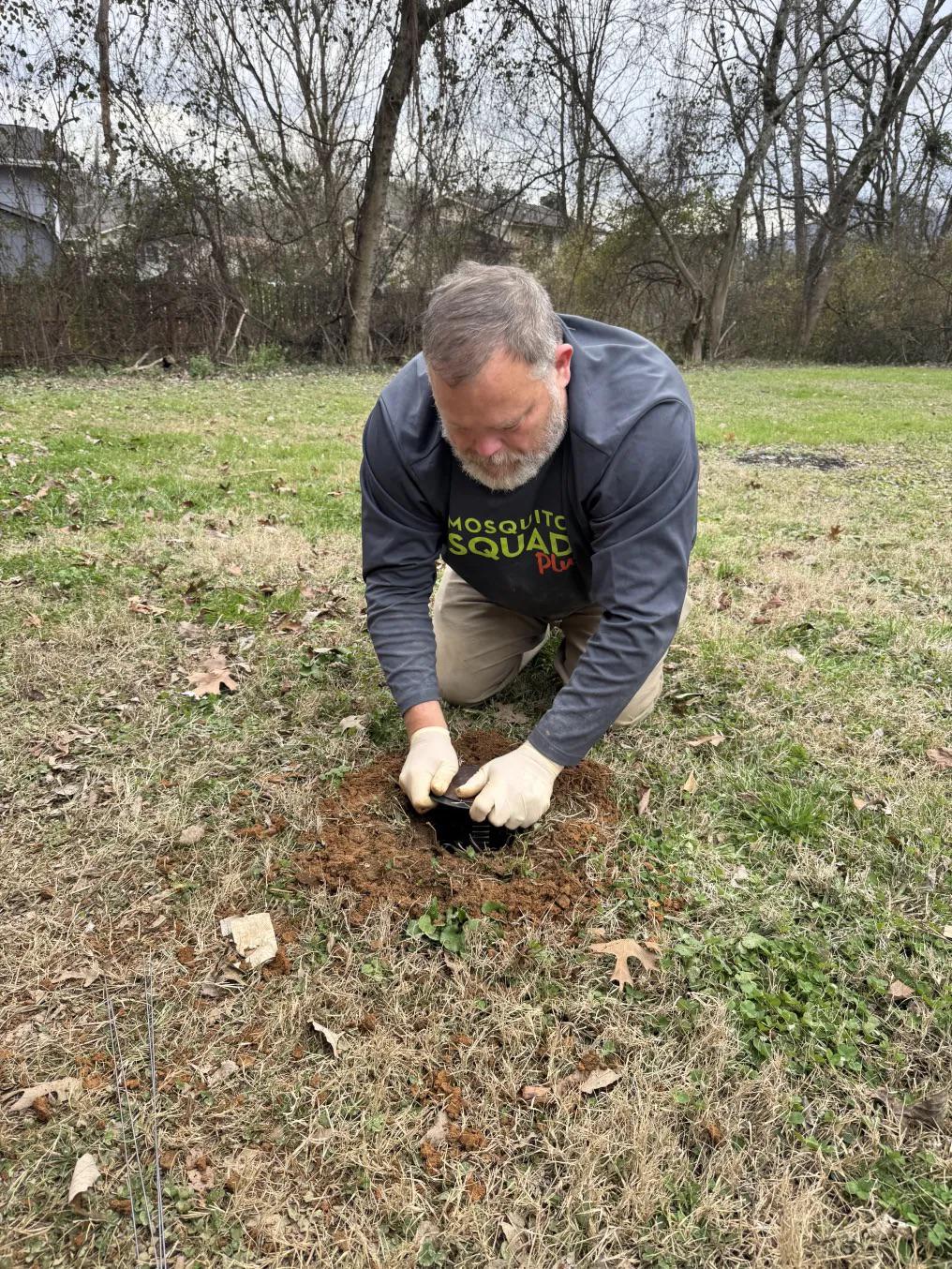
The second is a monitored bait station system around the structure, paired with targeted liquid termiticide at any risk points the inspection flags. On the newer slab homes off Ooltewah-Georgetown Road, most of the attention ends up at expansion joints, bath traps, and utility penetrations. On crawl space homes closer to historic Ooltewah, it shifts to the sill plate, the pier bases, and any spot where the grade has drifted upward against the wood line over the years. And on any property inside the Wolftever Creek watershed with real clay content, the termiticide concentration has to be adjusted to account for the soil refusing to take standard volumes. That last piece is why having a licensed Tennessee applicator matters here more than it would in a sandy market.
One other thing worth sorting out before calling anybody. Termite swarmers and flying ants get confused constantly, and the treatment path is not the same for both. Our termites vs ants comparison walks through the visual differences that hold up under a kitchen light.
When to Act
The honest window is February through early April, before R. flavipes starts flying. By the time you see swarmers on the inside of a window, the colony that produced them is at least three years old and has been working on the structure longer than anyone wants to admit. UT Extension notes that mating flights indoors almost never succeed, which means the swarmers you are seeing inside the house are not the problem. The colony that sent them out is.
Homes inside the Wolftever drainage, especially new construction along Ooltewah-Georgetown Road, are better served by annual inspection at a minimum. Properties with crawl spaces, sump pumps, or a retention pond within fifty feet of the foundation belong on monitored bait stations, not a once-a-year look.
Schedule a free termite inspection in Ooltewah and get the property walked before the March swarm window opens. It is the difference between managing the problem and finding it after a joist starts to give.