What Enterprise South and the Wooded Edges of Ooltewah Do to Tick Season
Posted by Mosquito Squad
April 3, 2026
Drive through the newer subdivisions in Ooltewah and you notice something that does not show up in the real estate listings. A lot of these back yards do not end at another yard or a neighborhood street. They end at trees. Dense Hamilton County hillside that drops away behind the fence line and keeps going. That wooded edge is one of the things that makes Ooltewah feel different from the subdivisions closer to Chattanooga. It is also exactly what makes tick season here a different problem than most new homeowners expect.
What makes Ooltewah different from the rest of the tick conversation in Hamilton County is not a river or a watershed. It is a neighborhood built right up against 2,800 acres of managed wildlife habitat.
Enterprise South Nature Park borders Ooltewah on the west and northwest. Its trails and wooded edges run directly alongside residential lot lines in multiple neighborhoods. The deer that Hamilton County documents as abundant throughout the park do not stay inside the park boundaries. They move through the corridors between the wooded park edge and the residential properties adjacent to it, and wherever deer move consistently, ticks follow.
Why Ooltewah's Growth Makes This Worse, Not Better
The Chattanooga Times Free Press has documented that Ooltewah and East Brainerd represent two of the region's fastest developing residential areas, with Ooltewah seeing the most residential growth in Hamilton County over the past decade. Every new subdivision carved out of wooded Hamilton County hillside creates a fresh lawn-to-woodline edge that did not exist before. That edge is exactly where ticks concentrate.
The Alabama Cooperative Extension System's guidance on tick control, which mirrors Tennessee Extension's findings, is direct that ticks are most commonly found in moist, humid areas with leaf-litter substrate under a foliage canopy, and that homeowners should watch for ticks specifically around border areas where lawn meets the woodline. In Ooltewah's newer subdivisions, that border is not fifty feet of established buffer between houses. It is often the back fence line of a lot that was cleared eighteen months ago, backing directly to the wooded terrain that Enterprise South or the surrounding Hamilton County hillside has been quietly maintaining for decades.
Neighbors in Georgetown and Collegedale sit in the same terrain corridor and deal with the same pressure along those wooded residential edges.
The Ticks Active in Hamilton County
The Tennessee Department of Health documents that tick-borne diseases are a growing concern across the state, with six medically important tick species present in Tennessee and populations increasing in recent decades.
The Lone Star tick is the most aggressive of the three you are most likely to encounter. The Tennessee Department of Health's tick species page identifies it as extremely aggressive, found throughout the southeastern United States, and capable of transmitting ehrlichiosis, tularemia, Heartland virus, southern tick-associated rash illness, and Alpha-gal syndrome. That last one is worth knowing about. Alpha-gal is a condition where a single tick bite reprograms the immune system to trigger an allergic reaction to red meat permanently. It is spreading in Tennessee and the Tennessee Department of Health has formally listed it as a disease of concern. Unlike most ticks that wait passively on vegetation for a host to brush past, Lone Stars actively pursue movement. People encounter them in maintained yards near the tree line all the time, not just on hiking trails.
The black-legged deer tick is the one drawing the most attention in recent years. Research published in Emerging Infectious Diseases found black-legged ticks infected with the Lyme disease pathogen in Hamilton County as part of a broader survey of the upper Tennessee Valley. The tick's preferred habitat is shaded woodland edges, the same terrain that defines the back edge of a large share of Ooltewah's residential lots. Nymphs are active in spring and early summer and are small enough to go unnoticed for days.
The American dog tick tends to show up in the yard itself rather than deep in the woods, particularly at the edge where mowed lawn transitions to wooded vegetation. Anyone with dogs that go in and out of a wooded back area in Ooltewah is dealing with this one regularly whether they realize it or not.
Our Hixson and Middle Valley tick blog covers the broader tick season picture for the Hamilton County plateau terrain if you want to see how this compares to the Hixson corridor.
What Homeowners Try and Why It Falls Short
The first move is usually landscape work. Mow more frequently, pull the brush back from the fence line, clear the leaf accumulation along the back of the property. The CDC recommends exactly those steps and they genuinely help at the margins.
The problem specific to Ooltewah is that the tick pressure is not originating in your yard. It is moving through your yard from the wooded park edge or the Hamilton County hillside behind it. Deer do not stop at a fence line. Neither do the mice and small mammals carrying larval ticks back into your lawn edges season after season. You can do everything right on your own property and still have a meaningful tick problem because the source of it is on the other side of your back fence and it is not going anywhere.
Natural sprays are usually the next attempt. Cedar oil, essential oil blends, perimeter treatments from the hardware store. The CDC is clear that natural products are not proven effective against ticks. In Ooltewah's humid Hamilton County summers, anything without real residual staying power breaks down before it does much work. Neighbors in East Brainerd deal with adjacent versions of the same terrain-driven pressure for the same reason.
What Tick Treatment Actually Does
Here is the part most people do not know going in. Ticks are not spread evenly across your property. They are concentrated in specific zones, and treating the wrong places does almost nothing.
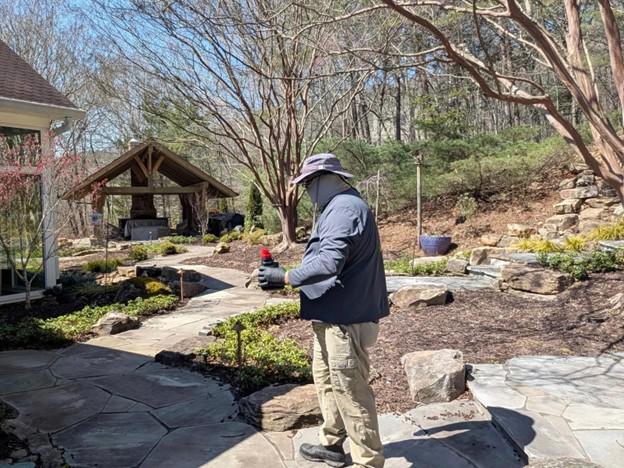
The CDC recommends removing leaf litter, clearing brush around homes, and creating a three-foot barrier of wood chips or gravel between lawn and wooded areas to restrict tick migration. That is the right foundation. What goes beyond it is treating the transition zones directly. The shrub beds along the back fence. The shaded low spots where moisture collects after rain. The vegetation edge where your mowed lawn gives way to the wooded terrain behind it. That is where the population lives and that is where the treatment goes.
Our tick control program for Ooltewah targets those zones specifically on a recurring schedule through the active season so there is no gap between visits where the population quietly re-establishes. For properties with significant wooded boundaries bordering Enterprise South or the surrounding Hamilton County terrain, tick tubes can add a second layer by targeting the small rodent hosts that carry larval ticks back into your yard before they ever reach the biting stage. You can also see how the Hopewell community approaches a related but different pest challenge in our Hopewell mosquito blog.
When to Start
The Tennessee Department of Health notes that while ticks are most active in warmer seasons, the black-legged tick poses a threat any time temperatures stay above freezing. In Ooltewah's wooded lot terrain, that means tick pressure does not fully shut down the way it does on open flat lots during winter. A stretch of mild February temperatures is enough to bring Lone Star activity back before most homeowners have thought once about the season.
Most people call after they find a tick on a child or a dog. By that point the season is already established and running. Getting a program in place before April means you are managing it rather than chasing it.
Get a free quote for tick control in Ooltewah and let us walk the property before the season gets underway.