What Candies Creek Means for Mosquito Season in Hopewell
Posted by Mosquito Squad
March 20, 2026
According to the U.S. Census Bureau, Hopewell sits at approximately 722 feet above sea level, one of the lowest elevations in Bradley County. That detail matters more than most people living along Georgetown Road or Freewill Road realize. Water drains toward this community. It moves through it. And Candies Creek, which the USGS tracks across an 88-square-mile drainage area in Bradley County, runs directly through Hopewell on its way northwest toward the Hiwassee River. That creek has been here longer than Cleveland has. It was already named, already settled along, already part of the land before Bradley County was formally established in the 1820s. What's changed is everything that feeds it now.
Cleveland's city limits have expanded to within less than a mile of Hopewell's center. That kind of growth doesn't just mean more neighbors. It means more impervious surface, more engineered stormwater systems, and more water moving off pavement into Candies Creek's natural drainage corridor. Bradley County's own stormwater management plan identifies Candies Creek as one of its primary target streams for water quality monitoring, and it's not hard to understand why. What was once a creek fed mostly by springs and agricultural runoff now handles a significantly larger volume of water from a growing suburban footprint.
For homeowners in Hopewell, the practical result is this: low ground plus creek drainage plus increased stormwater volume equals conditions favorable to mosquito breeding that arrive earlier in the season and persist longer than most residents expect.
Why the Season Starts Before You're Ready for It
The Tennessee Department of Health is clear that standing water is the foundational driver of mosquito populations, and that even small amounts of water in protected spots are enough to support breeding. Hopewell's low terrain creates those spots across properties with no standing water feature at all. A low spot behind the fence. A drainage swale that holds moisture after rain. Leaf litter against the foundation that stays damp for days after the rest of the yard dries out. These are the places that matter.
UT Extension's mosquito management guidance notes that larvae feed on microorganisms and organic matter and develop quickly, with new adults emerging within seven to twelve days under warm conditions. In the Tennessee Valley specifically, TVA mosquito management documentation recommends that larval control begin during the latter part of March or the first of April and continue through fall as new generations emerge. That timing is not arbitrary. It reflects how quickly populations build once temperatures stabilize in the mid-50s, which in Hopewell's low corridor typically happens before most homeowners in higher-elevation parts of Bradley County are thinking about pest control at all.
Two Mosquito Species, Two Different Problems
Most people think of mosquitoes as a dusk and dawn issue. That's accurate for Culex pipiens, the northern house mosquito that's common across Tennessee and most active in the evening hours. It's not accurate for Aedes albopictus, the Asian tiger mosquito, which according to University of Florida IFAS Extension research is a daytime feeder with peak activity in early morning and late afternoon, resting in shaded vegetation close to the ground between feeding bouts.
The Asian tiger mosquito was first identified in North America in 1983 from a specimen collected in Memphis, Tennessee. It has since been identified in every county in Tennessee. In Hopewell and the surrounding North Cleveland corridor, properties with shaded wooded edges, creek-adjacent drainage, and dense vegetation near the home provide exactly the habitat this species exploits. The practical consequence for homeowners is that mosquito pressure in these areas isn't limited to evenings on the patio. It shows up during afternoon yard work, during the kids' after-school time outside, during the weekend morning you're trying to pull weeds along the back fence line.
What Most Homeowners Try First
The instinct for most people is to wait until the problem is obvious and then react. By mid-May, when the yard feels unusable after rain, they pick up a consumer repellent or light citronella candles and try to manage individual encounters. The Tennessee Department of Health notes that adulticiding alone is not recommended as the sole mosquito control method because sprays dissipate quickly and new adults continue to emerge from breeding sources that haven't been addressed. Consumer products operate the same way at a smaller scale. They reduce bites in the moment. They don't change the season.
The other common approach is source reduction, which both the Tennessee Department of Health and UT Extension recommend as the most cost-effective foundational step. That's genuinely useful. In Hopewell, though, properties near Candies Creek or in the low drainage areas of the community have standing water inputs that individual homeowners can't fully control: the creek itself, seepage from neighboring properties into low terrain, engineered stormwater moving through the corridor from upstream development. Source reduction alone doesn't solve those inputs.
What a Barrier Treatment Actually Does
A professional barrier treatment addresses the mosquito population at its resting stage. Adult mosquitoes spend the majority of their time resting in cool, shaded vegetation, not flying. They feed and return to those spots. Treating vegetation, eaves, overhangs, fence lines, and shaded bed edges on a regular schedule interrupts the population before it compounds across breeding cycles.
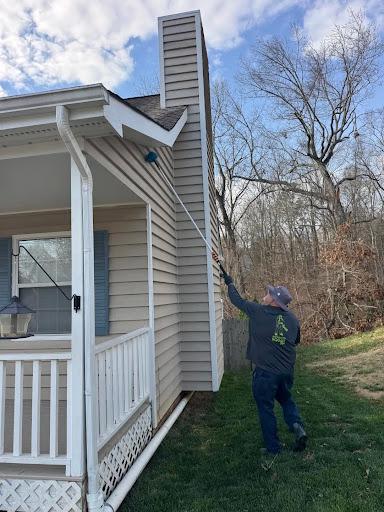
For Hopewell properties near creek drainage or with wooded lot exposure, the barrier treatment schedule typically begins in late March or early April, aligned with the TVA's documented recommendation for larval control start timing in the Tennessee Valley. Our technicians walk every property on every visit, checking harborage spots and clearing eaves and overhangs in addition to treating the perimeter and vegetation. That walkthrough isn't a formality. It's how the treatment stays effective across the season rather than just after the first application.
Larval control is a second layer that matters in drainage corridor areas. Products using insect growth regulators, including Altosid, target larvae in standing water before they develop into biting adults. Applying both adult and larval control simultaneously is what shifts the season from reactive management to something that actually changes the experience in your yard.
Ticks Are Part of the Same Story
The Tennessee Department of Health identifies the black-legged tick as the primary vector for Lyme disease in Tennessee, with reported cases increasing 18 percent from 2022 to 2023. The department specifically notes that yards adjacent to brushy areas or with tall grass and leaf litter carry meaningful exposure risk even outside formally forested areas.
TickEncounter at the University of Rhode Island documents that black-legged ticks predominantly occupy deciduous forest and tall grassland habitats near forest edges, questing for hosts on low-growing shrubs at roughly knee height. The shaded, humid conditions along Candies Creek and the wooded property edges throughout Hopewell check every one of those habitat criteria. Properties backing up to the creek corridor or any wooded lot transition in this community face consistent tick pressure from spring through fall and into early winter on warm days.
UT Extension tick identification guidance notes that American dog tick adults are most active April through June in Tennessee, and that the lone star tick is most active from April through the end of July. Early spring treatment covers the opening window of elevated activity across all three of the tick species most likely to affect Hopewell homeowners.
When to Get on the Schedule
If your property sits in the low terrain near Candies Creek, backs up to a wooded edge, or is in the drainage corridor along Georgetown Road or Freewill Road, the time to schedule mosquito control in Hopewell is before the end of March. By the time you notice the problem in May, the population has already gone through multiple cycles.
We treat properties throughout Hopewell and North Cleveland on a regular schedule through the season. A free consultation walks through what we're seeing on the property and what the treatment calendar looks like.