
What are Vinegaroons? All About These Creepy Arachnids
Posted by Emma Grace Crumbley, Entomologist
December 10, 2025
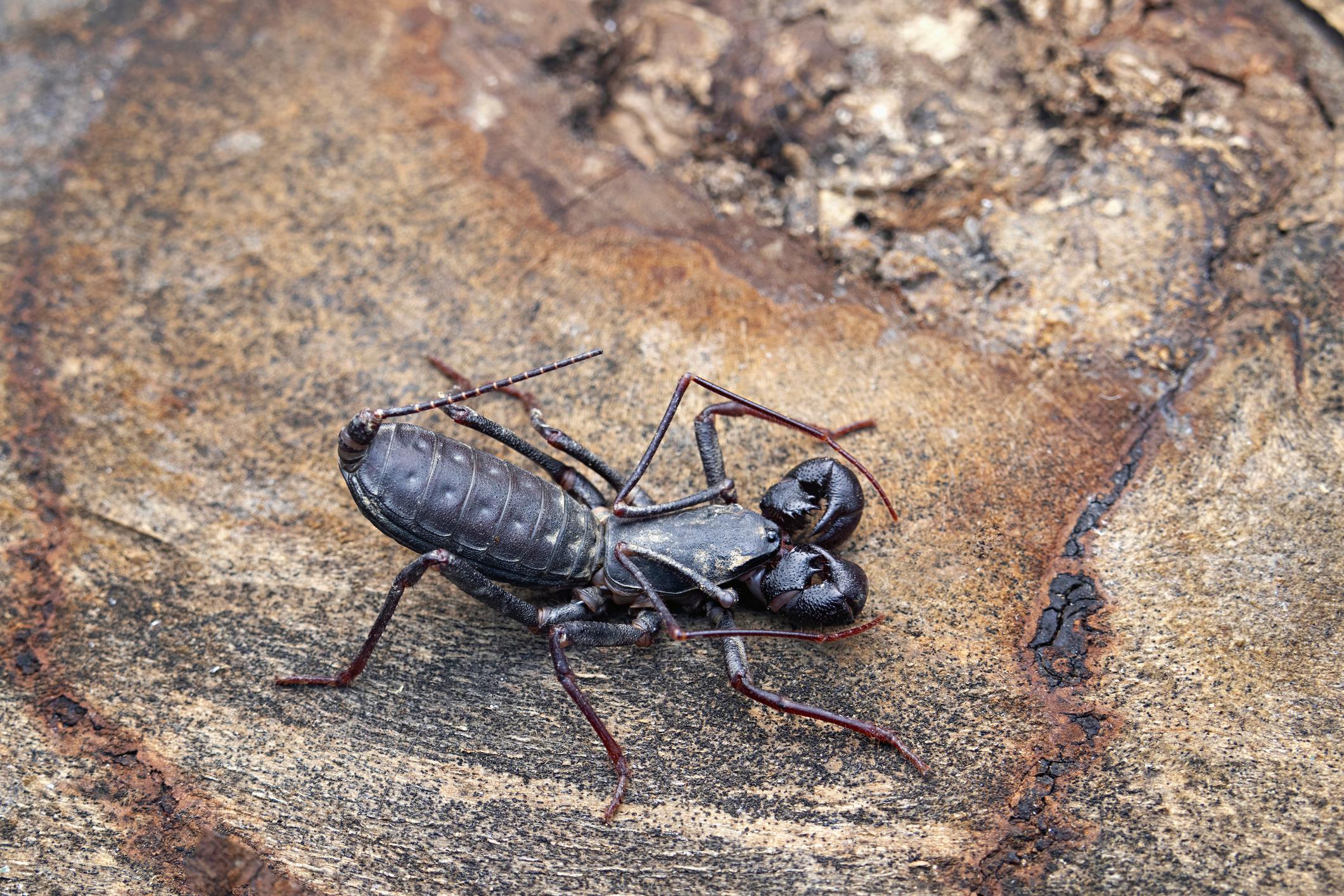
To those living outside of the southwestern deserts of the United States, the term "vinegaroon" may be new to you. Is it a new type of fusion cuisine? Maybe the setting of a 1950s musical? Or is it the animal you get when you mix a vine snake, a gar, and a raccoon? With a silly-sounding name, I bet your first thought isn't an arachnid with thick pincers and a tail that shoots acid (and if it was… my sincere apologies for misjudging your desert-arthropod knowledge!).
But it’s true! Vinegaroons (Mastigoproctus giganteus) are eight-legged animals belonging to the order Uropygi, the arthropod group for whip-scorpions. Also called desert whip scorpions, vinegaroons are native to the United States and found in arid climates. And I wasn’t joking before about their acid-flinging abilities; vinegaroons shoot a fine spray of 85% concentrated acetic acid from their tails when threatened, hence the name vinegar-oon.
In the wild, these arthropods hunt for their food. Slugs, crickets, roaches, worms, and even moths make a suitable meal for these acidic ambushers. However, vinegaroons don’t use their tails to spray their prey into submission. Instead, they catch their food the old-fashioned way: using their big, chunky pincers to grab onto prey.
Quick Facts about Vinegaroons
- Average size of 1-3inches from head to tail
- Average weight of 12.5 grams
- Usually brown, black, or tan in color
- Classified as nocturnal desert predators
- Males and females look very similar to one another
- Females carry their babies on their backs, just like scorpions
Despite their appearance and defense techniques, vinegaroons are not as harmful as they seem. There is no evidence that vinegaroons spread disease to people, pets, or plants, and they do not have venom like scorpions and other arachnids. Getting bitten or pinched by a vinegaroon is rare, though getting sprayed is not. Thankfully, though the acid produced can be painful if it gets in your eyes or an open wound, this defensive mechanism is an irritant, not a corrosive agent.
And even though vinegaroons have eight eyes, like spiders, they have very poor eyesight and move pretty slowly, using their antenniform front legs to pick up vibrations and navigate their environment.
All in all, vinegaroons are more bark than bite (or more “being big and scary looking” than “spraying you in the face”), making them a fun animal to find in the wild, and an even more fun one to keep as a pet. That’s right – people keep these creepy arachnids as pets! But before you think of getting one for yourself, you should realize that these critters live a long time. We’re talking a life expectancy of 7-9 years in the wild, and some reports of vinegaroons in captivity living up to 20 years!
But what do you think? Did this creepy critter charm you? Or are you steering clear of this arachnid?
Got bug questions? We've got answers!
At Mosquito Squad Plus, we understand that the best way to deal with a pest problem is to know the pest itself. That's why each of our technicians receives high-quality training on insect identification and common insects found in their regions. Find a Squad near you today and call to learn more about our extended pest control services and get a free quote for your next treatment.